






About
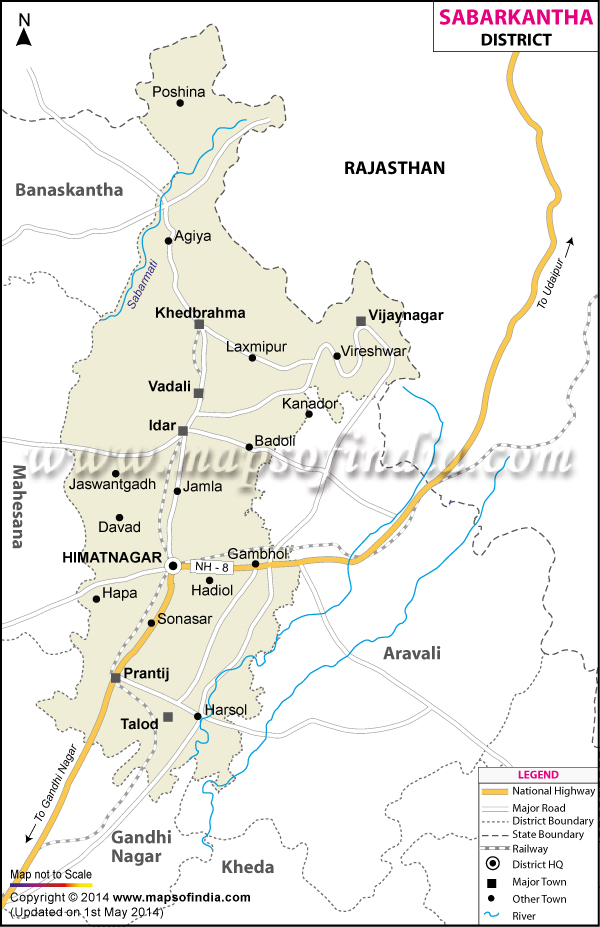
Away from the coast, in northeastern Gujarat, Sabarkantha unfolds as a blend of tradition, work, scenery, and local rhythms stitched into one frame. Centered on Himatnagar - its administrative core - the area holds steady amid open farmland, low forested hills, and clusters of lively villages. Flowing through without rush, the Sabarmati River gives part of its name; the word “kantha,” standing for border or margin, adds the rest - a quiet nod to water’s role in forming both terrain and identity.
Each day begins before light, shaped by routines passed down yet touched by change. Along dusty roads, farmers carry fresh milk toward waiting vehicles - part of a system built long ago but still running. Near these paths stand ancient temples, their chimes floating through early air like whispers from another time. Among thick woods lies the Polo Forest, scattered with remnants no longer grand but softened by moss and shadow. Travelers arrive slowly, drawn without knowing why, finding silence between roots and broken stone.
Bordering Rajasthan, Sabarkantha became a quiet meeting point long ago. Centuries passed, yet outside influences kept shaping its look, speech, and daily habits. Crops now rise in patterns shaped by old currents, not sudden change. Factories operate where traditions once stood without erasing them. Travelers stop here, drawn not by slogans but by something slower, less told. Its history unfolds through actions more than words - farming, praying, gathering. No fanfare marks its growth; just steady adaptation between land and life. Place decides pace, not ambition chasing attention. What survives does so quietly, built into routine rather than declared.
History and Culture
Hidden beneath Sabarkantha’s surface lies a story shaped by shifting rulers and clashing empires. Scattered across Polo Forest, broken walls whisper of busy communities thriving between the 10th and 15th centuries. Though time has worn them down, shrines to Shiva, Jain saints, and others still hold echoes of masterful design. Far from forgotten, Idar carries forward the legacy of Rajput roots deep within its streets. Standing tall through centuries, the Idar fort and palaces whisper stories of courage, defiance, yet delicate craftsmanship. While Rajput rulers laid foundations, Mughal administrators layered governance, whereas Maratha currents subtly wove new threads - each contributing to Sabarkantha’s evolving cultural fabric. Underneath its quiet surface, Sabarkantha pulses with living culture shaped by generations of folk practice. Tribal groups like the Bhils and Garasias weave distinct rhythms into daily life - through dance, custom, and ceremony.
Festivals like the Idar Mela gather craft makers, sellers, and entertainers who keep local customs alive through practice. Stone carvings from Idar stand out in Gujarat; detailed work appears in both sacred statues and ornamental objects. While markets shift yearly, these skills pass steadily between generations.
Folk songs, ballads, or tales shape how the area sees itself through spoken word handed along family lines. Because of these accounts, figures from history, gods, and terrain feature strongly in daily understanding. While change touches Sabarkantha, its core practices shift slowly, holding on to what matters most. Instead of being stored away, customs breathe within routine acts across villages and towns.
Economy
Farms shape daily routines through many parts of rural Sabarkantha. Near the banks of the Sabarmati, rich earth grows mainstays like wheat, maize, bajra, also cotton - these anchor farming here. Instead of just grains, orchards now spread wider; pomegranate trees plus vegetable plots appear more often in fields. Because better watering methods arrived alongside smarter growing practices, harvests grow stronger, steadier. Life for growers gains firmer footing this way. Farming sticks around hard in tribal areas, old ways holding strong even now. Not just crops - milk work matters too, tied closely to making goods and helping customers, all of it weaving into an economy that bends but rarely breaks.
Pride lingers quietly among many homes in Sabarkantha through ties to raising cattle for milk. Central to this scene stands Sabar Dairy, located in Himatnagar, now ranking among the biggest farmer-run dairies across Gujarat. From dawn onward, fresh milk flows in large volumes each day from nearby villages. This raw supply becomes common household goods - butter forms first, then ghee follows, along with cheese and dried milk solids.
Farmers previously facing unpredictable earnings now get consistent returns for what they deliver. Especially women - new forms of autonomy emerged under shared structures, altering influence within homes. Stability arrived quietly for some; dignity followed closely behind. The milk collection point functions beyond labor - it became something relied upon when uncertainty loomed.
Not only in financial terms, but also in spirit, Sabar Dairy stands as proof of what communities build together. Where once separate hardships marked village life, cooperation now shapes common gains. Across the region, vehicles move milk daily - an ordinary image, perhaps, yet rooted in something less visible. That unseen layer holds determination, gradual shifts in power, through steady work without spectacle. Rural Gujarat changes, slowly, differently, because of such efforts.
Growth in manufacturing has touched Sabarkantha through sectors like ceramics, textiles, chemicals, alongside plastics. While Himatnagar and Prantij lead in tile production, their reach stretches well beyond national borders. Craft-based enterprises, food processing outfits, and workshops with mechanical focus help sustain local jobs.
The service sector holds significant weightage in the economy. Growth in education, medical care, financial institutions, and shops is most visible in cities. Higher learning now finds a center in Himatnagar, where degree programs span disciplines like art, natural sciences, business studies, and technology.
Still rooted in farming and milk production, Sabarkantha has slowly absorbed new economic currents. Yet factories and service jobs now stretch across the region, altering old patterns. Resilience shows not through grand shifts but quiet adjustments over time. Balanced progress emerges where tradition meets gradual change.
Tourism
What unfolds across Sabarkantha goes beyond sightseeing - immersion defines the encounter. Amid weathered stone and quiet groves, traces of bygone eras linger without fanfare. Temples rest beside winding trails, their presence steady through seasons. One finds elevation not on maps alone but in moments between footsteps. Stillness arrives unexpectedly near village edges or river bends. Each site speaks only if listened to closely. Time slows when shadows stretch over stepwells carved centuries ago. Connection forms quietly, shaped more by absence than spectacle.
What draws many visitors is the Polo Forest, close to Vijaynagar. Covering vast stretches of land, it serves those drawn to natural landscapes along with remnants of ancient times. Amid thick vegetation, traces of old temple structures appear - built between the 10th and 15th centuries. Scattered throughout are small places of worship honoring Shiva, Jain spiritual figures, among others, where carved stones show age but retain quiet solemnity. Through rolling hills and across rivers, paths unfold beneath treetops filled with bird song. Where history lingers in scattered ruins, fresh patterns emerge - campfires glow under stars, footsteps mark untouched trails, efforts grow quietly around preservation. Above, leaves rustle. Below, time slows.
High above rocky slopes sits Idar, a place marked by stone ridges and ancient shrines. From its fortress walls, sightlines stretch across open fields and distant hills. Built in royal styles of old, its halls and worship spaces show careful craftsmanship. Centuries have passed, yet hand-carved stonework continues here unchanged. Movement through narrow lanes reveals quiet courtyards where tools shape rock as they did long ago. Color arrives with seasonal gatherings, when rhythm and gathering bring streets to life. History lives not just in ruins but in daily practice.
One of India’s uncommon sites, Khedbrahma houses a sanctuary honoring Lord Brahma - few others exist like it. Arriving visitors come for sacred favor; quiet reverence marks daily rhythms across the streets. Not only does faith shape this place, but glimpses into tribal culture appear through close settlements preserving native artistry and customs.
Among quiet trees, the Abhapur temples rise in Polo Forest, their stones shaped by time rather than people. A short distance away lies Tower Chowk in Himatnagar - its presence marks what once mattered deeply in local history. Himatnagar serves as the center of administration; here, culture appears through old structures, lively trade, and movement. While woods remain still, streets hum differently under open skies. Ancient peace meets steady change without one overtaking the other.
Demographics
Around 2.42 million people lived in Sabarkantha during the 2011 Census, packed into every square kilometer at roughly 451 individuals. While towns such as Himatnagar and Idar show modern settlement patterns, remote tribal communities remain scattered across the region. Education levels hover near 76% literacy - this marks improvement, yet city outcomes differ sharply from countryside results. Despite growth, uneven access shapes how knowledge spreads.
In this area, people speak Gujarati, along with Hindi and various tribal dialects. Though Hindi spreads easily because of closeness to Rajasthan, it is Gujarati that connects most speakers across groups. Different tribal populations keep their forms of speech alive, bringing subtle variety to local expression. These preserved ways of talking shape part of what makes the region's voice unique.
Administration
Above all stands Himatnaggar, where the Collector's office, courts, and key departments reside. Though rooted in history, the district’s framework adjusts to present demands. Here, decisions unfold through a terrain marked by farms, tribal regions, towns. Despite differences across areas, coordination begins at the top tier. Where administration flows outward, it meets varied settings - each shaped by location, need, legacy.
Within Sabarkantha, governance splits across multiple tehsils, serving as regional divisions. Among them stand Himatnagar, followed by Idar, then Khedbrahma, alongside Prantij, Talod, Vadali, plus Bhiloda. Once included here, Modasa now lies beyond these lines due to boundary shifts when Aravalli emerged in 2013. At the core of every tehsil sits an office led by one Mamlatdar - managing revenues, maintaining land data, guiding rural programs. From such centers, connections extend downward where policy meets community life at distant hamlets.
While one may find compact clusters of homes among wooded tracts, inhabited largely by tribal groups, elsewhere lie expanded communities equipped with clinics, learning spaces, trading spots. Despite differences in layout or numbers, governance remains anchored at the village tier.
Coordination between the district administration and local urban authorities occurs in places including Himatnagar and Idar. Civic services - water distribution, garbage disposal, city layout - are handled by these governing councils. As the biggest settlement, Himatnagar holds an advanced municipal framework, aiding its position in trade and learning within the region.
From village outposts to tehsil hubs, policing flows through a network anchored by Himatnagar’s central command. Rather than broad mandates, progress unfolds via focused units handling farming aid, indigenous communities, and related efforts - each piece moving under structured oversight.
| Facts of Sabarkantha District | |
|---|---|
| Official Name | Sabarkantha |
| Location | North Gujarat |
| Area (km2) | 5390 |
| Population | 2428589 |
| Language | Gujarati, Hindi |
FAQs
Q1: Where is Sabarkantha district located?
Sabarkantha situated in the north of Gujarat has border with Rajasthan. Also its district headquarters is at Himatnagar.
Q2: Why is Sabarkantha famous?
Sabarkantha is home to Polo Forest, Idar Fort, Sabar Dairy, ancient temples, tribal culture, and beautiful natural settings.
Q3: Which is Sabarkantha's primary source of income?
Agriculture and dairy farming are the backbone of our economy. Also we see support from manufacturing, trade, tourism and services.
Q4: Why is Sabar Dairy important?
Sabar Dairy which is supporting the success of thousands of milk producers by marketing their milk and also has a wide range of dairy products which we have available all over India.
Q5: What sets Sabarkantha apart from other districts in Gujarat?
Sabarkantha has a mix of the past which includes ancient heritage and tribal traditions, also present are elements of modern industry in dairy development as well as large forests which give it a unique character.
Q6: Is Sabarkantha becoming an industrial zone?
Yes. While farming is still a mainstay which we must focus on, we have also seen growth in manufacturing, dairy, education, health care, and service sectors.
Last Updated on : May 12, 2026
