




About
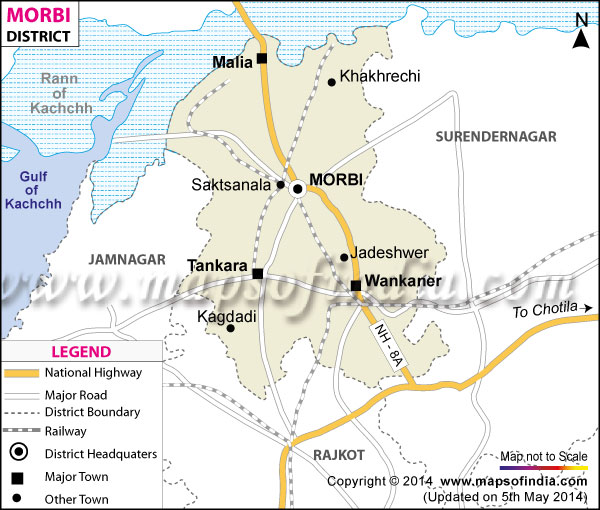
The youngest among Gujarat’s administrative regions, Morbi district came into existence on 15 August 2013, separated from Rajkot. Situated within the Saurashtra peninsula, its center is the town of Morbi, resting beside the Machchhu River. Spanning close to 4,872 square kilometers, it links Rajkot and Kutch geographically. Because of this placement, movement of goods and services flows consistently through the area. Adjacent to Surendranagar, Rajkot, Jamnagar, and Kutch, it holds a core position in western Gujarat.
Known widely as India’s hub for ceramics, it manufactures close to eighty percent of the nation’s tiles and bathroom fixtures. Its reputation in manufacturing draws international trade, sending goods into markets throughout Asia, Africa, Europe, and parts of West Asia. Despite heavy industry defining its image, the area holds layers of heritage, tradition, and scenic landscapes. Flowing across the land, the Machchhu River influences both terrain and past events. Scattered within the urban layout are structures - temples, old bridges, royal residences - that display blends of Indian and European design elements.
Beyond trade, endurance defines the area. Tragedy struck Morbi long ago - the breaking of the Machchhu dam in 1979 left ruins across land and lives. Then again, decades later, the fall of a bridge in 2022 brought sorrow that lingers. Such moments remain fixed within public awareness, quietly guiding how people see themselves here. Growth moves forward, yet shadowed by past weight. Industry thrives now, part of Gujarat's wider economic story. Tradition holds strong amid change. History does not fade - it shapes what comes next.
History and Culture
Long before modern times, power in Morbi rested with warrior clans of royal status. From "Morvi" comes the current name, an old tale speaking of abundance like streams of milk and butter moving across fields. Rule once held firm by Jadeja leaders, known for control across Kathiawar's terrain. After shifts in authority, imperial forces from Delhi extended reach into this western area. Under foreign administration much later, local governance continued beneath distant oversight during empire years.
Among the notable leaders stood Sir Waghjee Thakor, governing during the latter part of the 1800s. Modern thinking marked his reign; electrical power facilities emerged under his direction, followed later by communication networks along with improved access to clean water.
Leadership then passed onward - Prince Lakhdhirji took charge, shaping learning environments instead: schools arose, notably what became L.E. College, still ranked highly among Gujarat’s technical institutes today. Progress shaped their time, traces remaining within the town’s present form, quietly influencing how life moves now. Legacy lives less in monuments than in routine things - wires overhead, pipes below, classrooms where ideas shift slowly.
Among its structures stands Mani Mandir, crafted under Sir Waghjee Thakor, displaying fine detail through mixed Indo-European design. Not far, the bridge known as Jhulto Pul stretches above the Machchhu River - a relic from royal times, shaped by both craft and time. Where temples meet older palaces and colonial forms, one sees how shifts across centuries settled into brick and stone. From these remains, continuity appears - not forced, yet clearly present - where old rhythms continue alongside newer ones.
Economy
In Morbi, economic activity flows strongly through manufacturing, though farming still plays a role alongside service sectors. Industrial output shapes much of the region’s financial movement, yet crop production remains part of the foundation. Services contribute steadily, even as factories define the area’s working rhythm. Growth emerges not only from mills and workshops, but also from fields and smaller enterprises nearby.
In the government segment, jobs are held by many within local administrative bodies, learning centers, and infrastructure units. Public economic activity relies heavily on academic facilities, higher education campuses, because they sustain institutional operations across the region. Despite their modest scale, cooperative ventures in farming and milk production often assist those living in country areas. Meanwhile, businesses aided by regional authorities tend to generate work opportunities nearby.
Driven by manufacturing advances, transport networks now link more regions than before. Logistics operations follow close behind, adapting to new volumes each quarter. Retail spaces appear where movement increases, shaped by routine needs. Hospitality grows without announcement, responding silently to foot traffic. Hotels open near junctions, restaurants line pathways, trading centers cluster unexpectedly. Demand arrives quietly - first from nearby towns, later from distant countries. Movement defines structure here, not plans.
Ceramics occupy an important position in the economy of the district. Nearly eighty percent of India's tile output comes from this region, positioning it as the nation’s primary hub for such manufacturing. Employment for hundreds of thousands links back to these factories, either directly or through supporting roles. In Gujarat’s broader industrial setup, few places carry as much weight as this town does.
Once known for making clocks, it gave rise to names such as Samay and Ajanta Clocks. Over time, that trade faded, yet its mark lingers within the town's economic past. Rural life still turns on agriculture, where fields yield cotton, groundnut, cumin, and bajra. Water from the Machchhu River, along with other supplies, keeps cultivation alive across the area.
What sets it apart begins with its modest industrial units - those in packaging, printing, workspaces for mechanical tasks. Not by chance but through steady effort, local initiative shapes much of what occurs there. Innovation emerges quietly, built not on announcements but actions taken over time. Growth appears less sudden, more like layers added slowly beneath notice. This part of Gujarat thrives because persistence replaces flash. Enterprise lives in routines repeated, improved, trusted.
Tourism
Morbi goes beyond factories and workshops, revealing layers of travel appeal. Where ancient structures meet scenic landscapes, curiosity finds reason to linger. History rests in stone towers, while rivers trace quiet paths through open land. One might expect only machinery, yet culture stands equally present. Beauty emerges where least expected - between bridges, temples, and sunlit hillsides.
Over the Machchhu River, the Suspension Bridge - known locally as Jhulto Pul - stands out among regional landmarks. Built long ago under royal patronage, its presence once reflected the historical identity. Despite the painful failure in 2022, public remembrance holds tight to what it represented. Engineering ambition and shared past merge where steel once spanned water.
Standing near the river, the Mani Mandir was constructed under the direction of Sir Waghjee Thakor. Though small in size, it draws attention through finely detailed sculptures. Devoted to various Hindu gods, the structure blends Indian motifs with European forms. From a distance, the Darbar Gadh appears imposing due to its scale and layout. Built to display authority, the palace once housed the ruling family of Morbi.
Alongside these sites, the city holds Art Deco structures reflecting colonial design. Not far from them sits Lukhdhirji Engineering College, a marker of long-standing academic tradition in the region. Lush scenery appears by the Machchhu River when rains arrive each year. Views along its banks grow vivid once the monsoon transforms the surroundings.
What draws people to the district goes beyond historic sites. During festivals, rhythms of tradition fill the streets. Local gatherings unfold at village fairs under open skies. The taste of Kathiawadi dishes lingers on travelers’ palates. Each visit becomes layered with moments - old architecture, working kilns, quiet courtesies. Heritage does not stand still here - it moves through craft, meals shared, daily life seen close.
Demographics
Some 960,000 people lived in Morbi district as recorded during India's 2011 census. Growth took hold after it became a district in 2013. Industrial activity pulled development forward. Urban areas grew because of shifting economic patterns. One such place rising quickly within Gujarat was the city called Morbi.
A figure near three-fourths marks reading proficiency across the area, shaped by shared priorities between officials and residents. Shifting focus toward learning spaces, one finds Lukhdhirji Engineering College alongside many schools forming key parts of academic life.
Spoken within the district, Gujarati holds status as the main form of communication. Beyond that, Hindi appears regularly, particularly where cities take shape. English finds usage too, though mostly seen near developed zones. Away from towns, local variants of Kathiawadi Gujarati emerge more frequently. Dialectal differences rise naturally in villages, shaped by long-standing habits. A range of languages lives alongside each other here, quietly showing varied roots. This blend does not shout - it simply exists, steady and unforced.
Administration
Within the district, governance unfolds through multiple subdivisions. Five talukas shape its structure - Morbi, Maliya, Halvad, Tankara, along with Wankaner. Administration operates locally in each of these areas. Decentralized oversight emerges where offices stand within every taluka.
With more than 400 villages, every one operates under a separate panchayat framework. Support for rural areas comes through cooperative groups alongside community-based organizations. Governance in towns falls under the authority of the municipality together with various municipal agencies.
When law and order fall under district police headquarters, oversight of development projects rests with the district collector alongside supporting officials. Although industrial demands receive attention, rural concerns do too within this framework. Because governance functions through layered roles, Morbi achieves equilibrium across varied community requirements.
| Facts of Morbi District | |
|---|---|
| Official Name | Morbi |
| Location | Southern Gujarat |
| Area (km2) | 4872 |
| Population | 960329 |
| Language | Gujarati, Hindi, Kathiawadi Dialect |
FAQs
Q1: Why do we refer to Morbi as the ceramic capital of India?
The district is home to a large share of India’s ceramic tile and sanitary products production which in turn makes it a leading manufacturing center in the country.
Q2: What languages are used in Morbi?
Gujarati is the primary language but also in use are Hindi and the Kathiawadi dialect which large sections of the district’s population speak.
Q3: What is Jhulto Pul?
Jhulta Pul is the historic bridge which spans the Machchhu River. For a very long time it has been Morbi’s most known landmark.
Q4: Is agriculture still important in Morbi?
Yes, while it is true that we have dominant industries in our economy, the agricultural sector still supports many rural families.
Q5: Why do people visit Morbi?
People go to Morbi for the historic monuments, ceramic industry, local culture, traditional food, and also for the great royal era architecture.
Q6: Which river flows through Morbi?
The Machchhu River runs through that district and has had a key role in its past, growth and agricultural practices.
Last Updated on : July 16, 2026
