






About
Within central Gujarat’s rich plains rests Kheda, formerly called Kaira - an area linked by streams, fields, and customs passed through ages. Covering close to 3,667 square kilometers, it sits between two key rivers: the Sabarmati bordering one edge, the Mahisagar in the opposite. From the flow of these rivers emerged patterns of living rooted deeply in earth and season alike.
Often grouped under Charotar, a stretch famed for soil so generous it yields abundance year after year, the area bears a name tied closely to ripening grain, rows of green tobacco, and village routines guided by seasons rather than clocks. Farming here does not merely feed families - existence itself turns around sowing and harvest, root and rain. The essence of the region grows from farming traditions, yet stands alongside revered places of worship, collective efforts by local groups, while also marked by participation in national independence events. Mentioning Kheda brings forward endurance, deep commitment, along with the unspoken grace found across village life in Gujarat.
History and Culture
Long before Gujarat’s history was written down, fertile soil defined Kheda. Through ages, control shifted often, though empires rarely centered on it, still shaping life across western India. Slowly, colonial rule took hold, changing goals and views, yet farming held firm as the core of existence there. A shift emerged unexpectedly - not war, but protest grew where crops once dominated. Attention did not come by order or force; instead, struggle under pressure brought visibility at last.
That year, 1918, unrest unfolded across Kheda as farmers stood firm amid crop collapse and hunger. Led not just by Gandhi but also Patel, villagers withheld tax payments under shared hardship. Rather than mere money concerns, their stand spoke of justice, self-respect, strength in unity. Though quiet in method - no force, no violence - the impact rippled outward, touching distant corners of national thought. Resistance bloomed without noise, still echoed louder than shouts ever could. Long after, traces of that resistance remain tucked within Kheda’s shared past. These instances refuse to vanish - instead, they sink into quiet, resurfacing each time bravery comes to mind.
Under moonlight, Kheda reflects Gujarat’s living traditions. As Navratri begins, quiet streets fill with movement and sound. Rhythmic drumbeats travel along alleyways, pulling residents outdoors. Instead of silence, there is dancing - circles turning with energy, shaped by faith and celebration. Adorned in vivid chaniya cholis, women step in time next to men wearing crisp kediyus, each gesture tuned to ancient beats. While worship centers on Durga, something else grows quietly - the closeness between families, built step by step, night after night.
Eastward sits Dakor, known for the celebrated Ranchhodrai Temple. In this place, devotees honor Lord Krishna as Ranchhodrai, drawing visitors who travel long distances just to pray. While worship flows through daily life, so does commerce thrive - markets hum with energy, offering sacred meals, artisan goods, yet sweet snacks too. Devotion weaves into joy; one feeds the other, quietly, steadily. The rhythm of belief moves alongside celebration, never separate.
Beyond festivals, the villages of Kheda keep alive a rich tradition of oral expression. When harvest time arrives, songs emerge from the fields - voiced by farmers, drifting on the wind. Evenings unfold with tales told slowly, stories shaped by hardship and strength, handed gently from older kin to younger ears. Life’s major moments - arrival, union, departure - are honored through ritual, each ceremony stitching individuals into the fabric of collective memory.
Deep within Vadtal, quiet reverence takes shape around the Swaminarayan temple, equally sacred ground and marker of time passed. Though built of stone, it pulses with memory - reform breathing beneath ritual. Over in Nadiad, attention turns gently toward Santram Mandir, where silence speaks louder than scale ever could. What happens there unfolds without show: helping hands become prayer made visible. Here, meaning grows not from doctrine alone, yet from doing - faith shaped by what is given freely.
Economy
Farming forms the base of Kheda’s economic life, rooted in the rich earth of Charotar. From this land, tobacco emerges as a key product, influencing work patterns and community character alike. Instead of monoculture, mixed crops appear - cotton spreads through some plots, while others host rice, wheat, or seasonal greens. Water reaches these fields via river-fed channels, making growth possible even during drier phases. Harvest time brings golden stalks of wheat into view, a common scene stretching across open tracts. Beneath it all runs a network of cooperatives, quietly shaping how produce moves and value circulates. Paddy fields ripple under wind currents, adding rhythm to rural landscapes throughout the season.
Employment emerges within the government framework via administrative centers, educational facilities, and medical services. Positioned as a central hub, Nadiad hosts essential departments responsible for regional oversight and planning. In contrast to bureaucratic structures, collective initiatives define much of public economic life. This area, including nearby Anand, forms part of a region widely recognized for milk production, driven largely by community-owned dairies. Influence from Amul extends beyond borders, shaping rural economies in Kheda.
In towns and holy sites, service-based work grows strong. Take Dakor: here, guesthouses, stores, and local transit thrive by serving visitors on spiritual journeys. Instead of only farming, people engage in crafts like cloth making, clay shaping, or preparing foods. These activities combine so Kheda's livelihood shifts beyond crops alone. Its economy adjusts quietly, yet clearly, to present-day demands.
Tourism
Faith shapes much of what draws people to Kheda. Beyond prayer, its sites serve as centers where tradition gathers momentum across seasons. While rooted in devotion, these spots unfold into broader community experiences. What brings visitors to Kheda begins with faith. More than spots for worship, its temples serve as anchors - tradition deepens there, village routines align with their cycles. Though built for prayer, they open into wider currents: daily existence weaves through quiet piety. People come in every season, pulled less by ceremony than the hush that rests upon old stone and carved wood. To walk among them means stepping past observation; echoes of time lived, believed, remembered settle slowly.
Within this circle of holy sites, prominence belongs to the Ranchhodrai Temple at Dakor, held deeply sacred across Gujarat. Rising above the quiet sprawl of the town, its towers reflect long lines of artisan skill and spiritual dedication. When celebrations like Janmashtami arrive, crowds move steadily through lanes, bringing sound, color, and steady footsteps shaped by belief. Carved stone surfaces, worn slightly by years, carry stories older than memory - each groove placed with intent, preserved without speech.
Apart from its peaceful environment, Vadtal hosts a central Swaminarayan temple. This site functions as the main base for the religious group linked to Swaminarayan. Devotees find comfort through daily worship held within quiet landscapes. While known mainly for faith practices, the location draws visitors seeking calm. Spiritual routines unfold amid simple architecture surrounded by open fields.
Demographics
Over two million residents lived in Kheda when last counted in 2011, putting it midway across Gujarat’s districts in terms of headcount. Surprisingly high, though, is how tightly packed those lives are - nearly 627 persons fit into each square kilometer here. Such closeness tells more than size alone; space shapes daily life in quiet but clear ways.
Far from wide cityscapes, daily existence settles quietly in clusters of village homes, where people know each other by voice and gesture along narrow paths, shared yards, outside barns. Rooted patterns repeat season after season under vast daylight, unchanged because time moves differently when sky meets soil. Out here in Kheda, figures on a page do more than count bodies - they echo how meals pass hand to hand after reaping, celebrations pull kin together year-round, belonging grows through stories told beside plowed earth.
With roughly 84% literate, the area exceeds the country's typical rate, showing how schooling remains a regional priority. Despite their size, institutions in places such as Nadiad and Kapadvanj have shaped many learners over time. In Kheda, people mainly speak Gujarati - it shapes routines, governance, and heritage. Alongside it, one finds Hindi; English appears too, especially within schools and formal exchanges.
Administration
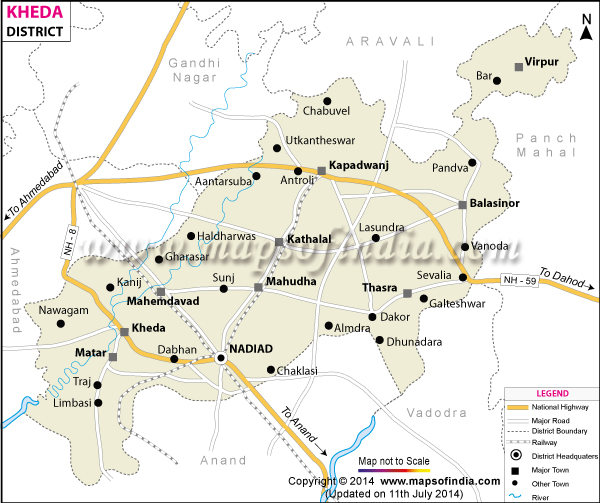
Ten subdivisions make up Kheda district - called talukas - including Kheda, Nadiad, Matar, Kapadvanj, Mahemdabad, Vaso, Mahudha, Kathalal, Thasra, and Galteshwar. Clusters of villages lie inside each taluka, where daily administration operates via gram panchayats. Though modern in structure, these councils carry forward traditions rooted deeply in rural Gujarat’s past. Norms shaped over decades guide choices in village life, forming a steady rhythm for community actions. Authority flows locally, less from far-off offices, more from shared understanding built slowly across years.
What makes this system hold together is how consistently it operates. Because villages follow long-standing routines, local influence shapes district decisions without needing top-down orders. Power moves up from neighborhood groups instead of being sent down from faraway centers. Over time, shared ways of making choices have stayed alive, not through force but by fitting smoothly into daily village existence. Even under today’s official structures, traditions around taking part - settling conflicts, handling land use, arranging celebrations - continue in their own quiet way.
Nadiad hosts the district administration of Kheda within its collectorate, functioning as the core point for preserving civic stability alongside guiding growth efforts and support schemes. Policies emerge from this center, spreading across villages via a chain of taluka offices. Nearness to residents shapes how these local units operate, making state functions respond more closely to everyday needs. Access improves when governance steps nearer, aligning formal structures with the pace of countryside routines.
| Facts of Kheda District | |
|---|---|
| Official Name | Kheda |
| Location | Gujarat |
| Area (km2) | 3667 |
| Population | 2299885 |
| Language | Gujarati |
FAQs
Q1: Why do we see Kheda as a key district in Gujarat?
Kheda is a home to very productive farm land, we also see here a great history and present as many religious sites. Also it was in the forefront of Indian freedom movement which we remember through the famous Kheda Satyagraha.
Q2: What is the importance of Kheda Satyagraha?
In 1918 the Kheda Satyagraha took place which was an early great non violent action in Indian history. In what is now known as the Kheda campaign farmers did not pay taxes when their crops failed which was led by Mahatma Gandhi and Sardar Vallabhbhai Patel.
Q3: Why do thousands of tourists go to Dakor each year?
Most of the tourists visit the Ranchhodrai Temple which is a very respected Krishna temple in Gujarat. Also the town is known for its active markets and festive ambience.
Q4: Is Kheda mainly an agricultural district?
Yes. Farming is the base of Kheda’s economy. With rich soil and a good irrigation system farmers in that area are able to grow crops all year round.
Q5: Which crops do we see the most in Kheda?
Tobacco is a large scale crop in the district. Also grown are rice, wheat, cotton and a variety of seasonal vegetables.
Q6: Is Kheda more rural or urban?
In the main Kheda is rural which has hundreds of villages in it. Agriculture which includes farming of various types is what large section of the population does for a living.
Q7: Which sets Kheda apart from other districts in Gujarat?
Kheda is a unique case of which also true that it has very productive farmlands, important religious sites and also plays a large role in the Indian independence struggle.
Q8: Which festivals are celebrated in Kheda?
Navaratri is a time for great celebration in our district. In Dakor we see large numbers of devotees each year at Janmashtami.
Last Updated on : May 12, 2026
