

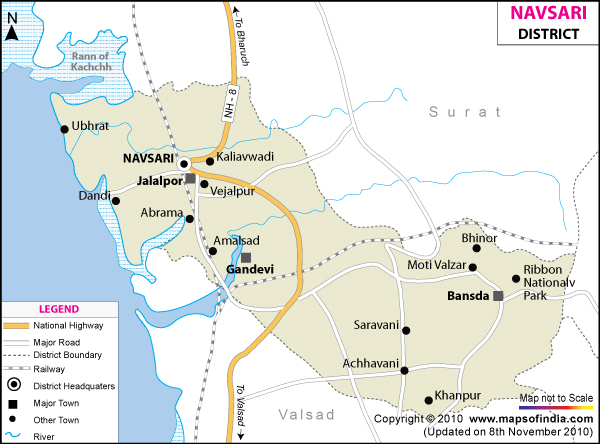





About
Navsari is an ancient city foundation situated in the south of Gujarat which is well-established in terms of culture and its soothing, serene, old-world style. It is located close to Purna River and has always been a hub of commerce, agriculture and learning. The city is of special importance to the Parsi community, which was one of the earliest Parsi communities to settle in India, upon their arrival in India. In the course of time it turned into a significant center of Zoroastrian culture, and a few fire temples and institutions that preserved ancient traditions appeared.
History and Culture
History in Navsari does not happen suddenly, but accumulates gradually, layer over layer, as the memory of people formed by their migrations, religious affiliations and conservatism. The area has a fairly long history, having been a part of trade routes in western India in the early days but its time started with the coming of the Parsi community between the 8th and 10th centuries. In the course of it, Navsari became one of their main, cultural and religious centres, which was regarded as a bastion of orthodox practices in Parsi.
Here religious fire temples were developed and the ritual survived exile and distance. One of the oldest, and most solemnly respected fire temples, the Bhagarsath Anjuman Atish Behram, is the monument of this enduring belief. Spiritual authority and continuity was sustained by priestly families, especially the Bhagaria group of people. The town created a hub for the study of theology, whereby religious books, ways and lifestyles were highly maintained and inherited by generations.
In addition to its Parsi history, the area has also shown influence of the larger Gujarati culture, which believed in agriculture and trade and other locally based enterprise. Crops such as rice, sugarcane and chikoo were cultivated on fertile lands and provided a stable agrarian region which sustained settlement over centuries. The markets emerged as social groups of exchange, not only of goods but ideas and traditions, comprising diverse communities. Hindu traditions, temple structures and local festivals beautifully integrated with the Parsi customs creating a multi-layered cultural meaning instead of a one-dimensional account of the native region.
Navsari is further enriched by its connection with prominent names in history, most notably the dadabhai Naoroji. He was born in 1825, and later became one of the earliest chiefs of the Indian nationalist movement and the first Indian to be elected to the British Parliament. His ‘Drain of Wealth’ theory relating to the economic exploitation of Indians during the colonial reign was a foundational framework to the intellectual resistance of British rule. His work connects the town to the preservation of culture as well as the influence on contemporary thinking in Indian politics.
Lived traditions within the town are still echoed in its culture. Parsi festivals like Navroz are strictly ritualized with Gujarati like Diwali and Uttarayan also contributing color and rhythm to the social calendar. The same is true of the language because mostly the daily lifestyle is dominated primarily by the Gujarati language though the remnants of the Persian heritage are still noticeable in the emotional idioms of people and certain religious terms.
Economy
The economy of Navsari is undergoing gradual modernization, balancing traditional deep-rooted farming and gradually shifting to industries and services. The region lies within the alluvial soils of fertile plains of Gujarat to its one end and enjoys favourable climatic conditions to the other. Agriculture is the mainstay of economic activity with rice, sugarcane and Pulses being the most extensively grown crops. Even more remarkable than this is its horticultural activity, much of which is devoted to the cultivation of chikoo (sapodilla) around which it is generally known all over India. The landscape is covered with orchards, and it is an indication of economic stability as well as continuity of the generations.
In addition to agriculture, there has been gradual development in small-scale industries and agro based businesses in Navsari. The channeling of agricultural produce to food processing units, cold storage and the local trading networks have generated commerce and sustained the rural population. The cooperative sector is also involved and it assists farmers to access the market, credit, and modern methods. This mixture of traditional agriculture with supporting infrastructure has enhanced the local economy over the years.
The industrial development has not reached the scale as witnessed in big city centers but has grown slowly following its proximity to cities such as Surat and Valsad. There has been diversification in small and medium enterprises including textile industries, diamond cutting, light manufacturing industries, among others. The business-friendly policies and development of infrastructure in Gujarat have helped the industrial estates in the district to attract investments.
The service industry is increasingly becoming significant. The growth in education, and health facilities, banks and retail consequently increases with the growth in population and urbanization. The best training facilities and institutions are producing individuals for employment in companies and more efficient ways to communicate such as the road and rail systems have facilitated greater trade and movement. The additional layer is tourism, which is small, however, helping to preserve and promote the region’s cultural heritage and its proximity to coastal areas.
Tourism
Tourism in Navsari does not come with barking crowds and spectacle, on the contrary, it takes place in very low tones and conveys to the people who prefer depth over the spectacular. The town is in the south of Gujarat and is a quiet and effective repository of cultural heritage, spirituality, and accessibility to seashores. Instead of being filled with excess, its appeal is in the combination of history, faith, and daily life that bring the experience of the world, which seems both grounded and enduring.
Another aspect that describes tourism in this area very well is that it is closely tied to Parsi. The town also has significant Zoroastrian religious locations of which the revered Bhagarsath Anjuman Atash Behram, the home to the local Zoroastrian Gods and goddesses, draws devotees and visitors seeking to learn more about one of the oldest existing religions. The fact that these holy places are not just some architectural structures but also they remain living institutions with rituals that have been in existence since the centuries. To most, a visit to Navsari is an experience of continuity- and here convention is upheld with extraordinary conservatism.
Other than religious significance, the region provides an insight into one of the cultural landscapes deeply influenced by Gujarati culture. Temples, the local markets, and traditional neighborhoods is a style of life which has never changed suddenly. Other festivals like Navroz, Diwali and Uttarayan make the town colorful and people come to celebrate with the whole community and it is deeply rooted in the heritage. The cuisine is also a part of the adventure in which local tastes provide an innermost view of agrarian abundance as well as cultural variety.
The other aspect of tourism arises from its proximity to natural attractions. The adjacent Dandi beach is important historically as the final point of the Salt March led by Mahatma Gandhi in 1930 uniting the region to one of the most significant historic events in the struggle to achieve Indian freedom.
Demographics
The demographic inputs of Navsari are a cautious balance of traditional and gradual changes based on the agrarian foundations, cultural differences and incremental urban growth. The 2011 Census records 1.33 million people as the population of the district, but the town itself includes less people in urban areas. This figure has experienced a moderate growth in recent years, owing to better connectivity, educational opportunities, and economic prospects. Nevertheless, in spite of such development, this region has a semi-urban nature, with rural and urban ways of life existing side by side.
Population distribution is uneven with a great percentage living in villages and engaged in agricultural sectors while the urban center serves as an international business place, educational and administrative centre. It has an average level of population density as compared to other bigger cities in Gujarat and represents the land availability and continued value placed on agriculture. This geographical distribution forms a less overcrowded rhythm of life, allowing communities to keep in close social and cultural contact with each other.
The area is characterized by social diversity. Most people in the country are Hindus, with some significant groups of Parsis, Muslims, and Jains, all of whom make a significant contribution to the cultural mix. The Parsi community is fewer in numbers but it has some historical and cultural values that shape the institutions, traditions, and local identity. This cohesiveness of communities has created a culture of relative peace where a common space and shared festivals tend to double up.
This diversity is also shown in language. Gujarati is the main dominant language of everyday life, administrative, and educational spheres, Hindi and the English language are familiar as well, especially in urban and institutional areas. Also some relics of Persian language culture are still evident among the Parsi community in the religious context which helps them maintain connection to their roots.
The district literacy level is quite high according to the overall development in the educational system of Gujarat. School access and universities, college and vocational sector access have been enhanced with time resulting in a more knowledgeable and conscious population. There is also a slight difference in the literacy levels between males and females with female literacy steadily catching up as there is more focus on educating everyone.
Administration
On the one hand, the administrative system of Navsari represents a larger governance system in Gujarat, and on the other hand, it changes depending on the needs of the community, predetermined by its geographical position and people. Navsari serves as a district and an urban administration centre making sure that most of the rural governance systems are coordinated with urban governance. District administration gained prominence in 1997 when Navsari was carved out of Valsad district, an administrative reorganization aimed at improving efficiency and regional development.
At district level, the administration is led by the District Collector whose duties include the preservation of law and order, administration of the government policies and revenue administration, as well as development programs coordination. The Collector functions along with other officers of the district-level responsible for different departments like health, education, agriculture, and public works. This is the structure which guarantees that there is decentralization in both planning and execution.
The district is further divided into a number of talukas such as Navsari, Jalalpore, Gandevi, Chikhli, Vansda and Khergam. There is a Mamlatdar in each taluka who sits in charge of the gathering of revenue, land registers, and administrative duties of the taluka. These departments enable better ways of managing resources and services within various regions, especially in the rural and tribal regions.
The urban government is under the administration of the Nagar palika or Navsari Municipality as an organization in charge of providing civic services in the form of water supply, sanitation, waste disposal, roads and local infrastructure. There is a democratic representation with elected representatives such as councilors, therefore democratic governance at the local level. Municipal administration becomes important especially as the town keeps expanding to be in a position to balance development and sustainability.
The system of governance that is based in rural areas is the Panchayati Raj system; it is a three tier system and this includes the Gram Panchayats, the Taluka Panchayats and the top level being the District Panchayat. It is a decentralized system, which promotes the involvement of people and recognizes the decision-making into the hands of the local population.
| Facts of Navsari District | |
|---|---|
| Official Name | Navsari |
| Location | Western India |
| Area (km2) | 2211 |
| Population | 1329672 |
FAQs
Q1: Which river flows through Navsari?
The Purna River which runs through the district has supported farming and settlement for generations.
Q2: What is the significance of Dandi?
Dandi is known for being the site of the end of the great Salt March in 1930 which in turn made it a very important element of India’s freedom struggle.
Q3: What crops do we see in Navsari?
Farmers produce mostly rice, sugarcane, pulses, and the very much so chikoo which is a distinguished product of this district.
Q4: Is Navsari mainly an agricultural district?
Yes in that agriculture still forms the base of our local economy although over the years industry and service sectors have grown.
Q5: What industries are found in Navsari?
In addition to agriculture which is a mainstay, the district also has food processing units, textile based companies, diamond work and other small scale manufacturing industries.
Q6: Which famous religious sites are there in Navsari?
Yes the district is a home to very important Parsi fire temples as well as many Hindu temples which see great visitation all year round.
Last Updated on : July 15, 2026
