






About
Panchmahal district is a historical and geographically diversified district which is in the eastern region of the Indian state of Gujarat. Panchmahal was named so because of the word Panch which means five and the word Mahal that means administrative units or divisions. In the past, there have been five such administrative divisions that made up the region and led to this name that has ever since characterized it up to date. This naming is not just a symbolic one, but it is a sign of the administrative system, which influenced the initial organization of the district.
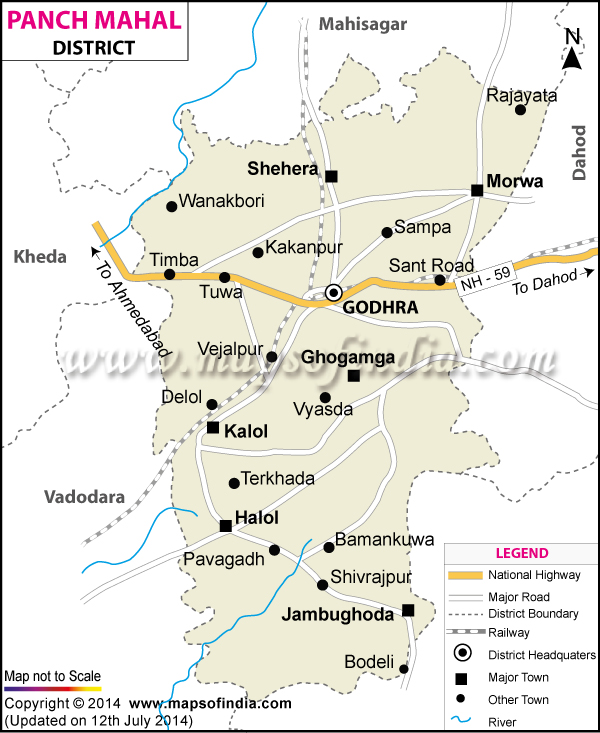
The district is topographically diverse being a mixture of fertile plains, low hills and forested terrains, especially on the east. Agriculture is also facilitated by the availability of rivers like Mahi and tributaries to it though rainfall fluctuation is also witnessed in the district thereby affecting the farming practices. The closer examination of the Panchmahal district map will show how the natural features like the rivers and hills impact the settlements and the land use.
The other significant attribute of the district is connectivity. It is also accessible and strategically located as it has good road and rail network to major cities such as Vadodara and Ahmedabad. These transportation routes are also indicated in the Panchmahal district map and the way the district can serve as an interface between the developed urban centres and tribal hinterlands. In general, the Panchmahal district is a mixture of the historical heritage, geographical variety, and the future development.
History and Culture
The Panchmahal district has a really long history that accurately dates back to ancient time, and it can hence be stated that the area was well occupied at the time of the Mauryan and Gupta Empires. Through centuries, it was under the influence of different regional powers leaving their mark in cultural and architectural landscape of the district.
Among the most important periods in the Panchmahal history was the time of the Sultan Mahmud Begada of the Gujarat Sultanate in the 15 th century. He created the city of Champaner which was located close to the Pavagadh Hill and his capital in the short-term. Champaner turned out to be a prosperous trade, architectural and cultural hub. The ruins of this city today constitute the Champaner-Pavagadh Archaeological Park that is today listed as a UNESCO World Heritage Site. The Panchmahal district map distinctly shows that this area is a key historical and archeological area.
The region fell under the control of the Mughal Empire, and then under Marathas after the fall of the Gujarat Sultanate. It was finally included in British India whereby the district organisation was formalised. Panchmahal had a major influence of the British on the formulation of its modern boundaries and system of governance.
The tribal population of Panchmahal district is so strongly influenced culturally. There are also communities like Bhils and Rathwas which comprise a very huge percentage of the population and add a great deal in the cultural identity of the district. They also have distinctive dances, music, painting and rituals which are related to the nature and the cycles of agriculture.
Panchmahal Festivities represent a combination of mainstream Gujarati culture and the tribal culture. Large scale celebrations like Diwali, Holi and Navratri are celebrated with lots of zeal in the district. In particular, Garba dances characterize Navratri. However, in the tribal regions, the festivals usually embrace local traditions, and so they are not similar to festivals in Gujarat cities.
When the Panchmahal district map is considered in the light of culture, it will be clear that various parts of the district are holding on to their own traditions yet they are a part of the same cultural system. This is among the characteristics of Panchmahal.
Economy
Panchmahal district is an agricultural based economy although other economic sectors have been slowly diversifying the economy. The Panchmahal district map is a handy depiction of the way the economic activities are spread in various parts of the district.
Employment opportunities in the government are created in the form of administrative services, education, health, and in other development programmes. Towns like Godhra, Halol, and Kalol have government offices which are the key sources of employment. The public welfare programs particularly the ones focused on development of the tribal groups are instrumental in enhancing the socio-economic status of the people.
The government sector plays an important role in terms of development of infrastructure and irrigation systems as well as institutions of cooperation. The dairy cooperatives especially in the rural regions are significant due to the overall achievement in the dairy industry in Gujarat. These cooperatives offer farmers a stable income, and stabilise the economy of the rural areas. The Panchmahal district map identifies areas where irrigations and cooperatives have boosted production in agriculture.
The economy of the district is still agriculture-based. Primary crops which are cultivated are maize, wheat, pulses and oilseeds. Moreover, there is the emergence of horticulture and farmers are producing local and regional fruits and vegetables. Livestock rearing is also a major contributor as it serves as a way of earning additional income to the rural families.
Services sector is growing at a steady pace with its increase being recorded in urban and semi-urban regions. The economic growth is being contributed by the retail trade, transportation, banking, education, and healthcare services. Small scale industries like food processing, textiles and hand craft industries are also coming out as a key player.
The Panchmahal district map reveals that there is a gradual transition towards more diversified economy, which is no longer agrarian. Nonetheless, there are still problems of poor industrialisation levels, reliance on rainfall, and inequalities within the regions. There is an attempt to solve these problems by means of infrastructure improvement and policy.
Tourism
The Panchmahal district focuses its tourism activities on the natural attractions, religious monuments, and historical monuments. Panchmahal district map is a very crucial guide that helps tourists to map out the different destinations available in the district.
The most striking is the Champaner-Pavagadh Archaeological Park. This UNESCO world heritage site also comprises a large variety of historical sites including mosques, stepwells, temples, and fortifications. It can be discussed as a certain combination of Hindu and Islamic architecture and attracts historians, archaeologists, and the tourists all over the world. This area is obviously recognized as one of the tourist destinations in the Panchmahal district map.
The Jambughoda Wildlife Sanctuary is a nature to travel to and part of it is found within the district. It harbors numerous wildlife species and has eco-touristic opportunities. Panchmahal district map indicates that there is a lot of ecological richness within the marked areas of the forested regions.
Hathni Mata Waterfall is another attraction seasonal which is most active especially on monsoon months. It is surrounded by plants and rocky landscape giving a serene abode to anyone who wants to experience the beauty of nature.
Panchmahal district map has proven particularly beneficial in terms of route planning when travelling in this region as it illustrates the connectedness of various tourist locations and the local towns. The tourism in the district has been growing and this is contributed by better infrastructure and efforts to protect the heritage.
Demographics
The population of Panchmahal district is around 2.4 million, and it is based on the latest available data. It is a rural population with a large percentage of the people being the members of tribal communities. This cultural makeup and social pattern of population make the district diverse.
The district literacy level is approximately 72 percent, which shows that the district had been experiencing a good development in the literacy level. The provision of schools and colleges together with the government efforts have been significant towards enhancing the level of literacy.
The major language spoken in Panchmahal district is Gujarati and the other language is Hindi which is also well understood. The linguistic differences in the region are also contributed by the fact that tribal communities have their dialects.
The Panchmahal district map assists in the distribution of population where people are found to be concentrated in the urban centres like Godhra and scattered in the rural and tribal regions. The distribution has consequences on the planning of infrastructure and services to people.
Administration
The Panchmahal district is administratively divided into a number of talukas with among them being Godhra, Halol, Kalol, Jambughoda, Morwa (Hadaf) and Shehera. Local governance and implementation of development programmes are done by each taluka.
The district has more than 1,200 villages, which constitute the rural economy and social system. The panchayati Raj institutions are run at the village level and are decentralised and the community is involved in the process of making decisions. An example of such important tools of administrative planning is the Panchmahal district map which clearly shows boundaries, settlements and infrastructure. It assists the authorities to distribute the resources efficiently and check the development processes.
Besides its taluka-level administration, Panchmahal district is further introduced into administrative blocks and gram panchayats that see to it that delivery of public services is done effectively at the lowest level. Block development officers are in charge of each block, and they organize with the local bodies on implementing government schemes with respect to agriculture, education, health, and rural employment. Such multi-level administrative regime enhances decentralisation and gives policy-makers an opportunity to customise policies to local functions, especially in tribal and remote regions where interventions are needed to target local demand.
A system of police stations spread around the talukas in the district ensures law and order in the district, and the district level authorities, which are based in Godhra, provide the overall supervision. The management is also keen on disaster management and planning of various resources particularly based on season-specific difficulties like droughts or downpouring.
FAQs
Q1: Which languages are spoken in Panchmahal?
Gujarati is the primary language of the district. Also Hindi is very much known by the people, and also many tribal communities have their own local dialects.
Q2: Why is Godhra important in Panchmahal?
Godhra is the district capital and a base for administration, education, health care, business and transport.
Q3: Do tourists visit Hathni Mata Waterfall all year round?
During monsoon and just after it the waterfall sees the greatest attendance which is when the water flow is at peak and the environment is very green.
Q4: Does Panchmahal have wildlife attractions?
Yes. In some parts of the district is the Jambughoda Wildlife Sanctuary which has great offerings for tourists including forest, wildlife and eco tourism.
Q5: What festivals are celebrated in Panchmahal?
People mark out Navratri, Diwali and Holi. Also tribal communities put on music, dance and local customs for their traditional festivals.
Q6: Is Panchmahal suitable for heritage tourism?
Yes. In Panchmahal you will find ancient forts, temples, archaeological monuments which in turn present a great heritage tourism destination. Also in Panchmahal there is a large collection of historical sites which make it a very important heritage travel spot in Gujarat.
Q7: Why should tourists visit Panchmahal?
Panchmahal is a blend of history, culture, natural beauty, religious sites and tribal traditions which in turn presents an excellent destination for travellers looking for more than what urban areas have to offer.
Last Updated on: May 12, 2026
