






About
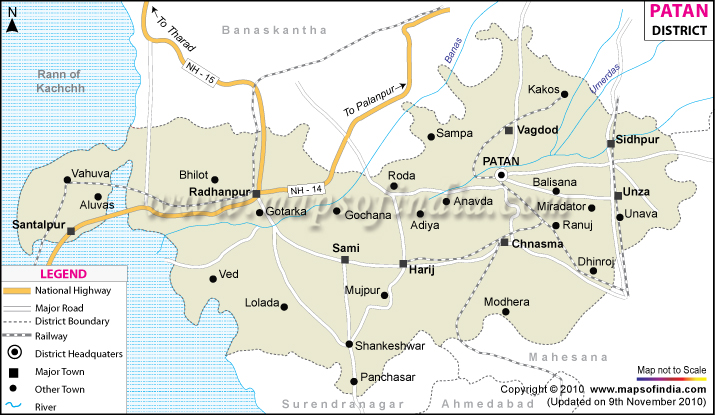
Patan district is a key administrative unit of the Indian state of Gujarat in the north. The district is known by its rich history and marvels of architecture as well as its rich cultural identity that takes centre stage in the landscape of western Indian heritage. With its headquarters in the town of Patan, where the capital of the medieval Solanki dynasty was located and remains a historical and cultural hub to date. The Patan district map aids in interpretation of its geographical map that comprises of semi arid plains, farming lands and sparsity of settlements that make it rural.
The district is geographically enclosed in the north, south and northeast by Banaskantha, Mahesana and Rajasthan respectively. The Saraswati River passes through some portions of the district and contributes to the agricultural activities of the district. Its relation by road and rail also features in the Patan district map which makes it approachable by the other major cities of Ahmedabad and Mehsana.
The Rani ki Vav, a step well dating back to the era of architectural genius in India is also a UNESCO World Heritage Site in the district. Moreover, Patan is one of the region that in the world produces Patola silk sarees which are woven so meticulously and their value is very high. The Patan district map also provides insight into how these traditional groups of craft dispersed in the area. Altogether, Patan district can be considered a melting pot of history, culture and economic security with the heritage value on the one hand and the modern development on the other.
History and Culture
The Patan district has a long history way back to the ancient and medieval times in which it was termed as Anahilwad Patan. It was created in the 8th century by Vanraj Chavda and later made the capital of one of the most ruling dynasties the Solanki (Chaulukya) dynasty in Gujarat. In the Solanki period, Patan was a prosperous trading, artistic, architectural and learning centre. Patan district map assists in the historical tracking of settlements which emerged in this prosperous period.
The Rani ki Vav built by Queen Udayamati in 11th century in reminiscence of King Bhima I, has been taken as one of the most excellent examples of the architecture of a step well in India. Jainism and Hinduism were other religious forces in the area and many temples and other religious places were erected. These heritage sites are often identified in the Patan district map, and the way they fit spatially is captured in the map.
The region thereafter fell under the control of the Solanki dynasty and later the dated Delhi Sultanate and the Mughal Empire, after the downfall of the Solanki dynasty. At these times Patan still remained a significant regional administrative and trade centre. The region later fell under the British colonial rule but the Marathas had ruled the region prior to its colonisation. These historical changes can be expressed in terms of the development of administrative boundaries, as is reflected in the Patan district map.
Patan district is a district, rich in terms of culture, festivals and craftsmanship. One of the most famous elements of the cultural heritage is the Patola silk weaving. This form of ikat is complicated and time consuming, and it can take many months to make a single saree using this double ikat technique. This art is practised by traditional artisan families which are present in the Patan district map.
Usually thru festivals like Navratri, Diwali, Uttarayan and Holi, the Gujarati culture is very colorful. These celebrations have folk dances such as Garba and Dandiya Raas. Also long tradition of folk music, local fairs and religious assembly is present in the district. Major fairs and cultural events are usually noted on the map of the Patan district where they are conducted every year. Patan culture therefore forms a very peaceful combination of past and present life and so is a distinct cultural landscape in Gujarat.
Economy
Patan district has a mainly agrarian based economy and this is helped by a combination of agrarian initiatives by the government, the activities of the public sector and the increasing services sector. The map of Patan district can give one an idea of the distribution of the agricultural areas, industrial sites and residential centres that provide economic base of the district.
The government plays its part by implementing various development programmes like infrastructure development, irrigation development, rural livelihood development. Agricultural, water and rural employment schemes are major contributors to the sustenance of the district based economy. The map of the Patan district shows agriculture areas assisted by the government and irrigation projects.
Institutions being put forward by the public sector entail cooperative societies, agricultural boards and the rural development agencies. Dairy cooperatives and especially those important in helping farmers and giving them a constant stream of income. Such networks of cooperation between villages are hinted at in the Patan district map.
The economy of the district is mainly agricultural with wheat, bajra, mustard and cumin being the most common crops grown there. Semi arid climatic conditions require the application of effective water management techniques such as use of tube wells and irrigation systems. The map of the Patan district assists in identifying the areas which are more productive in agricultural activities.
There has been slow expansion in the services sector particularly in urban areas such as Patan town. Employment and economic diversification include education, healthcare, retail trade and transportation services. Services sector also involves tourism where people visit such heritage sites as the Rani ki Vav. The map of the Patan district is frequently used by the tourists and planners to get to these essential destinations.
Small-scale industries and especially industries connected with textiles and handicraft are also important contributors to the local economy. Not only does the Patola silk industry maintain a traditional skill, it makes money both locally and globally. The map of the Patan district shows aggregates of such industries. In general, the Patan district economy indicates the equilibrium between the traditional economic activity of agriculture and new service-based activities.
Tourism
The historical monuments and the cultural heritage and architectures are the major focus of tourism in Patan district. The map of Patan district is a handy source of information to the travellers interested in the major attractions of the area.
The best known tourist site in the district and a UNESCO world heritage site is Rani ki Vav. This is a highly intricately hewn stepwell, an architectural marvel connoting the artistic masterfulness of the Solanki era. This landmark has been identified by a distinct mark on the map of the Patan district, and has thus become a target of tourists.
The other tourist area is the Sahastralinga Talav, an ancient water reservoir which is attributed to the Solanki rulers. It may be ruins now, but it shows the high level of water management systems of those days. Its location has been denoted by the Patan district map as an object of historical interest.
Those who wish to appreciate the heirloom textiles must visit the Patola house. It contains the information about the complicated process of Patola weaving, and shows the wonderful sarees. The tourist can easily identify this cultural centre in the town by using the Patan district map.
Jain temples within and around Patan are also an important tourist attraction site due to their elaborate carvings and spiritual atmosphere. Pilgrims and tourists flock these temples. These religious sites are mentioned in the Patan district map of the district.
Modhera Sun Temple, situated near the district boundary is also an attraction often visited by tourists. Patan district map gives connection choices to tourists intending to pay a long visit.
The tourists are also drawn to local fairs and festivals which give one an insight into the rich culture of the region. Traditional music and local dishes, as well as handicrafts add to the list of attractions in the whole travel experience. These events are frequently planned by visiting Patan district using a map of this district. Heritage, Culture and spirituality are therefore blended to make tourism in Patan district an attractive tourism destination in Gujarat.
Demographics
The population in Patan district is very rural with few urban settlements that are located around the district headquarters. As per the recent estimates, the number of the district population is 1.3 to 1.4 million approx. The Patan district map assists in knowing how the population was distributed among the towns and villages.
The literacy level in the district is approximately about 73 to 75 per cent which is an indication of continuous growth in education over time. The district has educational institutions such as schools and colleges which are involved in developing human resources. The map of the Patan district identifies important educational centres.
The main language spoken in the district is Gujarati but Hindi is also well comprehended. Education and administration are done in English. In Patan district map, language distribution is indirectly reflected in terms of settlement patterns.
The district is balanced in terms of the demographic composition, which consists of the different communities that make it culturally diverse. The social structure is determined by rural livelihood, agricultural activities and the traditional jobs. These patterns of demographics can be seen visually on the Patan area map. In general, Patan district demographics represent the mixture of tradition and slow modernisation.
Administration
The administrative unit of Patan is divided into a smaller number of tehsils (talukas) to ensure reasonable government and development thereof. These include Patan, Chanasma, Harij, Sami, Santalpur and Radhanpur. These punctuates are well defined by the map of patan district that facilitates administration and planning.
Many villages and local Administration unit also make up the tehsil. This district consists of over 500 villages and every village consists of its own local panchayats charged with rural administrative and development duties. The distribution of the villages is described in detail in the map of Patan district.
Its head is a District Collector (in charge of law and order, revenue collection and maintenance of government schemes). The districts and tehsils have various departments; they are efficient in execution of services. This is attributed to the fact that the Patan district map is one of the most vital tools in the administration and coordinating of planning.
The municipal authorities take control of cities and towns and the gram panchayats take control of rural areas. Patan district map helps decide these government apparatus and their jurisdiction. The district of Patan is well administered and the administrative system has helped in planning and developing the district using geographical devices such as maps.
FAQs
Q1: Is Patan a great place for history lovers?
Yes, Patan is a key heritage destination in Gujarat. It’s home to monuments, temples and stepwells which tell the story of the past.
Q2: What is Sahastralinga Talav?
Sahastralinga Talav which is an ancient water reservoir from the Solanki era. It is a display of advanced water management in medieval Gujarat.
Q3: Why do people visit the Patola House?
Visitors watch the art of making Patola silk which is a very old textile craft still practiced in India.
Q4: Does Patan have religious importance?
Yes in many years the district has seen large numbers of pilgrims at its Jain and Hindu temples which also are known for in depth carvings. Some ancient temples which are popular with the pilgrims also.
Q5: How can travellers reach Patan?
Patan has very good road connectivity to Ahmedabad, Mehsana and also other nearby cities. Also we have regular bus and rail services which make travel easy.
Q6: What is the primary crop in Patan?
Farmers produce mainly wheat, cumin, mustard, bajra, and castor. Agriculture is still the base of the district’s economy.
Q7: What role does Patan play in Gujarat’s heritage?
Patan is home to some of Gujarat’s best preserved medieval architecture and traditional crafts. It is a cultural destination which continues to draw visitors and researchers.
Last Updated on : July 15, 2026
