






About
The Dangs district, also simply known as Dang, is found in the green, wooded crests of the southern Gujarat. Its name alone has a rich historical and geographical commitment- we suppose that it was based on the word Dang, that is the wooded or mountainous lands, the areas where tribes live. In marked contrast to much of the arid or semi-arid land of Gujarat, this district is a green enclave, endowed with biodiversity rich and rolling hills and dense forests which appear to be telling a tale of an older India.
Being in the Sahyadri (Western Ghats) range, The Dangs borders Maharashtra to the east-south with The districts of Navsari and Tapi situated to the west and north respectively. It is most ecologically important but the smallest in population area in Gujarat. It is based in Ahwa, a small quiet town, which is the administrative and cultural centre of this region.
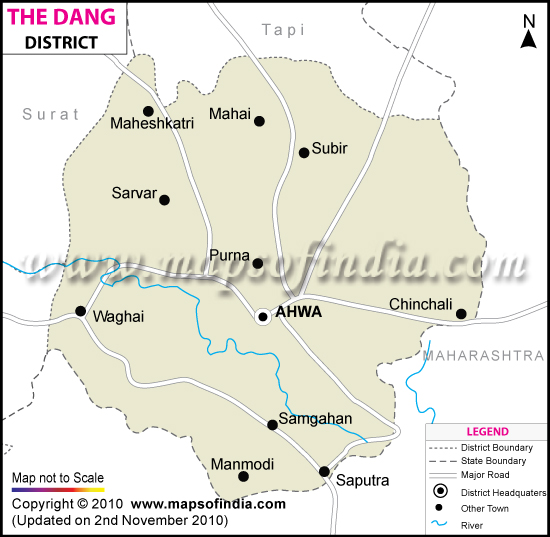
The high forest cover that occupies almost 90 percent of the total area of the Dang district map is oftentimes the characteristic feature of that area. This peculiarity of geography conditions not only the environment but the way people live there, their economy and their culture as well. When examining the Dang district map, it is evident that it is a place in which nature prevails over human habitation and not vice versa.
Other areas of Gujarat have been comparatively more isolated as shown by the Dang district map which has also helped to maintain the tribal customs and the ecological diversity of the district. Therefore, The Dangs is probably one of the least urbanised areas in the state, which provides the chance to see the unique vision of the mode of living, which is closely tied to forest and land.
History and Culture
The Dangs district has a history which one cannot take out of its tribal origins. The indigenous people were the members of Bhil, Warlis, Kunbis and Gamit tribes that have long been living in the region. These people were at peace with the forests, which served as their food source, shelter and spiritual satisfaction. They are even present today, as the defining element of cultural life in the district.
In the past, the Dangs did not come under the direct control of the big empires as that of other regions in India. Rather, it was composed of small jurisdiction princely units under local chieftains, called: Dangi Rajas. Under the British rule, the area fell under its indirect control with the British signing agreements with these tribal chiefs, whose primary aim was to tap the forest resources, especially the teak wood. The heritage of such arrangements is reflected in the local traditions.
Among the most interesting cultural events in the district is an annual event, the Dang Darbar, which is held in front of the festival of Holi. This has its roots in the colonial era when the tribal chiefs could gather to have their allowances paid by British administration. It has today become a colorful cultural festival which exhibits the tribal dances, music, crafts and traditions. It is a strong reminder of the historical course of the district.
The Dangs have their cultural life which is very rooted in nature. Close with agricultural cycles and forest rhythms are festivals. Holi is organized with loads of fun and may take days, accompanied by dances that are traditional as the Dangi dance. The celebrations are accompanied by music done on native instruments.
An analysis of the culture through the Dang district map portrays groups of villages that serve as culture centers where cultures are upheld and handed down to the next generation. These are not just locations as they are also living reservoirs of oral history, folklore and tribal wisdom.
Art forms like the Warli painting, which is more commonly referred to the neighbouring Maharashtra are also practiced in The Dangs. These paintings which are typified with simple geometric figures portray daily living, rites and the bond between man and nature.
Economy
The Dangs district has a small economy which mainly relies on government assistance, natural resource and farming. With the hilly flows and dense forested areas, the development of the industry in the area has been low though the district is self-sufficient with the blend of the traditional and modern economic activities in the area.
The government plays a crucial role in the district’s economy. Much of the jobs are provided following government programs, administrative services and development programmes directed at enhancing the standards of living of the tribal populations. Rural development, education, and healthcare initiatives offer services and job opportunities.
Dang district map is frequently used in pointing out the location of government offices and institutions, located mainly in Ahwa and some other important points. These centres are hubs of economic action on a hitherto dispersed rural terrain.
Forest management as well as other related activities have high involvement of the public sector. One of the most significant organizations in the district is the Forest Department which is in charge of conservation, afforestation, and sustainable use of forest resources.
Timber, particularly teak has been a natural resource of great value in the past but it is highly controlled by strict laws today. The Dang district map shows expanses of preserved forests this speaks of the need to preserve rather than commercially exploit the land.
Also, the initiatives of the government in irrigation and rural infrastructure have assisted in enhancing the agricultural production and connection in the past few years.
The Dangs has a slowly growing services sector, especially in education, healthcare and tourism. Many of the residents are earning their living through small businesses and local markets and transport services.
Despite the terrain constraints, there is agriculture (including paddy, millets and pulses). The Horticulture (mango and cashew) is becoming relevant. Forest products including Honey, bamboo and medicinal plants are also contributing to household incomes as non-timbered products.
The Dang district map demonstrates the way the economic activities are distributed in the region with the villages tending to be dependent upon the surrounding forests and small pieces of land. Such a decentralised economic arrangement is indicative of the reliance on natural resources and a community-based way of living in the district.
Tourism
Dangs district is a treasure to be explored by nature enthusiasts, and people in need of peace outside the city. Pristine environment, waterfalls, hills and forests among other things makes it one of the most beautiful places in Gujarat.
Saputara is the only Gujarati hill station and is a tourist facing hoot in The Dangs. It is situated in the Sahyadri region that offers breathtaking views, pleasant climate and excursions such as Saputara Lake, Sunset Point and the rope way are some of the destinations. The Saputara is clearly marked on the Dang District map as being a great tourism destination which attracts people in and out of the state.
Gira Waterfalls is a great attraction point to see, particularly under the monsoon season, and situated north of Waghai. The flowing water through lush vegetation generates a spectacular dazzling vision that gives an unforgettable impression. According to the Dang district map, the area would be conveniently accessible by the road and hence a preferred travel destination.
This garden is a jewel of plants that denote a very rich array of local plants. It is a recreational centre as well as a learning centre to people who may have interest in botany.
An important religious location in the country is Shabari Dham that is thought to be linked to Ramayana. It is a tourist attraction that draws pilgrims, and injects spiritual flavor into the tourism profile of the district. Tourism in The Dangs is in its infancy yet the prospects are staggering. The Dang district map can be a very helpful guide, which assists a traveller in order to explore the natural and cultural attractions of the area.
Demographics
Dangs district is situated with a very small population as compared to other districts of Gujarat. The most current statistics state that the population is about 228,291. The district is more or less rural and most of the people are Scheduled Tribes.
Literacy level is approximately 76 andthis is an indication of consistent improvement in education although in remote locations there are still problems. The government programs have been important in enhancing access to education.
The languages used in the district are Dangi (a local tribal dialect), Gujarati and Hindi. The cultural diversity is reflected in the linguistic one.
The Dang district map gives us a clue about the population distribution with rather scattered settlements and not a cluster of urban populations. Such a tendency is characteristic of the tribal areas, where people dwell near the natural resources.
Administration
The Dangs district, being not very large in administrative terms, is relatively simple. It contains a taluka (tehsil), Ahwa, that controls the whole district.
The district contains about 311 villages, which are of small size and scattered along the forested and hilly land. Governance is concerned with the rural development, tribal welfare and environmental protection.
The Dang district map is a vital administrative map which shows the villages and roads of the administration as well as the nature of features. It assists in the planning of infrastructure, provision of services and proper management of the resources.
The district administration has special problems because of hard land and lack of central settlement. Nevertheless, there is an improvement effort in increasing connectivity and public services.
The Dangs district has a heavy emphasis on decentralised government with local governments known as Gram Panchayats and in addition to the basic administrative structure. These micro institutions at the village level are very essential in carrying out government schemes, sustaining local infrastructure, as well as tackling localized problems. With the tribal majority in the district, a lot of development programme aims to honour and incorporate traditional decision-making systems with official administration structures.
FAQs
Q1: What is the total number of villages in The Dangs district?
The Dangs district has around 311 villages, most of which are located in forested and hilly areas.
Q2: What is the population of The Dangs district?
The population of The Dangs district is approximately 228,291 people.
Q3: What is The Dangs district famous for?
The Dangs district is famous for its dense forests, tribal culture, Saputara hill station, and natural attractions such as Gira Waterfalls.
Last Updated on : May 12, 2026
