






About
Formed in 2013 from parts of Sabarkantha, Aravalli stands among Gujarat’s newest districts - though steeped in layers of history and ecological depth. Covering roughly 3,308 square kilometers, its identity draws from the ancient Aravalli Hills, where weathered peaks and wooded inclines shape much of the terrain. Modasa, the central hub, functions as the core for administration, learning, along with trade activities. Villages and modest urban centers link through shared traditions, forming the region’s community network. Positioned in northern Gujarat near Rajasthan, cross-border cultural threads weave into daily life here. Known for tribal communities, dense forests, places of worship, one finds here an agricultural base shaping life across villages. Formed not just by bureaucratic choice yet shaped through acknowledgment of cultural uniqueness tied to landforms and heritage. A reflection of Gujarat’s broader variety appears within these boundaries without exaggeration or exception. Recognition came slowly - rooted in landscape, sustained by traditions older than records show. Distinctiveness emerges clearly when observing how terrain influences daily routines and long-held customs. Not simply another zone on maps but a space where history speaks through settlement patterns and farming cycles.
People live closely linked to seasonal rhythms, their ways preserved apart from urban shifts elsewhere. Geography plays a strong role - evident in housing styles, crop selection, movement routes followed year after year. Pilgrimage sites draw visitors, yet remain embedded within rural settings rather than standing apart. Forest resources support livelihoods while maintaining ecological balance under community oversight. Identity formed over time rests upon more than policy - it grows from soil, speech, shared memory passed quietly. Administrative status arrived later, following decades of informal cohesion among scattered settlements. Diversity shows plainly - not as a slogan but as lived reality across languages spoken at home. One sees adaptation without loss of core practices, even as outside connections increase gradually. Cultural depth remains visible - in crafts made locally, songs sung during harvest months. No sudden transformation occurred; instead, change unfolded alongside enduring elements unchanged.
History and Culture
Rooted deep within the Aravalli landscape are age-old practices of Bhil, Garasia, and several native groups whose lives blend seamlessly with forest and ridge. From elder to child, stories flow through time - sung at night, whispered near fires - telling of bold fighters, trackers skilled in silence, figures touched by unseen forces. Scattered across this land stand weather-worn sanctuaries, remnants carved long ago, among them Shamlaji Temple rising beside flowing waters of the Meshwo. Dedicated to Vishnu, it stands less as stone than as memory made visible, visited not just for prayer but shared custom.
Each year, people gather across the Aravalli hills - drawn by devotion, yet bringing movement, hues, and music. Not mere ceremonies, these events breathe as active celebrations, thudding through mountain air with rhythms, song, voices entwined. Centuries ago, rulers governed here, small courts balancing between Gujarat’s reach and Rajasthan’s hold. Where ridges rise sharply, where trees grow dense, the land itself forms barriers. When outside forces advanced, forest-dwelling warriors answered first, standing firm against attack.
Through time, routine existence in the district has taken shape through separate customs meeting widespread Hindu observances. Rooted habits - originally held within tribal groups - gradually merge into statewide rites, forming patterns at once common and particular. Navratri illustrates this mix clearly: movements including Garba and Bhavai unfold with a manner and intensity bearing faint local marks, differing quietly from those seen in other parts of Gujarat.
Emerging yearly, this event paints Aravalli through moments rather than words - vendors offering handcrafted items, songs lifting above gatherings near flames or stars. Held together by routine yet shaped by imagination, containers made of bamboo, pottery formed from earth, fabrics drawn on looms meet practical demands without losing symbolic weight. With harvests or rites come sound - a swell of melody tracing legends about gods, warriors, those who came before and left marks upon these hills. Though anchored in practices passed across generations, subtle shifts appear over time, new expressions folding quietly into what already exists. Motion defines existence here; tradition flows like fabric stitched anew every year, past threaded carefully into unfolding present.
Economy
Farming forms the backbone of Aravalli's economic activity, while public administration provides steady support. Cooperative structures play a role alongside this base, yet gradual expansion in trade and services adds new layers. Economic life here remains rooted in land, though office work and small enterprises slowly gain ground.
In the government sector, jobs emerged locally when Modasa became a district center, hosting administrative functions, judicial facilities, and schools. Instead of isolated efforts, coordinated programs focused on tribal support, preservation of forests, or advancement in rural areas began influencing daily life.
Despite being rural, farming shapes daily life here. Through collective effort, crop growers produce staples like maize, wheat, and legumes. Meanwhile, milk collection networks support regional output quietly. Such organized efforts align with broader land stewardship goals. Where trees remain dense, conservation becomes a shared responsibility.
Colleges, tutoring institutes, and clinics now form a noticeable part of the town’s identity. Outside urban cores, micro-enterprises thrive - retail outlets, logistics providers, small vendors sustain livelihoods quietly. Pilgrimage spots such as Shamlaji draw visitors consistently. Natural features within the Aravalli range add further pull. Over time, travel-related activity gains modest economic weight. Town economies adapt without fanfare. Growth appears gradual, rooted in daily needs rather than grand plans. Local conditions shape opportunity. Employment patterns reflect this steady shift. Economic contributions emerge from routine human movement.
Expansion unfolds at its own pace. Not every change arrives loudly. Some progress settles slowly into place. The region adjusts beneath the surface. Activity builds where demand exists. Services evolve with little announcement. Results appear through persistence. Influence grows behind ordinary fronts. Despite narrow foundations, enterprise expands slowly - woven fabrics, handmade items, crafts, alongside farming outputs shape early industry. From roots of ancestral work patterns emerge new directions; schooling gains ground among indigenous groups while self-run ventures rise gradually.
Tourism
Among hills where old paths wind through quiet woods, visitors find temples shaped by time. Shamlaji Temple stands apart - its stone walls carved deep, resting beside flowing water. Each year, when seasons shift, people gather under open skies near its gates. Faith moves slowly there, mixed with songs, woven cloth, and voices trading stories. A river murmurs nearby while rituals unfold without hurry. Markets rise like tents from earth, filled not just with goods but gestures of shared belief. Stone steps bear footprints worn smooth across centuries. Silence returns after crowds fade, leaving only echoes beneath arched doorways.
Past Shamlaji, the land rises into ancient hills where paths wind through quiet woods. Trails lead travelers across rocky slopes and green valleys shaped by time. Here, forests shelter rare plants along with animals unseen elsewhere nearby. Stone shrines appear on ridges, their carvings worn smooth by weather. Water once gathered in deep steps carved below ground level. History lingers in fragments - carved pillars, old inscriptions, silent ruins. These places speak without words, revealing layers built slowly over centuries.
Modasa draws visitors, drawn less by governance than by bustling bazaars, schools, festivals. Nearness to Rajasthan shapes perception - customs here flow between Gujarati rhythms and desert-rooted practices. Spirit meets landscape, ceremony merges with forest trails; slowly, Aravalli becomes distinct within Gujarat’s travel narrative.
Demographics
Around 1.05 million individuals reside in Aravalli district. With roots deep in tradition, many belong to tribal communities - Bhils and Garasias stand out prominently. Their presence shapes much of the region's social fabric. Culture here draws strength largely from these groups. Distinct customs persist through generations among them. Some 10.5 lakh people live here, scattered through towns, small villages, and settlements tucked within wooded areas.
At roughly 79 percent, literacy shows advancement - yet uneven when viewed through the lens of remote communities. School availability remains sparse in tribal regions, shaping these figures. Progress exists, though not uniformly felt across populations.
Official status belongs to Gujarati, yet tribal variants appear regularly across regions near Rajasthan. Where community links exist, Hindi gains presence alongside local forms of speech. Prevalence shifts where borders approach, though dominant usage remains unchanged in daily life.
Change marks the region, as age-old customs stand alongside new schools and city growth. Though youth turn more toward degrees and careers in towns, older members hold firm to ancestral ways. Where one path moves forward into classrooms, another stays rooted in heritage.
Administration
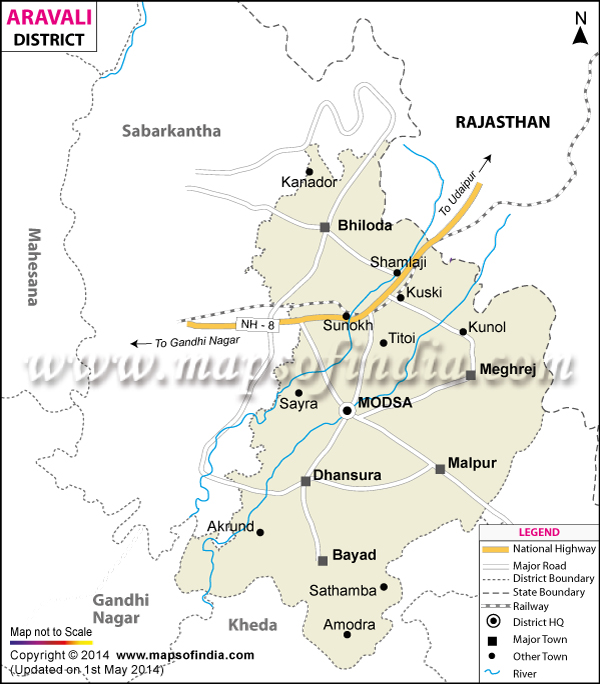
Aravalli district is divided into six talukas - Modasa, Malpur, Meghraj, Bhiloda, Bayad, and Dhansura. Governance functions operate distinctly in each zone, supported through designated offices located across these regions. Educational institutions appear throughout, placed so access remains possible regardless of distance. Medical aid exists nearby, embedded within community frameworks. Services extend outward, reaching settlements that lie far from central hubs.
Spread across the region are 676 villages, every one operating under a local panchayat structure that mirrors Gujarat’s approach to distributed authority. Found mainly near wooded areas or elevated terrain, these settlements tend to be modest in size. Residing within them are indigenous groups whose livelihoods depend largely on farming, forest resources, and handmade goods.
Within Modasa, serving as the central hub, sit the Collector’s office, judicial buildings, and principal public bodies. Bayad along with Bhiloda stand noted not for size but heritage depth and long-standing traditions. From this setup flows coordination of initiatives - those tied to growth, citizen support, and physical networks alike.
| Facts of Aravalli District | |
|---|---|
| Official Name | Aravalli |
| Location | North Gujarat |
| Area (km2) | 3308 |
| Population | 1039918 |
| Language | Gujarati |
FAQs
Q1: What is the total number of villages in the Aravalli district?
There are a total of 676 villages in the district divided among six talukas.
Q2: What is the total population of the Aravalli district?
The district caters to around 1.05 million individuals.
Q3: What is the district known for?
Shamlaji Temple, tribal heritage, and the beautiful views of the Aravalli Hills are some of the popular spots in the district.
Last Updated on : July 13, 2026
