






About
Found within the Saurashtra peninsula of Gujarat, the district stands as a place deeply rooted in history and tradition across western India. “Junagadh” means “Old Fort,” named after the enduring Uperkot structure, present for over twenty centuries, marking time through stone and memory. At its core lies the town, serving as administrative center, nestled where land meets the slopes of Girnar hills - held holy by both Hindu and Jain followers.
Famous as it may be, Junagadh holds something rare: wild lions living where they belong - inside Gir National Park. Not many places on Earth offer that sight. Rising nearby, Girnar Hills carry silence broken by footsteps of pilgrims climbing toward ancient temples. These peaks do not speak, yet their presence tells long stories. Agriculture shapes life here, with orchards stretching far under hot sun. One fruit stands apart - the Kesar mango, noted for taste so special it carries an official mark across borders. Sweetness travels farther than people think, reaching shelves overseas without fanfare. Wild animals roam, believers climb, farmers harvest; each part fits like stone in the wall. Few regions balance nature, faith, and farming quite this way.
Monuments remain, not as relics alone, but as markers of evolving influence. Coexistence defines modern Junagadh: ancient sites neighboring advancing infrastructure without conflict. Visitors encounter spiritual spaces alongside forests teeming with animal presence. Residents live within layers, where daily routines unfold beneath historic shadows. Rather than merely marking territory on a map, this place holds memory in stone, ritual, and landscape. Resilience shows not through statements, but in continuity across centuries. Diversity appears quietly - in speech patterns, building forms, seasonal celebrations. Pride exists absent fanfare, rooted instead in unbroken presence. What emerges is less a city, more an open archive where time accumulates rather than fades.
History and Culture
The history of Junagadh unfolds through successive reigns that shaped its traditions. Under the Mauryans, one of the first ruling powers, construction began on Uperkot Fort circa 319 BCE by Chandragupta. Inscriptions carved into stone near this site emerged later - fourteen decrees placed there by Ashoka, grandson of the founder, expressing principles tied to Buddhism and state conduct. Rule shifted afterward, arrival of the Kalingas marking a new phase before their decline. Power then passed to the Maitrakas whose presence endured from 475 until 767 CE.
During the Middle Ages, it entered the Mughal domain by way of conquest in 1573; governance later shifted when local rulers known as Nawabs assumed control nearly two centuries afterward. Architectural legacies emerged under these leaders - among them, the Mahabat Maqbara, where elements of Gothic design merge with traditional Indo-Islamic forms. Though operating beneath British oversight beginning in 1807, the region retained self-rule in name only until the mid-twentieth century. After colonial withdrawal, an accession attempt favoring Pakistan failed to hold, resulting instead in inclusion within Indian territory five years after independence.
Economy
The economy in Junagadh spreads across farming, manufacturing, and service work. Farming holds central importance here; groundnut, cotton, wheat, alongside mangoes dominate what is grown. Known widely is the Kesar mango - this region’s specialty - a type granted geographical indication status due to distinct taste and scent, shipped beyond national borders. Because of rich land and suitable weather patterns, growing fruits and flowers thrives, positioning the area within reach of new methods in crop development.
Along the Arabian Sea coastline, fishing provides income, where places like Veraval and Mangrol stand out as key hubs. Instead of individual effort, shared structures such as cooperatives and government-backed ventures shape work in milk production, fish handling, and farm-based manufacturing. Textile looms, handmade items, and preparing food form part of local industry; meanwhile, bigger operations turn toward making cement, chemical products, and machinery parts.
Steady expansion marks the services industry, where tourism, education, and health stand out through quiet momentum. International travelers arrive at Gir National Park, lifting demand across lodging and related fields. From Junagadh Agricultural University to smaller learning centers, knowledge hubs shape expertise alongside inquiry. Medical access reaches town and village alike, supported by clinics and hospitals working without fanfare. Administrative units operate behind policy, guiding public efforts with structured oversight.
Tourism
Hidden among Gujarat's quiet landscapes, it draws visitors with ancient temples, wild spaces, and deep-rooted history. Not far from the city, Gir National Park stands apart - home to the last surviving population of Asiatic lions in the world. Those who study animals or simply love nature arrive here throughout the year, guided by silence and stillness. Movement flickers at dawn: shadows of leopards slip through trees, herds cross open land, wings cut air without sound. Birdsong fills gaps between moments, stitching together an ecosystem few places can match.
Sacred status draws many toward the Girnar Hills, a place held deep in tradition. Reaching shrines such as Amba Mata Temple requires climbing countless stone stairs, one after another. Among these, Jain Derasar stands quietly amid steep paths and shifting light. Each year, followers walk around the entire mountain during Girnar Parikrama, step by deliberate step. Devotion marks every turn of this journey, slow and steady under open sky.
Inside Uperkot Fort, layers of time unfold across two millennia. Stone by stone, centuries speak through caves carved for quiet reflection. Water once gathered deep within stepped wells, shaped by hands long gone. Cannons rest where battles were planned under open skies. Elsewhere, Mahabat Maqbara rises - not with noise, but with balance - blending arches and domes in silent harmony. Traces of rule linger here, held within walls that remember nobility.
Somewhere beyond the city limits sits Somnath Temple, technically in Gir Somnath yet woven into Junagadh’s cultural thread. Along the shore, quiet spaces appear at Shil Beach and Chorwad - places set apart by calm. Inside town, museums stand beside bustling market lanes, each revealing fragments of daily rhythms and history. Because wild habitats exist near sacred trails, travel here moves between stillness and motion. Uncommon but clear, that mix shapes what visitors find across Gujarat’s landscape.
Demography
With data from the 2011 Census, Junagadh district records a population of 1,525,605 individuals across its area. Spread over each square kilometer, nearly 300 people reside on average within this region. Despite variation in access, education shows improvement through measurable outcomes like a 76.88% literacy rate. Learning opportunities exist where schools and colleges contribute quietly to long-term growth.
Spoken most often, Gujarati stands first among languages here; meanwhile, officials rely on Hindi along with English within schools and government offices. Hindus live alongside Muslims and Jains, their presence shaping layers of local tradition. From one festival to another, shared customs emerge - peace forms slowly through daily exchanges, not grand declarations. Together, differences blend without force, visible in both worship and ordinary routines.
Administration
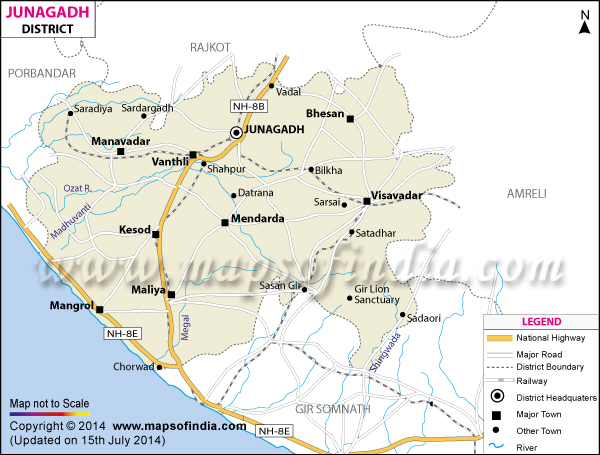
Within the district lie multiple tehsils - Junagadh, Visavadar, Manavadar, Bhesan, Malia Hatina among them. Over a thousand settlements dot its landscape, serving as foundational units of public order. Leadership rests with the Collector, assisted through coordination between revenue and development wings. At village level, governance flows via Panchayati Raj systems; cities rely on municipal structures instead. Preservation of cultural character shapes planning, even as forward movement takes place. Progress moves alongside tradition, neither overriding the other.
Overseeing duties like public safety, tax processes, and rollout of national and regional initiatives falls mainly on the District Collector. Beyond supervision, shaping local growth plans forms part of their responsibility. Disaster response coordination emerges as another key function woven into routine tasks. Balancing relations across differing socioeconomic layers becomes necessary work amid shifting local dynamics. Beneath this leadership operate Sub-Divisional Magistrates, Deputy Collectors, along with heads overseeing sectors like agriculture, education, health, and rural development. From their combined efforts emerges a structure of distinct functions enabling governance to progress through alignment and consistent procedure.
Split into multiple talukas - Junagadh, Visavadar, Manavadar, Bhesan, Malia Hatina, Keshod, Mangrol, and Vanthali - the region organizes its administration through these units. Oversight falls to a Mamlatdar in each area, guiding operations tied to land documentation, revenue collection, along with execution of state programs locally. From village needs up to district decisions, coordination happens mainly here. Where policies meet real-world application, these subdivisions make implementation possible.
Spread across the District, over nine hundred villages form the backbone of its administrative reach below the taluka level. Governance here operates through locally chosen bodies known as Gram Panchayats. Though small in size, these councils carry real authority under India’s three-tiered rural self-governance model. Decisions on basic services emerge from within the community rather than being handed down. Access to safe water, sanitation systems, road conditions - each falls under village-level oversight.
The city along with smaller towns including Keshod falls under municipal management responsible for public services, development projects, and layout of urban spaces. Because Mangrol lies near the sea, its economy relies heavily on fishing and seafaring tasks - this demands tailored administrative approaches. Governance here mixes top-down control with grassroots input so responses stay practical yet flexible. District supervision works alongside community involvement at the village level; because of this pairing, old customs coexist with current needs. Progress moves forward without ignoring distinct regional traits.
| Facts of Junagadh District | |
|---|---|
| Official Name | Junagadh |
| Location | Western Gujarat |
| Area (km2) | 5093.36 |
| Population | 1527329 |
| Language | Gujarati, Hindi, English |
FAQs
Q1: Where is Junagadh district located?
Junagadh is in the Saurashtra area of western Gujarat. It is near the Arabian Sea and surrounded by hills, forests and fertile farmland.
Q2: Which fruit does Junagadh produce the most?
Junagadh is a very large producer of Kesar mangoes. Their flavour and aroma which is very rich has brought them to the notice of people in India and also in the international market.
Q3: In Junagadh what is the primary occupation?
Agrarian based economy is the main focus in many parts of the district. Also we see that which goes into the local economy is farming, animal husbandry, tourism, and small industries.
Q4: What is the best time to visit Junagadh?
Between October and March is the best time which you’ll enjoy. The weather is great for sightseeing.
Q5: Does Junagadh have historical importance?
In the past several dynasties have ruled the district which includes the Mauryas, the Mughals and the Nawabs. Also its monuments and inscriptions tell a history of over two thousand years.
Q6: What does Ashoka's Rock Edicts represent?
Ashoka’s rock edicts in Junagadh are what many of India’s historical inscriptions are made of. These note out in detail Emperor Ashoka’s rules as well as how Buddhism was introduced by him.
Q7: Why is Uperkot Fort famous?
Uperkot Fort has withstood for over 2,000 years and is a testament to the area’s rich past. Within the fort are ancient caves, wells, and old defensive structures.
Last Updated on : July 14, 2026
