


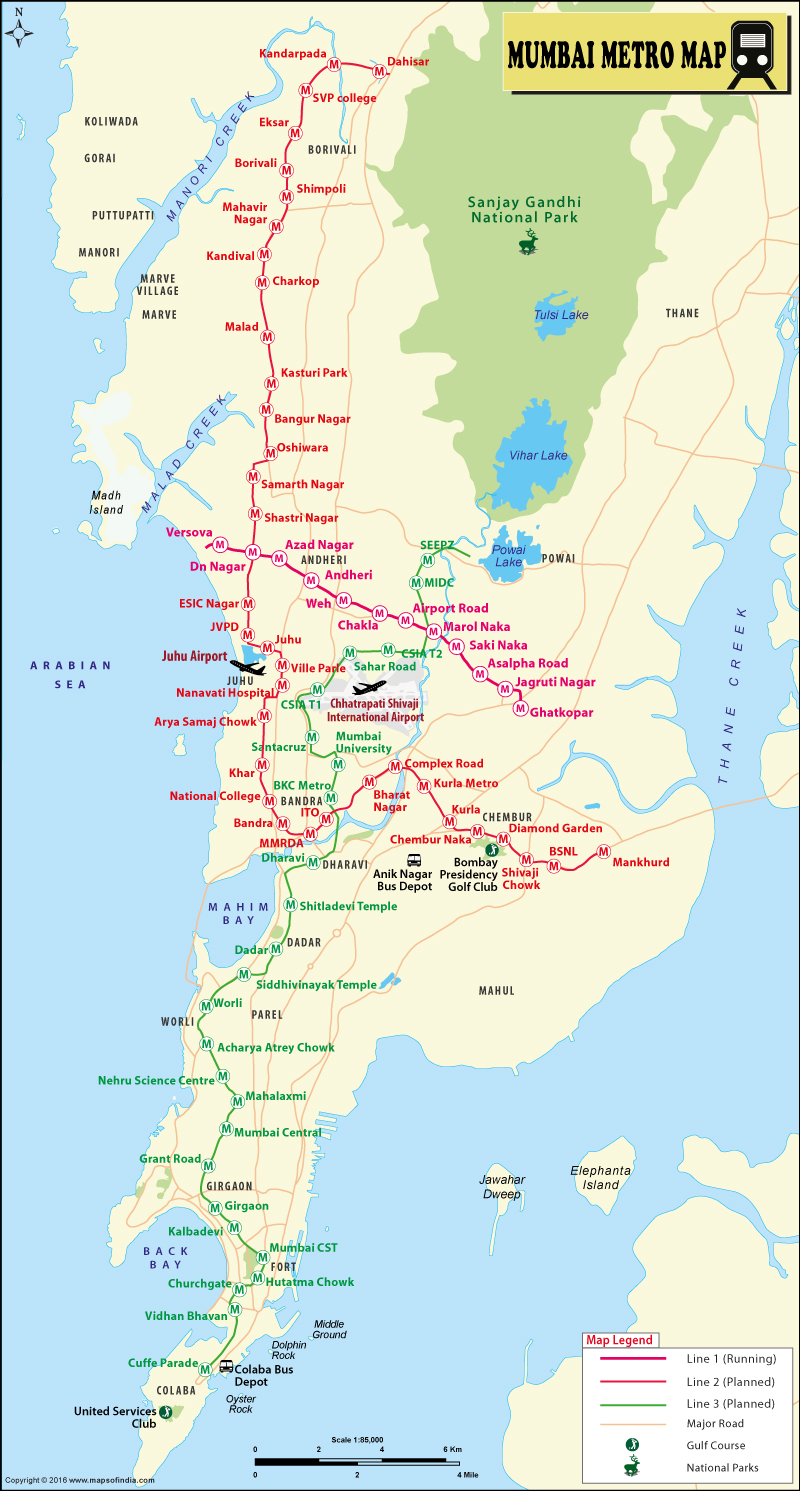





Metro service is available for the general public every day from 6 am to 10 pm. According to MMRDA commissioner SVR Srinivas, around 60 CCTV cameras have been installed at each station, the footage of which will be provided directly to the police. MMRDA has said to start service on the remaining route of Metro-7 and Metro 2A in the next six months.
Mumbai Metro Timings
The frequency of Mumbai Metro Trains on Weekdays (Monday to Saturday) will be 4 minutes at peak hours while in non-peak hours it is 8 minutes. On Sundays or Public holiday the frequency of each metro is 8 minutes.
- The first train will start from Versova at 05:20 hrs and Ghatkopar at 05:29 hrs.
- The last train from Versova will leave at 23:20 hrs.
- The last train from Ghatkopar will leave at 23:46 hrs.
About the Mumbai Metro
In Mumbai, the financial capital of India, the existing suburban rail system was under extreme pressure; more than 11 million people travel by public transport daily. Due to the practical constraints in expanding the existing road and rail networks many pockets in the suburbs and the Island city could not be connected by a rail-based transport system. To improve the traffic and transportation scenario in Mumbai Metropolitan Region (MMR), the Mumbai Metropolitan Region Development Authority in conjunction with Delhi Metro Rail Corporation (DMRC) prepared the Master Plan for Mumbai Metro. Priority was given to the areas that were not connected by existing Suburban Rail System. Metro would provide interchange facilities for connecting neighbouring areas like Thane, Navi Mumbai, Vasai, Virar etc.
The long wait of the commuters of Mumbai for the much-needed relief came to an end with the launch of the metro line in the city. The Mumbai metro service was launched in the city on 8 June 2014, around 10:10 in the morning. It was flagged off by the Chief Minister of Maharashtra Prithviraj Chavan at the Versova station. The chief minister took a ride from Versova to Ghatkopar (Line 1) in the metro. Also, ADAG Chairman Anil Ambani and his wife Tina Ambani were present at the inauguration. The line became functional for the common public at 1 p.m.
With the beginning of the metro line in the city, Mumbai has entered the list of cities having metro rail services in the country. The cities already existing on the list are Kolkata, Delhi and Bangalore.
The Mumbaikars have begun to enjoy the convenience of the metro train. However, as far as the fares go, the public will feel the pinch on account of a recent court ruling. The ruling settles the dispute between the Maharashtra government and Reliance Infrastructure, allowing the latter to implement its fare structure. This increase is expected as the project cost has jumped a whopping 70% from its initial estimates.
According to the Mumbai Metro officials, the metro service has been started for the public only after thorough trial runs. A welcome innovation in the Mumbai Metro has been the introduction of "influence zones" aimed at reducing congestion during peak hours; under this provision, the area within 100 metres of the metro stations will be banned for hawkers and other encroachment.
- Mumbai Metro Line 1 (Versova-Andheri-Ghatkopar) is an 11.40 km elevated corridor providing connectivity between Eastern and Western suburbs to Central Railway. It facilitates a smooth interchange - at Andheri and Ghatkopar Stations - between the suburban rail system and MRT System thus reducing current travel time by more than 40 minutes.
- Mumbai Metro Line 2A (DAHISAR-D.N.NAGAR) is 18.589 km. long elevated corridor with 17 stations providing interconnectivity among the existing Western Express Highway, Western Railway, Metro Line 1 (Ghatkopar to Versova), Metro Line 2B (D.N.Nagar to Mandale - ongoing), Metro Line 7 (Andheri (E) to Dahisar (E)) and Metro Line 6 (Swami Samarth Nagar to Vikhroli - proposed). The interchange stations at Dahisar and D.N.Nagar provide inter-connectivity between Western, Central and Northern suburban Mumbai reducing up to 70% of the current travel time.
- Mumbai Metro Line 2B (D.N.NAGAR-MANDALE) is 23.643 km. long elevated corridor and has 22 stations connecting the existing Western Express Highway, Eastern Express Highway, Western Railway, Central Railway, Mono Rail, Metro Line 1 (Ghatkopar to Versova), Metro Line 2A (Dahisar to D.N.Nagar), Metro Line 3 (Colaba to SEEPZ - under implementation) and Metro Line 4 (Wadala to Kasarvadavali). It will also provide connectivity between Eastern and Western Suburban Mumbai reducing the current travel time considerably.
- Mumbai Metro Line 3 Also known as Aqua Line, Mumbai Metro Line 3 is completely underground and covers the distance between Cuffe Parade in South Mumbai and Seepz and Aarey in North Mumbai. The route will also pass through Mumbai airport which will further boost connectivity in the region. The total cost of construction of this route is Rs 23,136 crore.
- Mumbai Metro Line 4 (WADALA-KASARVADAVALI) is 32.32 km. long elevated corridor with 32 stations to interconnect the existing Eastern Express Roadway, Central Railway, Mono Rail, Metro Line 2B (D.N.Nagar to Mandale - ongoing), Metro Line 5 (Thane to Kalyan - proposed), Metro Line 6 (Swami Samarth Nagar to Vikhroli - proposed) and Metro Line 8 (Wadala to General Post Office) reducing the current travel time to up to 75%.
- Metro line 5 The 24-km-long Thane-Bhiwandi-Kalyan Metro-5 corridor, also known as the Orange Line, was built for Rs 8,416 crore, and it has 17 stations. The Metro-5 corridor eventually connects with the Metro-4 line of Wadala-Thane-Kasarvadavali and the Metro-11 corridor between Taloja and Kalyan.
- Metro line 6 Also known as the Pink Line, this route will connect the western suburbs with the eastern ones and will be the second west-east metro corridor after the already operational Versova-Andheri-Ghatkopar section. This 14.5 km long route will have 13 stations.
- Mumbai Metro Line 7 (ANDHERI EAST - DAHISAR EAST) is 16.475 km. long elevated corridor with 13 stations inter-connecting the existing Western Express Highway, Western Railway, Metro Line 1 (Ghatkopar to Versova), Metro Line 2A (Dahisar to D.N.Nagar -ongoing) and Metro Line 6 (Swami Samarth Nagar to Vikhroli - proposed). Interchange facility with the suburban rail system and MRT is at Andheri, JVLR and Dahisar. Apart from connecting Central Mumbai and Northern suburban Mumbai, this corridor would provide rail based access to the Mumbai International Airport (CSIA).
- Mumbai Trans Harbour MetroLink (MTHL) corridor has been planned by MMRDA from Prabhadevi to Sewri moving further to the Mainland through Navi Mumbai on the Panvel-Pen section. This link will accelerate development on the mainland and also facilitate the decongestion of other transport systems.
How the need for Mumbai Metro System was realized?
The Maharashtra government was looking for means to better the traffic and transportation scene in Mumbai. The government wanted to come up with something that would meet the future travel needs of the commuters well. It was this exploration of ideas that brought various options for the mass transit system into the picture. A detailed study was done in this area under the guidance of Indo-German Technical Co-operation by assigning the consultancy work to TEWET in alliance with DE-Consult and TCS in the year 1997-2000. A mass transit passage from Andheri to Ghatkopar was recommended in the study. Meanwhile, DMRC (Delhi Metro Rail Corporation) chalked out the master plan for the Mumbai metro, suggesting an extension of the Andheri-Ghatkopar route to Versova. Subsequently, the construction work of the metro system in Mumbai gained pace and was performed under the Public-Private Partnership (PPP) format.
Why is Metro Rail in Mumbai needed?
The Metro system is much preferred in any city for its high-capacity and attractive features. Metro trains move fast and are environment-friendly; they also offer excellent financial viability.
However, if considered from the point of view of Mumbai, the metro system is/ was much needed for the following reasons:
- Several pockets in the city and its suburban areas are not connected by the rail-based mass transit system
- For the protection of the environment
- Limitations that are faced in the expansion of the road network
- Present rail and road scenario not apt for future travel needs
- The role of the bus system is limited in the area of offering feeder services to railways
- Bus network alone cannot match the future travel demands
Features of Mumbai Metro Rail
About six decades ago, trams were used for travelling in Mumbai, as the number of passengers increased, trams were replaced by BEST buses. When buses started falling short, local trains became the lifeline of Mumbai. Now the government is providing a new option of travel to the people by laying a 337 km long metro network in MMR. The service was started on the 20 km route of Metro-7 and Metro-2A corridors. In the next 6 months, instead of 20 km, the metro will run in an area of 34 km.
Some of the attractive and technical features of the Mumbai metro system are mentioned below:
- Four or Six Coaches
- Capacity of 2,300 travellers
- Resernative breaking
- Made of stainless steel
- Runs on 25,000 Volt
- Women safety
- Single class
- Air conditioned
- 80 mph maximum speed
- 33 kmph average speed
- m/sec2 acceleration
- 1.2 m/sec2 deceleration
- 1500 accommodation capacity
- 60,000 system capacity
- Automatic Ticket Collection
- Train control with Driver
- Operation Control Centre
- Closed Circuit Television
- Dynamic visual displays and loudspeakers
- Routes shown on Mumbai Metro Map
- Versova-Andheri-Ghatkopar
- Dahisar-Charkop-Andheri
- Colaba-Bandra-SEEPZ
- Wadala-Mulund-Kasarvadavali
- Kasarvadavali-Gamukhi
- Thane-Bhiwandi-Kalyan
- Lokhandwala-Jogeshwari-Kanjurmarg
- Dahisar East - Bandra East
- Andheri-Mumbai Airport
- Mumbai Airport- Navi Mumbai Airport
- Dahisar East - Mira Bhayandar
- Gaimukh-Shivaji Chowk
- Wadala-CSMT
- Kalyan-Dombivli-Taloja
- Mira Bhayandar-Virar
- Kanjurmarg-Badlapur
| Blogs on Mumbai Metro |
| Comfortable And Swanky Mumbai Metro |
Last Updated on : June 17, 2026
|
|
