




Introduction
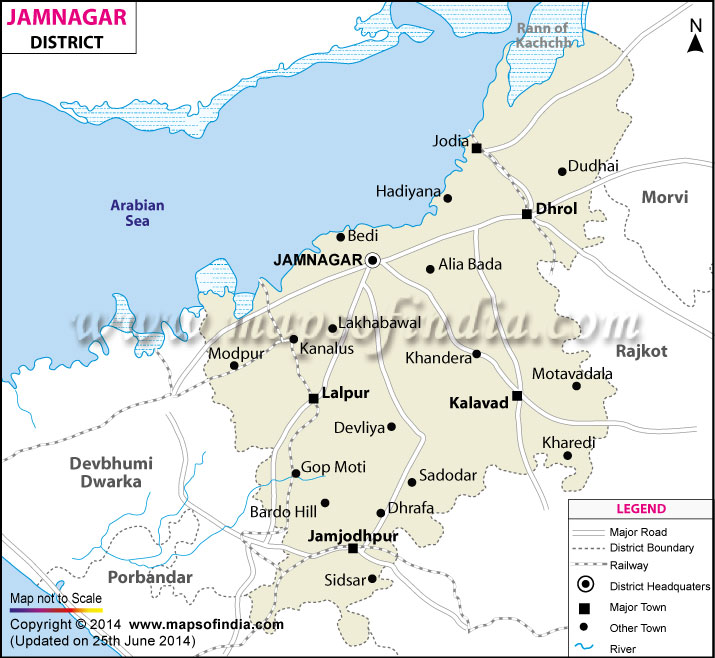
The Jamnagar district is a significant administrative and cultural area situated on the western side of the Gujarat Indian state. The district is located close to the Arabian Coast, which used to be a big center in the sea trades, interchange and administration. It is found on the Saurashtra peninsula and this aspect has contributed to its economic and social growth over the course of centuries.
In the past, the region grew as a strategic settlement due to its closeness to sea ways of trade. The traders, artisans and travelers going through the peninsula of Saurashtra helped to shape up markets and towns in the district. Fishing, salt production, and trade were some of the economic activities that were supported by the presence of natural resources and accessibility of the sea.
The district has in recent times become well known in the development of its industrial activities, such as petroleum refining, brass parts manufacturing, and sea industries. The growth in population in urban areas, better infrastructure and schools and colleges have only added to the economic and social environment of the area.
Although there are modern developments, the district has a close relation to its past. The historic structures and contemporary industries form a significant portion of the cultural and economic fabric of Gujarat as a whole since they coexist.
History
Jamnagar district history is very much related to the political and cultural history of Saurashtra region. The first communities to settle in the region did so because of water availability, good farmland, and the fact that they were along international trade routes leading to both the Middle East and the African regions by sea.
Jam Rawal of the Jadeja clan established a modern city of Jamnagar in the sixteenth century. He made it his capital in the princely state of Nawanagar. The foundation of this capital also became an important turning point in the political history of the area.
The Jadeja dynasty brought economic developments and political stability in the region. The rulers erected forts, temples and buildings which served as defensive and cultural structures. Growth of trade and craft was good, which attracted merchants and artisans to the developing urban center.
The Nawanagar rulers had also established some level of political association with the Mughal rule. As long as the region was under the local rulers, it was influenced by the Mughals in some areas of its governance, trade, as well as diplomacy.
The princely state retained its political power and was in contact with the regional powers and colonial governments in the eighteenth and nineteenth centuries. When the British Raj took over much of the Indian subcontinent under its control Nawanagar remained a princely state, subject to the indirect control of the British.
Amongst the most outstanding leaders that are linked to the state was Ranjitsinhji that reigned in the late nineteenth and early twentieth century. He had a great reputation as not only an accomplished ruler but an accomplished cricketer serving England. The princely state became known around the world through his efforts.
The Nawanagar princely state was incorporated into the Indian Union after the independence of India in 1947. The current district of the state of Gujarat was formed in the long run as a result of administrative rearrangement as the reorganization of states occurred in the year 1960.
The district has been experiencing a high level of industrial, infrastructural and educational development since independence. The economic environment of the region has been altered by the development of petroleum refining and port infrastructure, as well as creation of manufacturing plants, still retaining its historical heritage.
Culture
Cultural traditions in Jamnagar district are representative of a larger cultural heritage of the Saurashtra region as well as the cultural impacts of several centuries of trade and migration. The basic cultural aspects such as festivals, religion, traditional arts, and food also make the district rich in culture.
Navratri is one of the most significant events that are observed in the district as part of the culture. The traditional dances that are practiced during this festival include Garba and Dandiya Raas. Massive crowds are gathered in open areas where they listen to music, wear vibrant colors and engage the community in the festivities.
The other big festival that is held in the area is Janmashtami which is the birth of Lord Krishna. Temples and houses are illuminated with lights and flowers and bhajans and shows are arranged in honor of the event.
There is also a high craftsmanship culture in the district. There are also local artisans who make brass items, embroidery(Bandhani), and decorative textiles, as a representation of the artistic heritage of the area. Brass products produced in the district have high recognition and they are exported to other parts of India and to other countries too.
The cuisine in the area displays the taste of the traditional Gujarati cuisine. Food such as dhokla, thepla, undhiyu and khichdi are customarily served. A lot of these foods are a blend of sweet dishes and spicy as well as savory, thus typical of Gujarati food. The market of street foods is very diverse with various snacks and candies being consumed by the locals and tourists.
Cultural identity of the district is also reflected in religious sites. The most renowned temple in the area is the Bala Hanuman Temple wherein constant recitation of the Ram Dhun prayer has been going on without stopping for decades. This special tradition has been able to bring tourists from across the country.
Cultural programs that are arranged by local institutions and community groups enable the music, dance, and folk traditions to thrive.
Language
The Saurashtra region promotes language diversity which is shown in the language in Jamnagar district. Most people who live there speak the Gujarati language, both in their everyday communication and education systems and in the local government. The Gujarati literature, poems and folk songs are a significant element of the cultural heritage of the district.
The Hindi language is also extensively spoken and comprehended in the district. Due to the attraction of workers, traders and visitors to the region, Hindi is widely spoken in the region hence, serves as a connecting language that is used by people of varied origins.
English is also becoming a vital tool in the educational system, business and administration. Not only are a large number of schools and colleges teaching English, but it is also widely spoken in working and business situations. This has led to a large number of youth within the district being proficient in English, Gujarati and Hindi.
Some communities speak Urdu and this has been part of the literary heritage of the place. The Urdu verses and culture have traditionally been incorporated in the artistic and literary practices in some of the regions in Gujarat.
The presence of different languages has resulted in the development of a multilingual environment where individuals are likely to change languages at various moments based on the environment. Market, office and school conversations are usually characterized by a combination of Gujarati, Hindi and English. This language variety indicates the historical and cultural interaction of this district as a trading point.
Geography
Jamnagar district has the geography that is formed by the coastal location and the distinctive terrain of Saurashtra peninsula. The district borders the Arabian Sea which has in the past been an essential source of fishing, marine trade and coastal settlement.
The fact that the region is near the Marine National Park is one of the most outstanding geographical characteristics of the area. It is the first marine national park in India and has been known to harbor a great biodiversity of marine creatures such as coral reefs, mangroves and also different kinds of marine life. Researchers, environmentalists, as well as marine eco-tourists, find the park to be attractive.
The physical environment of the district comprises primarily coastal plains with a few inland slightly elevated plains. These plains are extensively used in farming in the rural areas of the district. The farmers grow groundnuts, cotton and millet crops since they rely on prevailing rainfall and availability of irrigation.
The climate of the area is mostly semi-arid. Summers are hot and dry and the temperatures become very high in the months of April and May. Between June and September, there is the monsoon season that irrigates the food crops and restores the local water supplies. Winters are not that harsh and are fairly pleasant.
Other features of the geography of the district are water bodies like lakes and reservoirs. Lakhota Lake is very famous and is situated in the middle of the city. The lake is not only a picturesque feature of the urban landscape but also has a contribution to tourism and the environment.
The past decades have witnessed a tremendous growth in urban development on the basis of increase in industrial growth and population. The landscape of the district has changed in reference to industrial complexes, residential areas, and transport infrastructure. Although this has changed, the rural society continues with their agricultural production and traditional ways of life.
FAQs
Q1: What does Jamnagar have to offer in present times?
The district is home to the large scale brass manufacturing which is very much a recognized element of the area, also we see in this district one of the world’s largest oil refineries, also there is the Marine National Park, and the non stop Ram Dhun at Bala Hanuman Temple.
Q2: What makes the Marine National Park special?
In the Gulf of Kutch which saw the establishment of India’s first Marine National Park. We see visitors coming to view the coral reefs, the mangrove forests, a great array of colorful marine life, dolphins and also a large variety of migratory birds.
Q3: What makes Bala Hanuman Temple unique?
The temple is known in India for its unbroken recitation of “Ram Dhun” which has been going on for over 50 years. Also this great tradition has won international acclaim.
Q4: Why do we refer to Jamnagar as the Brass City?
In many years of operation the district’s workshops which are mostly small and medium in size have been producing precision brass components for use in many industries. Our district has a very good name for quality brass products.
Q5: Which language do people in Jamnagar speak?
Gujarati is the main language of the local people. In terms of which is known across the board Hindi is very much the language which is put forward, we also see English in use in schools, businesses, hotels, and government offices.
Q6: Is Jamnagar only an industrial city?
Certainly. Though a large industrial center the district also has in it a great cultural heritage, quiet lakes, religious sites, coastal ecosystems, and many natural attractions.
Q7: What has Jamnagar transformed into over the years?
While the district has become a major player in terms of refining, manufacturing and trade it has also been successful in preserving its past through its historic sites, traditional trades, and cultural events in the face of modern growth.
Last Updated on : July 14, 2026
