








About
Older than most modern records show, Madurai stands firm as Tamil Nadu's beating cultural heart. Along the Vaigai River it rests, landlocked yet alive with rhythm passed down generations. South-central in placement, the city finds itself cradled by ancient rises - Anaimalai, Pasumalai, Nagamalai - each shaping its terrain like quiet guardians. Distance-wise, nearly 460 kilometers separate it from Chennai, a distance that does little to weaken the connection. Southern districts lean on it daily - not just for trade but movement, routes, lifeblood. From these hills outward, influence flows without pause.
Sweetness lingers in the name Madurai, shaped by old tales told through generations. It likely comes from the Tamil term "Madhuram," meaning exactly that - sweetness. In sacred stories tied to Hindu belief, King Kulasekara Pandyan once cut down woodland to make space for a new town. At that moment, Shiva revealed himself, offering favor from the tangled hair on his head - drops of immortal syrup falling like rain. Overcome by what he witnessed, the ruler called the place Madhurapuri, a title later worn lightly as Madurai.
History & Culture
Madurai's past stretches deep through time, anchored as the ruling center of the Pandyan Dynasty. Known beyond India, writers such as Megasthenes and Strabo mentioned it, describing a thriving city linked to Mediterranean markets by the cloth and pearl trade. Far from mere politics, its cultural life pulsed around the Tamil Sangam: gatherings where bards and thinkers shaped early masterpieces of Tamil writing. Royal support flowed consistently from Pandyan rulers into these scholarly circles.
Centuries passed before the Cholas lost hold, then came rule by the Madurai Sultanate, followed later by dominance from the Vijayanagara Empire. The 16th century arrived; soon after, architecture in Madurai began to flourish under the Nayak dynasty - especially during the reign of Thirumalai Nayak. His influence shaped much of the city's landscape, transforming earlier structures into grand stone edifices where life gathered anew.
Colonial times unfolded slowly, yet resistance took root firmly within this old town. British authority faced growing dissent here, nowhere more evident than in events tied to 1921. That year changed direction when Gandhi visited and stood among farmers laboring in sun-scorched fields. Moved beyond words at their resilience, he removed formal garments on site, embracing instead a humble cloth draped simply around his waist.
Outward from the temple, pathways spread - shaped much like a blooming lotus, giving Madurai its ancient form. At the heart stands Meenakshi Amman, around which daily life subtly bends. Celebrations peak with Chithirai, drawing vast crowds each spring to re-enact a sacred marriage. Instead of mere festivity, it becomes a pilgrimage, lasting weeks under warm skies. Bull taming finds a home here, too; Alanganallur hosts Jallikattu when harvest festivals arrive. Not spectacle alone, but heritage gripping close to identity. Meanwhile, night air fills with the scent of Madurai Malli, a bloom known far beyond state lines. Equally prized are Sungudi weaves, handcrafted with patterns passed across generations. Because of their roots in place and practice, both carry GI recognition - not as labels, but proof of origin.
Economy
Rooted in heritage tourism, Madurai's service sector strengthens an economy also shaped by robust manufacturing activity. Commercial retail holds strong here, supported alongside ongoing industrial growth. What emerges is a diverse urban economy where tradition feeds modern enterprise. Each part connects - yet functions apart - within the city’s broader financial landscape.
Government Sector
Among South India's key employers in law and governance stands the public sector. Located in Madurai is the Madurai Bench of the Madras High Court - this places the city at the center of justice for fifteen nearby southern districts. Public services stretch widely under district oversight, offering healthcare through large institutions like the Government Rajaji Hospital. Transportation infrastructure operates on a broad scale via TNSTC, managed by state authorities. Administrative offices spread across the region sustain numerous jobs, anchoring economic stability for many families.
Public Sector
Among the quiet rhythms of daily trade, state-run factories and financial institutions shape much of the local economy. Instead of private lenders, farmers growing jasmine often rely on national banking systems rooted in agricultural support. These include federally managed banks, smaller rural credit institutions, and long-standing mutual aid groups. From planting to weaving, money flows through these channels during key cycles of harvest and production.
Services Sector
Fueled by cultural significance and a tightly packed city layout, Madurai’s economy now grows mostly through service activities. While traditions draw attention, it is the concentration of people that keeps businesses active across sectors.
Madurai draws visitors year-round, fueling a steady income stream from heritage-focused travel services. Luxury accommodations thrive here, alongside smaller guesthouses rooted in local design. Tour companies organize visits to historic sites, shaping much of the city's service sector. Craft shops offering handmade goods line the streets near temples. This mix sustains jobs while preserving cultural practices across generations.
Out near Ilanthaikulum, a dedicated tech zone now hosts growing software firms, thanks to focused support from state authorities. Meanwhile, in Vadapalanji, another SEZ has taken root - drawing outside investment by offering structured infrastructure for digital services. Though separate, both locations form part of a broader shift toward technology-driven economic activity. Instead of generic industrial models, these zones target specific needs of global IT operations. Over time, they’ve become magnets for companies handling remote development and customer solutions.
Tourism
Standing at the heart of South Indian heritage, the Madurai district holds within it a rich blend of temples, ruins, and landscapes shaped by time. Central to its appeal lies the Meenakshi Amman Temple - world-renowned not only for its towering gopurams painted in bold hues but also for the forest of carved columns inside its famed hall. Rising just beyond, the 1600s-era Thirumalai Nayak Palace draws eyes with grand arches and stately domes because of how light dances across its pale stone during evening displays.
While some seek stories etched in architecture, others follow trails into recorded memory at the Gandhi Memorial Museum, where one fragile exhibit - a cloth marked by violence - speaks volumes about sacrifice. Elsewhere, near riverbeds once thought quiet, findings at the Keezhadi site reveal an advanced urban culture from antiquity through fragments buried long beneath soil.
Deep within the region’s heart rests Thirupparankundram Murugan Temple, carved directly into a solitary rocky hillside - an old sanctuary shaped from stone. Moving beyond it toward the upper reaches, green-topped Alagar Hills rise gently, cradling Kallazhagar Temple, where devotion to Lord Vishnu runs strong, alongside Pazhamudir Solai, a quiet stretch of woodland ideal for slow walks. Those drawn to nature paired with traces of distant times will find their way to Samanar Hills, known locally as Samanar Malai, where boulders frame a still lotus pool below, and pathways climb upward past relics - a cluster of Jain dwellings hollowed from living rock nearly two thousand two hundred years ago, etched now with fading scripts in early Tamil-Brahmi.
Not far off stands Yanaimalai, its form unmistakable, mimicking a resting beast; this safeguarded landmark also shelters antique cave shrines worn by time but not forgotten. Closer to urban lanes lies Vandiyur Mariamman Teppakulam, stretching wide across sixteen acres, centered on an isle planted thick with trees, offering calm space beside water - one last piece anchoring the area’s well-known stops.
Demographics
Deep within its streets, Madurai holds people shaped by city life, aware of heritage, able to read and write, tied closely to long-standing customs. Among those counted in the national headcount, Madurai district holds close to 3,038,252 residents. Though much of the region thrives on farming settlements, more than half now reside beyond open fields - about sixty-one percent dwell inside the active zones governed by the city corporation or nearby developed hubs. Life outside paved streets still shapes daily routines for thirty-nine out of every hundred people here.
Among Indian cities, Madurai stands out with a literacy rate of 81.66%, shaped by its long-standing role in education. Learning opportunities there support both men and women fairly well - males reach 87.82% literacy. Meanwhile, females achieve 75.54%, a figure that lines up closely with progress seen elsewhere worldwide.
Most people speak Tamil - it dominates daily life, rooted deeply through generations of written work. Over ninety-two percent grow up using it at home, shaped by an old literary form that stands out clearly. A notable number also use Telugu, brought here long ago when families moved under the Nayak rulers. In central neighborhoods, weaving groups keep Saurashtra alive, a northern-derived speech passed down carefully. Business areas lean on English and Hindi, common choices where trade happens regularly.
Administration
Madurai runs on a tight administrative framework, shaped by its sprawling growth and fast-paced industry. At the heart of governance sits the imposing District Collectorate building in the city - this is where oversight takes root. While scale demands order, much of the daily coordination flows through this central hub.
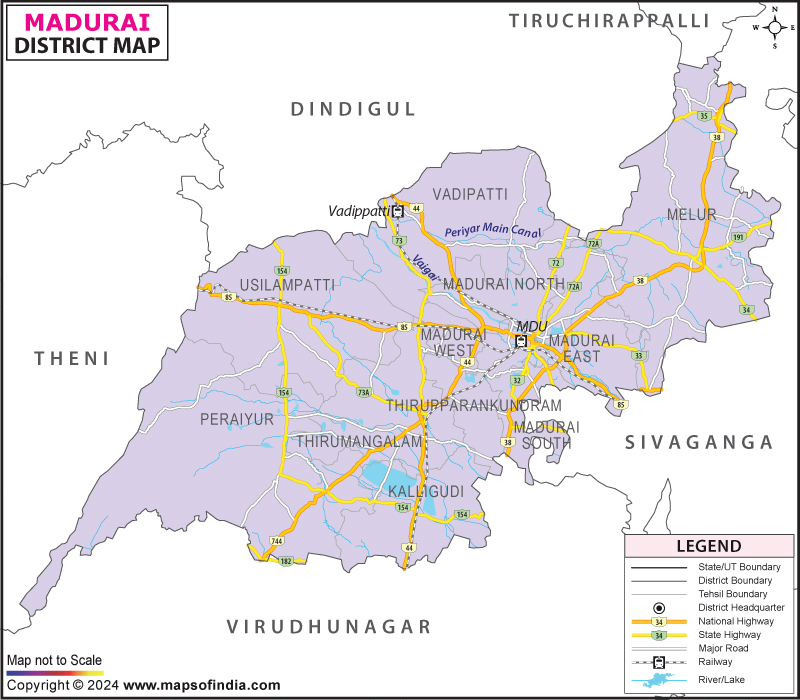
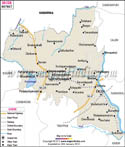
Four revenue units make up Madurai District: one carries the city’s name, while others go by Melur, Usilampatti, and Thirumangalam. Each of these splits into smaller zones called taluks, totaling eleven across the region. Names like Madurai North, West, East, and South mark parts of the core urban area. Then come Melur and Thirupparankundram, followed by Vadipatti, far from central hubs. Usilampatti stands both as a division and a taluk within its own block. Peraiyur appears toward the southeast, Kalligudi near it. One last piece, Thirumangalam taluk, ties back to its parent division at the northern edge.
Below the surface, 673 revenue villages form the foundation of land administration, each tracked and managed through systems led by the District Collector. Moving outward, rural progress unfolds across 13 community development blocks that bundle those settlements into 420 village panchayats. Meanwhile, towns operate differently - nine town panchayats take charge in smaller urban zones, backed by three municipalities guiding mid-sized centers.
| Facts of Madurai District | |
|---|---|
| Official Name | Madurai |
| Location | Tamil Nadu |
| Area | 3710 sq. km |
| Population | 3038252 |
| Language | Tamil |
FAQs
Q1: How many villages are located in the Madurai district?
There are 420 panchayat villages in this district.
Q2: What is the population of the district?
The population of the district is 3038252.
Q3: What is the district of Madurai most famous for?
Home to the grand Meenakshi Amman Temple - one of Dravidian design’s finest creations - Madurai draws worldwide attention. Not far behind in fame stands its bustling street food scene, alive at every hour, which helped earn it the name Thoonga Nagaram.
Last Updated on : July 16, 2025