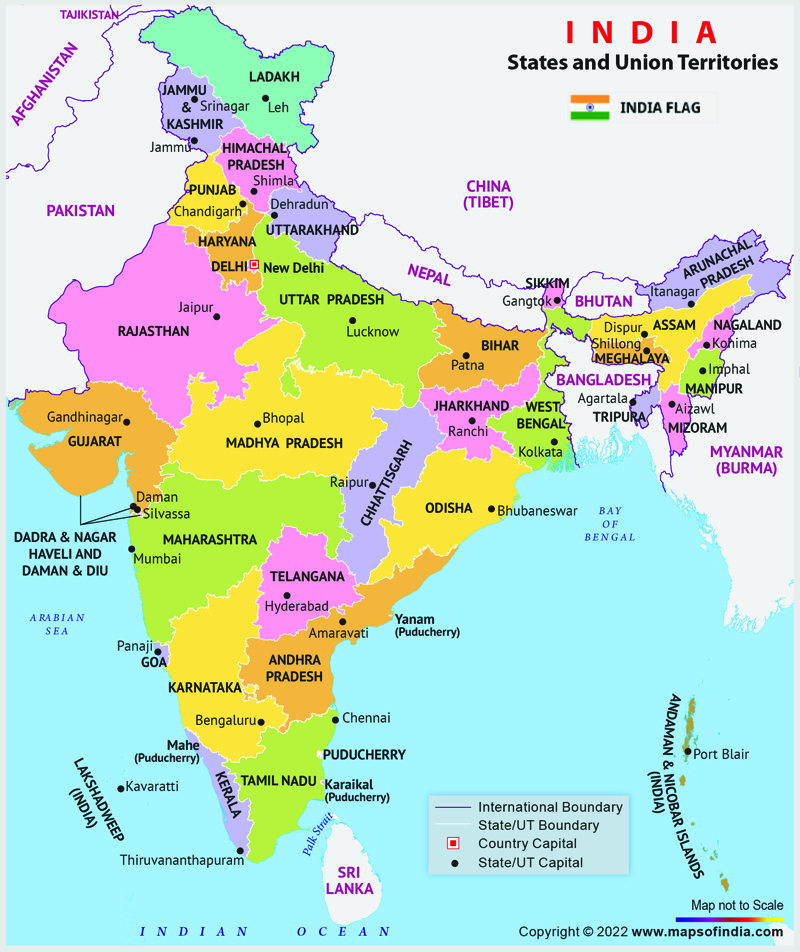







India is officially known as the Republic of India. It comprises a total of 28 states along with 8 union territories. India is the most populated country in the world and the world’s largest democracy. The country’s coastline measures 7,517 kilometres in length, out of which 5,423 kilometres belong to peninsular India, and 2,094 kilometres belong to Andaman, Nicobar and Lakshadweep island chains. Additionally, the Indian naval hydrographic charts along with mainland coastline include 43% of sandy beaches, 36% of mudflats, 10% of marshy shores, and 11% of rocky shores.
What is a Political Map of India?
The India political map is a geographical map of India that shows the administrative divisions of India and the capitals of all the states and union territories of India. A political map is used to show manmade boundaries, such as nations, states, and cities, and has political features like borders and boundaries. The map also shows the borders of India with its neighbouring countries, which can be helpful in understanding the administrative and geopolitical divisions of the country.
Political maps are extensively used in schools, colleges, government offices and competitive examinations as it helps the map user to locate administrative divisions swiftly and accurately.
States and Union Territories
India consists of 28 states and 8 union territories, each with its own administrative headquarters. The political map shows these divisions clearly with distinct political boundaries.
The India political map with states and capitals encourages users to find the following:
- Every state and its capital
- Every union territory and its capital
- Geographical location of each administrative region
- Relative position of neighbouring states
| Administrative Division | Capital |
|---|---|
| National Capital Territory of Delhi | New Delhi |
| Andhra Pradesh | Amaravati |
| Arunachal Pradesh | Itanagar |
| Assam | Dispur |
| Bihar | Patna |
| Chhattisgarh | Raipur |
| Goa | Panaji |
| Gujarat | Gandhinagar |
| Haryana | Chandigarh |
| Himachal Pradesh | Shimla |
| Jharkhand | Ranchi |
| Karnataka | Bengaluru |
| Kerala | Thiruvananthapuram |
| Madhya Pradesh | Bhopal |
| Maharashtra | Mumbai |
| Manipur | Imphal |
| Meghalaya | Shillong |
| Mizoram | Aizawl |
| Nagaland | Kohima |
| Odisha | Bhubaneswar |
| Punjab | Chandigarh |
| Rajasthan | Jaipur |
| Sikkim | Gangtok |
| Tamil Nadu | Chennai |
| Telangana | Hyderabad |
| Tripura | Agartala |
| Uttar Pradesh | Lucknow |
| Uttarakhand | Dehradun (Winter), Gairsain (Summer) |
| West Bengal | Kolkata |
Union Territory
| Union Territory | Capital |
|---|---|
| Andaman and Nicobar Islands | Port Blair |
| Chandigarh | Chandigarh |
| Dadra and Nagar Haveli and Daman and Diu | Daman |
| Jammu and Kashmir | Srinagar (Summer), Jammu (Winter) |
| Ladakh | Leh |
| Lakshadweep | Kavaratti |
| Puducherry | Puducherry |
Largest and Smallest States in India
The political map also helps users compare the size and location of India's states.
- Largest state by area: Rajasthan
- Smallest state by area: Goa
- Largest state by population: Uttar Pradesh
- Smallest state by population: Sikkim
Six Major Zones of India
Broadly, India is divided into six major geographical zones—North India, South India, East India, West India, Northeast India, and Central India. These regions are grouped based on their geographical location, cultural heritage, languages, and administrative characteristics.
East India comprises Bihar, Jharkhand, Odisha, and West Bengal, along with the Andaman and Nicobar Islands. It has a rich cultural heritage, fertile plains, and is a linguistically diverse area with numerous languages spoken, such as Bengali, Odia, Hindi, Maithili and Urdu.
West India includes the states of Gujarat, Maharashtra, and Goa, as well as the Union Territory of Dadra and Nagar Haveli and Daman and Diu. The region is home to the financial capital of India, Mumbai, and a significant trading, industrial, touristic and business hub.
North India consists of Himachal Pradesh, Punjab, Haryana, Rajasthan, Uttar Pradesh, and Uttarakhand, along with the Union Territories of Delhi, Chandigarh, Jammu and Kashmir, and Ladakh. The area is famous for the Himalayas, historic sites, arable lands, and big cities like New Delhi and Lucknow.
South India includes Andhra Pradesh, Karnataka, Kerala, Tamil Nadu, and Telangana, together with the Union Territories of Lakshadweep and Puducherry. It is known for its technological hubs, ancient temples, scenic coasts and vibrant culture. Bengaluru is sometimes called the "Silicon Valley" of India.
Northeast India comprises the Seven Sister States—Arunachal Pradesh, Assam, Manipur, Meghalaya, Mizoram, Nagaland, and Tripura—along with Sikkim. The area is known for its biodiversity, its distinctive tribal communities and its natural beauty, which is surrounded by hills and mountains.
Central India mainly includes Madhya Pradesh and Chhattisgarh. Located in the heart of the country, it is famous for its forests, wildlife reserves, mineral resources and rich historical and cultural heritage.
These six zones bring out the immense geographical diversity of India and explain regional features of the country in terms of the political map of India.
Difference Between Political Map and Physical Map
Although both political and physical maps represent geographical information, they serve different purposes and highlight different aspects of a region. A political map emphasizes political boundaries and features the states, UTs, districts, capitals of the state and country, etc. It is mainly employed in the comprehension of Governance, Administrative Boundaries and political regions and remains a vital tool for education, competitive exams and administrative reference.
On the other hand, a physical map shows how the land is shaped, including mountains, rivers, plateaus, plains, deserts and valleys. It does not show political borders but terrain and elevation, which enables the user to appreciate the topography and natural environment of the country. A physical map will give information about the various landforms of India, whereas a political map will give information about the administrative boundaries or divisions of India. These maps provide an all-round knowledge of the political and physical geography of India.
Uses of the India Political Map
The India political map is a very common map that is used in classrooms, for competitive exam preparations, travel and for research. Students use it to study the boundaries of the states and capitals; teachers use it as a visual teaching aid. Political maps are also used by government agencies, researchers, and planners for understanding the divisions of the government and regional planning. The map has been provided to enable travellers to get to know the state boundaries prior to travelling across the country.
Key Features of the India Political Map
The political map provides a comprehensive overview of India's administrative geography. Some of its important features include:
- Clearly defined state boundaries
- Union territory boundaries
- State and national capitals
- International borders
- Coastline along the Arabian Sea, Bay of Bengal, and Indian Ocean
- Andaman & Nicobar Islands and Lakshadweep
- Major neighbouring countries
- North direction and map scale for reference
Political Map of India with Capitals
The most useful feature of the political map is the identification of the centres of the states and the union territories. Capitals are the seats of government and key legislative functions of state governments.
By showing the capitals on the map, it aids the user in grasping the governance system of the country as well as enhances their knowledge of geography. It also helps students to learn to remember capitals through visual learning.
FAQs
Q1: What is a political map of India?
A political map of India shows the country's states, union territories, capitals, and international boundaries. It is used to understand India's administrative divisions.
Q2: Why is the India Political Map important?
It helps users understand India's administrative divisions, state boundaries, and the geographical location of states and union territories.
Q3: What is the difference between a political map and a physical map of India?
A political map focuses on administrative boundaries and capitals, while a physical map highlights natural features such as mountains, rivers, plateaus, and plains.
Q4: What are the major administrative divisions shown on the India Political Map?
The map shows states, union territories, state capitals, the national capital, and major cities.
Q5: How many states and union territories are in India in 2026?
As of 2026, India has 28 states and 8 union territories.
Q6: Can I download the political map in HD?
Yes, the India political map is available in high-definition (HD) and printable formats, making it suitable for educational, reference, and presentation purposes.
Q7: Which Indian state has the longest international border?
West Bengal shares a long international border with Bangladesh and is among the states with extensive international boundaries.
Maps in Other Regional Languages
- View India Maps in Hindi
- View India Maps in Malayalam
- View India Political Map Enlarged
- View India Political Map in A4 size
- View Political Map of the World
Last Updated on: July 03, 2026
India general Maps
Union Territories of India
India general Maps