






Introduction
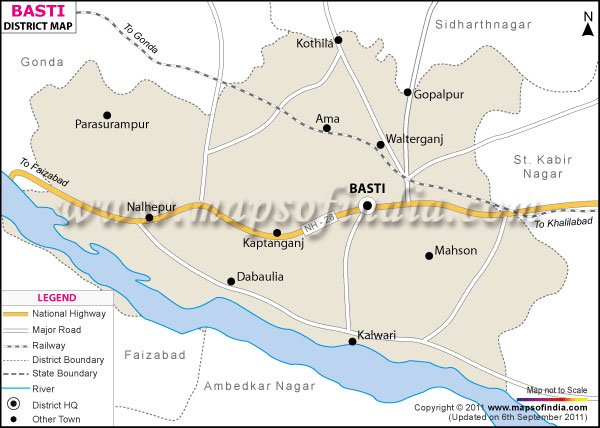
The Basti district is one of the major administrative and cultural regions of the Indian state of Uttar Pradesh that are located in the north east of this state. It is a part of greater Basti Division and has an administrative base at city of Basti. The geographical position of the district is in the eastern Gangetic plains and the boundaries are with other districts which comprise of Siddharthnagar, Sant Kabir Nagar, Gonda and Ambedkar Nagar. The area had been used as a hub of agriculture, local commerce and cultural interchange in Uttar Pradesh of eastern region long before. The governmental headquarters serves as the major urban centre and is a centre of numerous education establishments, markets and government offices. A detailed Basti district map effectively illustrates the extensive distribution of villages and administrative units across the region.
Basti district is characterized by its rural-modern combination of traditional and slow advancement of infrastructure and other social facilities. Throughout the decades the transport connection, educational infrastructure and medical services in the district have been advanced making it a key regional centre in the eastern part of Uttar Pradesh. The historical and cultural background of the district also adds to its identity as it has been related to a number of literary personalities, religious customs and neighborhood fairs. A Basti district map also highlights the location of major roads and market towns that connect rural communities with larger economic centres.
In general, the district of Basti is a good sample of agricultural districts of the eastern Uttar Pradesh where the traditional culture is mixed with the slow modernization. The combination of its geographical position, its demographic diversity and cultural heritage qualifies it to be a major region in the state. A Basti district map is often used by students, researchers and travellers to understand the spatial organisation of towns, rivers and neighbouring districts within this part of Uttar Pradesh.
History
The history of Basti district goes several centuries back and indicates the general historical processes of Northern India. Archaeological and literary source indicates that the region used to belong to ancient kingdoms that existed in the Gangetic plains in the early historical period. The area was strategic and the land was fertile hence settling in the area and practicing farming was viable.
The region was connected to it with the Kosala kingdom that is among the important political entities in the ancient literature of the Indians in the ancient times. The state of Kosala comprised regions of what is now eastern Uttar Pradesh and its borders reached most of the districts found in modern India. The cultural relevance of the region was also facilitated by the fact that the area had its local religious centres and pilgrimage routes.
At the medieval period, the region fell in the hands of different regional rulers and later got out of the circles of Delhi Sultanate and then the Mughal Empire. The region came to be a part of the imperial revenue system under the Mughal administration and agricultural production was promoted through the organised land management.
The district was further significant during the colonial era in which the British instituted administration units in the northern part of India. Basti became a headquarters of a district under British occupation and administrative institutions were also introduced gradually to control revenue collection, maintenance of law and order and local administration. The area had then territories that were to become independent districts.
Siddharthnagar and Sant Kabir Nagar nowadays were once part of the greater district of Basti under the colonial rule. Administrative reorganisation advanced by creating better-governing and better-developed new districts. One more thing that was blooming in the late nineteenth and early twentieth century in the district is the social intellectual life. The area was connected with the renowned Hindi scholar Acharya Ram Chandra Shukla who is usually regarded as having been the father of contemporary Hindi literary criticism. His scholarly writing was very vital in the evolution of the contemporary Hindi literature.
The history of the region was also affected by religious and cultural traditions. The neighbouring town of Maghar which is associated with the poet-saint Kabir has a great cultural affiliation with the region which was formerly part of the Basti district. These associations represent the larger spiritual and cultural environment of eastern Uttar Pradesh.
Basti district has also continued to develop in the modern times with reforms in administration, development programs and infrastructural development. An example of a Basti district map during other periods in historical time indicates that administrative boundaries have fluctuated whilst centrality of the district headquarters has not. The district is one of the examples of how the tradition and the contemporary governance can live in the changing environment of northern India.
Culture
The culture of the Basti district denotes the culture of the eastern Uttar Pradesh and the cultural heritage of the Gangetic plains in general. The community is so close to the rural culture and religious ceremonies and feasts of the population that persist to this day within the district.
Festivals are the primary foundation of the district culture. Holi, Diwali, Ram Navami, Krishna Janmashtami and Nav Durga are great Hindu festivals that are greatly observed. These also involve temple and outdoor decorations and fairs within the localities have giant numbers of people. The same religiosity is also practiced in Eid-ul-Fitr, Eid-ul-Zuha and Muharram and this depicts the religious diversification of the district.
Some cultural environment includes local fairs and religious gatherings. Such events are typical of traditional music and folk experiences and local markets where the inhabitants of the village get together and interact socially. The locations of these meetings are often situated on the Basti district map, and are large temples, shrines and fairgrounds.
The traditional diet of the district is linked to the production of agriculture. Wheat, rice and pulses are the staple foods of people. The food is mostly served as roti, rice, lentils and a seasonal vegetable and is prepared in the most primitive manner which is typical in the North Indian rural areas. Local food cultures are left to the influence of farming seasons and harvests.
Even the mode of dressing indicates the blend of rural and urbanism in the district. Men in the rural regions wear kurth and dhoti unlike women who wear sarees. In city areas, the modern attires like shirts, trousers and salwar suits are becoming more popular particularly among the younger generations.
A Basti district map will allow locating many cultural landmarks and historical sites in the district area, and it allows visitors to see how temples, historic sites, and the community spaces are distributed. These sites are a total reflection of the culture of the area.
Language
The language of the Basti district is a manifestation of the geographical location between the Awadhi and the Bhojpuri language regions of northern India. Even though the language of administration and education is Hindi, local dialects and variations are usually present in the vernacular speech.
Census records indicate that most citizens use Hindi as their native language, with good amounts of citizens using Awadhi and Bhojpuri dialects in their daily communication. A smaller portion of the population also speaks Urdu especially among the Muslim groups.
The presence of these languages brings a multilingual situation where individuals tend to alternate the dialects with respect to social setting. Awadhi and Bhojpuri expressions are widely used in rural villages in the statement of conversation, market, and community meetings. In linguistic studies a Basti district map is occasionally employed in identifying areas where one or other dialect is more common. The Basti district map gives information on the role of geography in distribution of language in the district.
Geography
The District is enclosed in is one of the neighbouring districts that causes the regional links. It is north of Siddharthnagar, east of Sant Kabir Nagar, west of Gonda and Ambedkar Nagar south of it. One of the sections of the southern border is passed by Ghaghara River and contributes to the fertility of the region and agricultural productivity.
Basti district was composed largely of a low-lying region, which is filled with alluvial deposits that are deposited by the rivers over the centuries. It is a large scale agricultural land with high rural density.
This district is governed by the administrative unit of the district that consists of tehsils and development blocks that govern the district and the rural development programme. A conveniently demarcated Basti district map containing these territories of the government agencies and planners is availed. The transport infrastructure connects the district to the big cities of the area (Gorakhpur and Ayodhya). The delivery of the villages to the markets and the learning centres or vice versa is dependent on the roads, and railways. These connections are more easily perceived following the Basti district map that do indicate great routes.
The geographical nature of the district is characterized by the natural features like rivers, agricultural plains and rural settlements. This environment provides support to agriculture as well as local biodiversity which consists of different trees, crops, and small wildlife species characteristic of the Gangetic plains. In short, geography of the district of Basti depicts the nature of fertile agricultural land which is influenced by rivers, monsoon rain and human settlement. Basti district map is a very useful visual instrument in the knowledge of the spatial arrangement of villages, towns and natural features which shape the landscape of the district.
| Facts of Basti District | |
|---|---|
| State | Uttar Pradesh |
| District | Basti |
| District HQ | Basti |
| Population (2011) | 2464464 |
| Growth | 18.21% |
| Sex Ratio | 963 |
| Literacy | 67.22 |
| Area (km2) | 2688 |
| Density (/km2) | 916 |
| Tehsils | Basti, Bhanpur, Harraiya, Rudhauli |
| Lok Sabha Constituencies | Basti |
| Assembly Constituencies | Basti Sadar, Harraiya, Kaptanganj, Mahadewa, Rudhali |
| Languages | Hindi, Awadhi, Urdu, Bhojpuri |
| Religion | Predominantly Hinduism |
| Rivers | Kuwano |
| Lat-Long | 26.818249,82.764423 |
| Travel Destinations | Pakke Bazar, Ahmath Pull, Kutiwa, Ganeshpur, Makhauda, Chawni Bazar, Nagar, Chando Tal, Barah, Jama Masjid, Kateshwar Park, Bhadeshwar Nath, Paida, Mahua Dabar, Bhuila Taal, Pakari Bikhy, Dihwa (Jaitapur), Agauna etc. |
| Government Colleges/Universities | A.P.N. Degree College, Kisan Degree College, Mahila Mahavidalya, Karma Devi Smriti Mahavidyalaya etc. |
FAQs
Q1: Why is Basti district historically important in Uttar Pradesh?
Basti district has historical connections with the ancient Kosala region and later developed as an administrative centre during British rule.
Q2: Which major river influences the geography of Basti district?
The Ghaghara River significantly influences the southern boundary and agricultural fertility of the district.
Q3: Which famous literary personality is associated with Basti district?
The renowned Hindi literary critic Ram Chandra Shukla was born in the Basti region.
Q4: What type of soil is mainly found in Basti district?
The district mainly has fertile alluvial soil that supports intensive agricultural cultivation.
Last Updated on : May 08, 2026
