






Introduction
Siddharthnagar is a district in UttarPradesh. It is endowed with an agrarian and economically prosperous culture, as it is situated with ample plains fed by the river systems of the Rapti and Budhi Rapti as well as the river supported agrarian and economically prosperous cultures that grows paddy, wheat and sugarcane.
It has great potential as an encashment of its folk culture and lively participative culture. Various forms of the folk traditions exist, as well as a great deal of the folk festival culture Additionally, a great deal of the festival itself exists. The various weekly markets as well as the bustling bazaars capture both the economic and participatory cultures of the district folk as well as the encashment of the rich cultural abundant district.
The ethnic, linguistic and participatory richness of the district folk is a testimony of the great warmth of the people. Most of the bazars and participative markets fully capture the economic culture of the district folk. The patron of the rich cultural and lively, Siddarthnagar as well as the modern provides relaxation, diversion and solace to the people.
History
Siddharthnagar is in the northeastern part of Uttar Pradesh. The distance from this district to the Nepal border is very less. It has been named after Siddhartha. This was the original name of Gautama Buddha. In ancient times, it was part of the Shakya Kingdom, which was a small clan who ruled the foothills of the Himalayas with their capital being Kapilavastu. Most of the historians believe that Kapil Vastu was in and around the present day Siddhartha Nagar.
Even today, in the archaic sites in the region, there are incidents that keep reminding people of that. One such site is Kapilvastu, which in its excavations found ancient constructs of buildings, utensils, and coins. This evidence suggests that the site in those periods was a fully developed civilized town. After the period of the Buddha, this region witnessed the rise of several big empires. One of these was the modern empire of Emperor Ashok that ruled a big part of northern India.
Ashok was initially a proponent of Buddhism and constructed several Stupas and pillars. He is believed to have spread Buddhism strongly in the region of his domination. Here, Monasteries and places of educational learning thrived. However, in the course of time, several of these places were neglected, destroyed or forgotten.
Eventually, the region fell to the rule of various succeeding dynasties of the Guptas and some regional kings. These new rulers embraced Hinduism and several of the indigenous traditions. The whole area retained its primitive simplicity and was predominantly agrarian. There was a gradual biological growth of the villages and a bridging of the social growth of the inhabitants. The region was traversed by important trade lines that interlinked the greater northern plains of India with Nepal. During the middle ages, the region was successively ruled by the Delhi Sultanate and then the Mughal Empire.
For centuries, the Mughals dominated northern India. Their administrative systems and land revenue systems introduced organized agriculture. Political chaos ensued as the British came. Like the rest of Uttar Pradesh, Siddharthnagar became British India. The British land administration systems and the road systems eased communication, but the revenue systems became burdensome to farmers.
During the freedom movement, protests of all types erupted against British rule, Ukhrul remained politically apathetic but the nationalism was documented. The leaders coupled with villagers supported the independence of India and continued to advocate across the free frontier. In 1947, India was partitioned and this region became an extension of free India, alongside the rest of what became Uttar Pradesh. For more than 30 years it was a region of the Basti district; only in 1988, when Siddharthnagar was carved out as a separate district. Income as of this time is still agriculturally driven.
Culture
People in Siddharthnagar are very down to earth. Almost 85% of the population live in the agrarian culture, countryside. Their culture is based closely on farming. Good harvest means happiness, and bad harvest makes everyone down. Family is also an integral part of life, and many families live with grandparents. Grandparents are very well respected due to their life experience and story telling.
Tales of grandparents are often centered on divine and local hero tales. People in the villages of Siddharthnagar are very social. Calm and social times of story telling are done in front of the house. Everyone looks forward to social village evenings after a busy day of farming.
All through the village the feeling of togetherness is celebrated in the villages through each other’s festivals, whether they are Islamic or Hindu. Folk songs of the village are played at gatherings and in each village new songs are created. At marriage ceremonies women of the village accompany the bride and sing songs and there is a dholak player, who plays the drum, and sings songs that are very emotional. In the village life is very emotional, and weddings are the most emotional part of life. There are many villages, many folk villages, and they prepare for the weddings.
Sweets made with local farm ingredients are somewhat more organic. In the rural areas, the festival clothing is mostly traditional. Men are in kurta pyjamas or dhotis and women are in sarees. In the cities, there is western dress also, but in the festival, traditional dress is worn. They feel a strong sense of attachment to Gautam Buddha which deepens their connection to the land.
Language
Siddharthnagar site lies in the eastern Avadh Purvanchal area of North India. The area has an extremely homogeneous, Indo-Aryan vernacular population. With the use of vernacular Indo-Aryan, Hindi is the official Language. It serves as the medium of instruction in the district schooling system, as well as the language of the administration, mass communication, and official documentation.
The vast majority of locals are Hindi speakers. The Hindi language is particularly present in the rural and semi-urban environments of the district and is applicable in all social vocabularies. Local dialects are also present in the informal and rural areas; Bhojpuri and Awadhi.
While Bhojpuri has a significant cultural influence in eastern Uttar Pradesh and bordering Bihar, the local dialects of Hindi, and specifically Awadhi, have numerous, distinct folk, songs, and oral traditions. Certain ethnic groups have a somewhat small inclusion of Urdu.
Siddharthnagar's languages showcase the cultural diversity and lively pulse of the district. With Hindi being the officially and widely spoken language, it unifies the residents of their villages and towns. Regional favorites, and locally embraced, Awadhi and Bhojpuri, are languages of the homes, markets, and especially in the celebratory discourse at the festive circuits. These expressive and folkloric languages are also custodians of the community's history of songs and oral traditions.
Geography
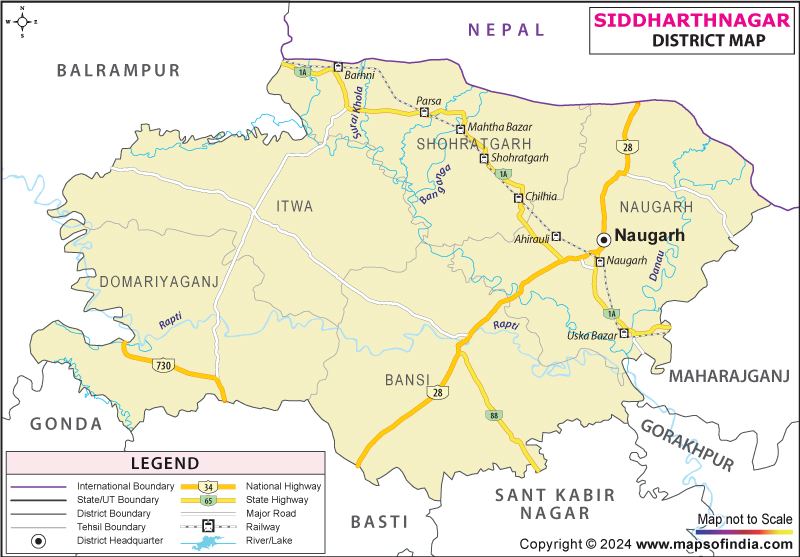
Siddharthnagar district is located in the northeastern part of the state of Uttar Pradesh. It is close to the international border with Nepal. The smooth slope, with its low-lying plains, decides the drainage and agricultural intervals of the region. Many seasonal rivers and streams are in this region, and numerous small rivers and streams are found in the plains of this region.
The soil is alluvial. It is rich and suited to the crops, which include paddy, wheat, and sugarcane. They are nourished by the greenery of the mountains and the runoff of the higher elevations to the north. These rivers seem modest most of the year but are quite dramatic during the rainy season. They cause waterlogging and localized flooding that results in the deposition of new alluvial soil across the fields.
The hot summers leave a visible mark on the landscape. Pond and shallow wetland evaporate and dry out. The monsoon season transforms the district again. This time bringing thick vegetation and shimmering bodies. The cold of winter arrives next bringing cool air and a thick layer of fog. This softens the horizon and the expansive landscape. Barely adds beauty. The hills and rocky outcrops may be dramatic but the geography of Siddharth Nagar is made of quiet continuity. The balance of cultivation and nature is best met here.
The subtropical climate of Siddharthnagar sustains three distinct seasons which impact day-to-day living and farming activities. Summer is long with extreme heat and humidity which makes it very uncomfortable. The winter is much appreciated by everyone with cool and brisk mornings and warm and inviting afternoons.
Winter is a very calm season and makes the countryside very inviting. The monsoon season is very crucial as it runs from June to September and during this time it rains very heavily which sustains and nourishes the rivers and grows the paddy and sugarcane crops and during this time the farmers harvest the crops. This heavily influences the natural setting and the farming cycle, festivals, and daily life of the people in the district.
| Facts of Siddharth Nagar District | |
|---|---|
| State | Uttar Pradesh |
| District | Siddharth Nagar |
| District HQ | Navgarh |
| Population (2011) | 2559297 |
| Growth | 25.45% |
| Sex Ratio | 976 |
| Literacy | 59.25 |
| Area (km2) | 2895 |
| Density (/km2) | 882 |
| Tehsils | Bansi, Domariyaganj, Itwa, Naugarh, Shohratgarh |
| Lok Sabha Constituencies | Domariyaganj |
| Assembly Constituencies | Bansi, Doomariyaganj, Itwa, Kapilvastu, Shohratgarh |
| Languages | Hindi, Urdu, Bhojpuri |
| Rivers | Rapti |
| Lat-Long | 27.283926,82.819633 |
| Travel Destinations | Kapilvastu, Bharat Bhari, Piprahava etc. |
| Government Colleges/Universities | Ratan Sen Degree College, Ratan Sen Inter College, Tilak Inter College, Government Girls Inter College etc. |
FAQs
Q1: What is the main occupation of people in Siddharthnagar?
The primary occupation of the people is farming. The growing of rice, wheat, sugarcane, and pulses, is made possible by the alluvial soil and seasonal rains.
Q2: What type of climate does the region have?
Siddharthnagar's climate is subtropical. It is marked by hot summers, rainy monsoon season, and cool winters, with fog in the winter. This affects rural life in the colder months.
Q3: Which are the major crops which grow in the region?
The major crops which grow here are rice, wheat, Indian bread, lentils, and fresh vegetables. All of this sustains the agriculture economy of the region.
Last Updated on : May 08, 2026
