




Introduction
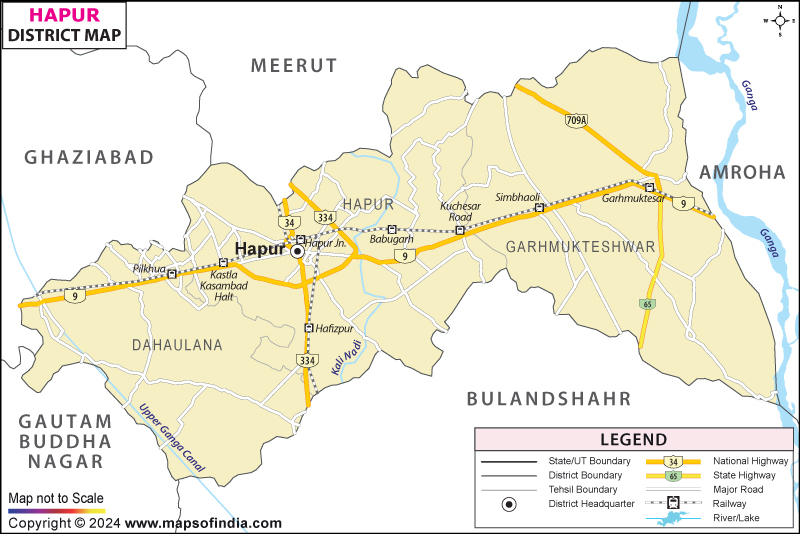
Hapur serves as a growing vibrant district which exists within Uttar Pradesh Indian territory, clearly visible on the hapur district map. The location serves as an advantageous trade and travel hub because it lies near New Delhi, clearly visible on the hapur district map, which functions as the capital city. Hapur exists as the state's smallest district because most people recognize its boundaries. The location displays two contrasting elements which include green agricultural areas and active grain trading centers.
The town is a key component of the NCR. There it is seen as a growth point which also has very strong connections to nearby urban centers which are Ghaziabad and Meerut. Hapur attracts visitors with its clean streets, sweet snacks, and large crop distribution center. The local markets create an energetic atmosphere which will attract your attention whether you enter the area through the highway or arrive for business purposes.
History
The story of Hapur dates back to ancient times which started in the Northern Indian region. According to local customs, Hardatta the king established the city during the 10th century. The ancient world recognized the region for its abundant fruit orchards and its exquisite garden spaces. The name Hapur derives from words that translate to the "the town of orchards."
For a long time the town was a peaceful place which saw its residents live off the land. Hapur in the late 1700’s grew in importance due to its location near the city of Delhi. The French military man Pierre Cuillier-Perron developed an interest in the area. He made Hapur his base to train soldiers and administer Maratha king's lands which were under their rule at the time.
British colonial authorities discovered that Hapur possessed some of India's highest quality agricultural land. The town's transformation into a large trading hub became their main objective. They established the necessary transportation network to enable grain and timber collection from nearby rural areas. This development marked the beginning of Hapur's transformation into Northern India's most extensive grain market.
The people of Hapur have always displayed exceptional courage and independence. The citizens of Hapur joined the freedom movement when it began in Meerut during 1857. Local leaders and farmers stood up against the British officers to protect their homes and their pride. The town's historical importance stems from its fighting traditions which have earned it great respect throughout Uttar Pradesh.
Hapur remained under Meerut district control until it became part of Ghaziabad district. Local residents pursued separate identities when the town expanded and market areas developed into busier spaces. The government declared Hapur its own district when officials recognized local demands in 2011. The town reached a significant historical milestone because it obtained the right to establish government offices which would help shape their future development.
Hapur presents to us the story of its past in its old streets and active “Mandis” which have been around for ages. The town has changed from what it was as a fruit garden into a growing commercial center. While the district has put up modern highways and factories the people here still tell tales of King Hardatta and the brave soldiers of 1857.
Culture
Hapur displays its culture in the mix of small town friendliness and dedicated work ethic. The town, clearly visible on the hapur district map which is a major trade center brings together people from many backgrounds who bring with them a mix of friendly dispositions and practical skills. Local markets which are the main gathering places for residents also see the development of close neighborly relationships. In every home and business in the area you will see traditional practices which are still very much much a part of life.
Papad making is a prominent cultural tradition in Hapur which stands out. Hapur is home to a famous Papad that is known throughout India. Women in many neighborhoods gather to spend time together while they create dough and sun-dry papads. The work function as a job but serve as a cultural social custom that unites people for story sharing and work activities.
Hapur has simple food traditions which create exceptionally delicious dishes. The town operates as a massive grain market which ensures that flour and lentils maintain their highest quality. People enjoy eating spicy kachoris and fresh jalebis for breakfast. The people take great pride in serving dishes which use ingredients from nearby farms because it makes every dish taste fresh and healthy.
The district experiences major daily life changes because of both religious practices and festival celebrations. Garhmukteshwar serves as the spiritual center of the area because it exists along the Ganga River. During the Kartik Purnima festival, hundreds of thousands of people gather to participate in the holy dip which occurs every year. The main element which defines Hapur's identity consists of thousands of oil lamps which people release to float on the river during nighttime.
The grain market which Hapur people call "Mandi" serves as the main center for their social activities. Business transactions take place through a handshake which business partners follow by sharing a cup of hot tea. The people developed a welcoming nature through their trading customs which enable them to easily connect with unfamiliar faces. The locals treat both big businessmen and curious travelers with equal respect by greeting them with a traditional "Namaste" and offering a place to sit.
The community produces high-grade stainless steel pipes through their local artistic and craft activities. The skill functions as a contemporary industry because it represents a traditional art form that family members transmit through generations. Hapur’s cultural heritage brings together its traditional agriculture practices, religious river ceremonies, and active metal production sites. The town maintains its fundamental identity while it progresses together with national development.
Language
In Hapur the main language is Hindi. In Hapur Hindi is used in daily life for conversation as well as in schools and at the office. The Hindi in Hapur has a western UP accent which is a little different from what you will hear in other areas.
Many families in Hapur use Urdu as their second language. People in markets and old areas use a combination of Hindi and Urdu for their speech. The shared cultural heritage of the town is demonstrated through this mixed language.
Hapur schools and colleges use English as their primary language of instruction. Young students in Hapur schools study English for their academic courses. People use basic English skills during business interactions and official work when they need to communicate.
In Hapur which is a large trading hub you will see a mix of Punjabi and Haryanvi in the grain markets. Traders from neighboring states bring in their own terms which create a mix of languages that to all seems very natural.
Hapur residents use straightforward language that maintains clear meaning. People from Hapur use friendly communication methods to interact with visitors from nearby cities.
Geography
Hapur has special geographical features because its location rests at the center of Northern India's most fertile agricultural territory, clearly visible on the hapur district map. The city exists in the northern section of the Ganga-Yamuna Doab which designates the area between two major rivers as its territory, clearly visible on the hapur district map. The district established its essential grain markets because the area contained flat and level terrain.
Farmers consider Alluvial Soil to be the primary soil type that exists in Hapur because this soil type brings them great value. Water carried earth from the Himalayan mountains throughout many years to create this land. The soil possesses deep roots which enable it to retain moisture effectively. The district displays continuous sugarcane fields and wheat fields and mustard fields which extend across the entire region.
The Ganga River which is a very important element of the geography forms the eastern border of the district, clearly visible on the hapur district map. In Garhmukteshwar the river forms a large bank right at the edge of the town. The river plain which is sandy in nature also acts as a natural barrier which in turn maintains high ground water levels which nearby farms use.
Hapur functions as a "Gateway" because its flat terrain makes it suitable for this purpose. The lack of mountains and deep valleys enables construction of extensive highways and railways without difficulty. Hapur emerged as a major trade center because its flat land enabled connections to Delhi and other areas of the state.
The geography of Hapur consists of two main features which are its fertile soil and its extensive flat plains. The land was formed by rivers to become an ideal environment for agricultural production and transportation of goods. The holy river at Garh and the wide fields in the villages both display a landscape which combines beauty with high productivity.
| Facts of Hapur District | |
|---|---|
| State | Uttar Pradesh |
| District | Hapur (Panchsheel Nagar district) |
| District HQ | Hapur |
| Population (2011) | * |
| Growth | * |
| Sex Ratio | * |
| Literacy | * |
| Area (km2) | 660 |
| Density (/km2) | * |
| Currency | Indian Rupee (INR) |
| Tehsils | Hapur, Garhmukteshwar, Dhaulana |
| Lok Sabha Constituencies | Meerut, Ghaziabad |
| Assembly Constituencies | Dholana, Garhmukteshwar, Hapur |
| Languages | Hindi, Urdu, English |
| Religion | Mostly Hinduism, Islam |
| Rivers | --- |
| Lat-Long | 28.730335,77.778296 |
| Travel Destinations | Chandi Mandir, Dudheshwar Nath Temple, Sapnawat Sai Mandir etc. |
| Government Colleges/Universities | Ssv Pg College, Shri Shanti Inter College, Ssv Inter College etc. |
FAQs
Q1: What is the importance of Hapur in the Western UP?
Hapur is an important district which is so because of its proximity to Delhi and its excellent road and rail connections. It is a key center for agriculture, trade and small scale industries.
Q2: How did Hapur get its name?
Local legend has it that Hapur got its name from the vast tracts of orchards which used to grow in the area. It is thought the name came from terms related to garden and fruit culture.
Q3: In which languages do people mostly speak in Hapur?
Hindi is the primary language in the district. Also very much into use are Urdu and English in the fields of education, business and within diverse communities.
Q4: Which crops do we see in Hapur district?
Farmers grow mainly in wheat, sugarcane, paddy and mustard. With the rich alluvial soil and irrigation at hand agriculture is a year round affair.
Q5: In what ways does agriculture play a role in Hapur?
Agriculture is the base of our district which supports a great many of our population into farming. We have fertile land and good irrigation which in turn produces high yield.
Q6: How is transport connectivity in Hapur?
Hapur has a good network of national highways and railways. That which pertains to travel to Delhi, Ghaziabad, Meerut and other nearby cities is made easy.
Last Updated on : July 23, 2026
