




Introduction
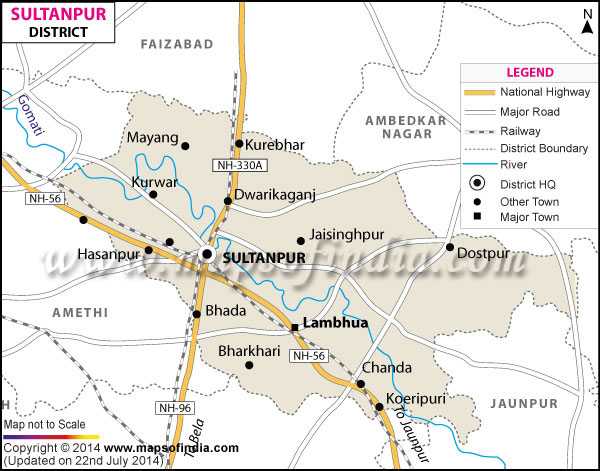
Sultanpur district is an administrative district located in the eastern region of the Indian state of Uttar Pradesh, clearly visible on the sultanpur district map which is located in the cultural region of Awadh in the past. The district headquarters is situated in the town of Sultanpur on the banks of the river Gomti, clearly visible on the sultanpur district map and the main centre of governance, trade and communication of the rest of the rural hinterland. Sultanpur is located in the Ayodhya division, it is encompassed by the following districts: Ayodhya district, Pratapgarh district, Jaunpur district and Ambedkar Nagar district, which puts it in contact with a complex of the historically rich and agriculturally fertile lands. The district is located in a territory that is mostly rural and the agriculture becomes the basis of its economic and social organization.
History
Sultanpur district has a rich history that mixes both mythical history and political history as documented. According to local faith, the area is connected to the ancient city of Kusabhavanpur that is traditionally related with Kusha who was the son of Lord Rama as mentioned in the epic Ramayana. Although this relationship is based on religious mythology as much as it is on archaeological certitude, it manifests the way in which it was a part of the sacred geography of northern India and the culture at large that is Awadh. The region had been under the control of larger kingdoms and regional polities over centuries that ruled the Gangetic plains.
In the medieval era, the power of northern India was under the rule of the Muslim dynasties, such as of the Delhi Sultanate and the Mughal Empire. Herein it was called Sultanpur, or town of the Sultan. The alteration in nomenclature marked the introduction of the region to administrative structures that were put in place by ruling authorities of the day. The region was within the subah of Awadh, (as on old sultanpur district map); it enjoyed well organized revenue systems and agrarian management systems under the Mughal rule that defined the rural life over generations.
The borderlines of the districts, clearly visible on the sultanpur district map and the governmental system during the colonial government became formalised, and the development of infrastructure was slowly boosting the connectivity (roads and railways, etc.). After the Indian independence in 1947 Sultanpur remained a District in Uttar Pradesh, with gradual social and economic transformation, but with a fundamentally agrarian nature.
Besides political transitions in Sultanpur, Sultanpur was also used to add to the greater currents in the Indian freedom movement of the late nineteenth and early twentieth century. Similar to most of the United Provinces, it experienced being involved in nationalist activities influenced by the leaders of the Indian National Congress such as non-cooperation and civil disobedience movements. Although not the focal point of one defining event, the district was a part of the greater rural awakening that would question the colonial rule and local leaders and common cultivator answered the call of reform and self-government. These changes led to Sultanpur being associated with the national struggle which finally resulted in the independence of India in 1947.
Culture
Sultanpur district has the cultural life that is the composite traditions of Awadh, which is characterized by politeness in speech, strong concern of tradition and the commonality in participating in the festivals among societies. The social system of the district consists of village life, kinship ties and agrarian rhythm of rural life. The traditional dresses are still in use especially in villages where men usually use a kurta featuring dhoti or pyjama, and a sari that is regionally unique is used by women. In cities, there is a rising trend of modern clothing but traditional events continue to depend on conventional clothing that unites people to their tradition.
Food in Sultanpur reflects the greater Awadhi food culture in more rudimentary country ways. The staple food comprises wheat as well as rice and lentils, vegetables of the season and dairy products. Festal food can be accompanied by elaborate cooking methods that build on the traditional methods of slow cooking and blending of spices. The idea of food sharing in the festival and family reunion strengthens the relationships in the communities and underscores the hospitability which Awadh is so well known.
The major part of cultural expression is represented by religious and seasonal festivals. Hindu festivals like the Diwali, Holi and Navratri are celebrated with great enthusiasm and the Eid with community prayers and social visiting among the Muslim residents. Such celebrations often cut across social borders and are indicative of trends of coexistence that have been developed through centuries.
Folk songs and oral literature are still relevant, and the songs are in the Awadhi language telling about mythological narratives, historical recollections and life experiences. Marriage rites, harvest fests and village fairs are all events where everyone in the community is involved and traditions have conserved over the years regardless of modernisation. In this way besides being a static and closed culture, Sultanpur is a living embodiment of tradition and modernity merged.
The other significant element of the cultural life on Sultanpur is the continuation of traditional fairs and local markets, which are held as hubs of trade, as well as as arenas of social interaction and mass celebration. Artisans, farmers and performers of the surrounding villages gather at periodical rural melas which are usually linked to religious celebrations or the change of a season. These meetings maintain folk crafts, promote sharing of agricultural produce and strengthening of the community ties. Although modern shopping and electronic communication is growing, these traditional gatherings remain a reference to the connection with the rural history of the district.
Language
The language in the Sultanpur district also shows administrative homogeneity and cultural heterogeneity. Hindi is the official language of the government, education and social communication. It is the one being utilized in schools and governmental offices, formal records and documentation, and guarantees that they are in line with the state and national frameworks. The role of standard Hindi has been enhanced by literacy programs and increased access to education by the generations.
The dialect of Awadhi has a very important role in everyday communication along with the standard Hindi. Awadhi is part of the Eastern Hindi and it has a rich literary tradition, particularly of devotional literature. In Sultanpur, the language of the home and of folk ballads and local stories is Awadhi. Its unique intonation and diction make it unlike formal Hindi but it is spoken by speakers who can easily move between the two forms in accordance to the context they are in.
Urdu is also in existence in the district especially among the Muslim communities and in the religious contexts. Its script and literary affiliations also add to the multiple linguistic nature of the area. English is not a popular language in the rural part of the country, but is taught in all schools and is taught as a medium of higher education and administrative correspondence. Hindi, Awadhi, Urdu and English living together portrays the stratified linguistic context of Sultanpur which is influenced by history, education and social interaction.
Geography
Sultanpur district is situated on the central Gangetic plain which is characterised by fertile alluvial deposits brought about by centuries of river runoffs of the soil. The land is quite flat, easy to cultivate and to stay. The Gomti River, clearly visible on the sultanpur district map, in which the district is traversed, is a large tributary of the Ganges and supplies the irrigation, as well as determining respirative distributions of habitation. Smaller waterways and canals supplement supply of water which facilitates farming activities throughout the rural areas.
The weather of Sultanpur is humid subtropical. Summers last between April and June and are usually hot with temperatures usually going beyond 40 degrees Celsius. This is due to the monsoons, which present a lot of rainfall that contributes to the ground water and agriculture towards the end of June or early July. Winters, from November to February winters are relatively cool with the temperature sometimes going below 10 degrees Celsius during the cold waves. The seasonal change is a determining factor of agricultural planning and life.
The land use is still based on agriculture, with the main crops being wheat and rice, but pulses, oilseeds and sugarcane. Couple of cropping patterns have been practiced in most regions because of fertility of the soil and availability of irrigation. Fields and ponds and groves cut through rural settlements to create a topography that has been created over centuries of farming. The Sultanpur is linked to other urban centres via transport networks such as road and rail networks that allow movement and trade. The topography of the district, which is characterized by plains along the river and the agricultural potential, has remained in the economy, settlement and the social organisation of the district.
In terms of geography, the soil composition of the district is mostly alluvial, due to deposits of the sediments of river systems over centuries, which preconditioned the land being very acceptable to intensive cultivation. The resources of groundwater are obtained through wells and tube wells and supplement surface irrigation and enable cultivation even in places that are far away along the channels of the main rivers.
The topography is relatively smooth which mitigates the chances of severe soil erosion although seasonal flooding in low areas of the tracts may arise during the times of heavy rains in the monsoon. The collective effect of these environmental characteristics is settlement patterns, types of crops and livelihoods in rural Sultanpur.
| Facts of Sultanpur District | |
|---|---|
| State | Uttar Pradesh |
| District | Sultanpur |
| District HQ | Sultanpur |
| Population (2011) | 2249036 |
| Growth | 18.11% |
| Sex Ratio | 983 |
| Literacy | 69.27 |
| Area (km2) | 2672.89 |
| Density (/km2) | 855 |
| Tehsils | Jaisinghpur, Kadipur, Lambhua,Sultanpur |
| Lok Sabha Constituencies | Sultanpur, Amethi |
| Assembly Constituencies | Isauli, Jagdishpur, Kadipur, Lambhua, Sadar, Sultanpur |
| Languages | Hindi including Awadhi, Urdu |
| Religion | Predominantly Hinduism |
| Rivers | Gomati |
| Lat-Long | 26.264786,82.072971 |
| Travel Destinations | Sita Kund, Christ Church, District Museum, Mausoleum Of Pahalwan Peer Baba, Satthin Sharif, Paryavaran Park etc. |
| Government Colleges/Universities | Ganpat Sahai Post Graduate College, Jham Baba Degree College, Kamla Nehru Institute Of Technology, Government Inter College, Keshkumari Government Girls� Inter College etc. |
FAQs
Q1: What river flows through Sultanpur district?
The Gomti River flows through Sultanpur district, clearly visible on the sultanpur district map and supports its agriculture.
Q2: Which cultural region does Sultanpur belong to?
Sultanpur belongs to the historical and cultural region of Awadh.
Q3: What is the primary occupation in Sultanpur district?
Agriculture is the primary occupation in Sultanpur district.
Q4: When did Sultanpur become part of independent India?
Sultanpur became part of independent India in 1947 after the end of British rule
Last Updated on : May 08, 2026
