




Introduction
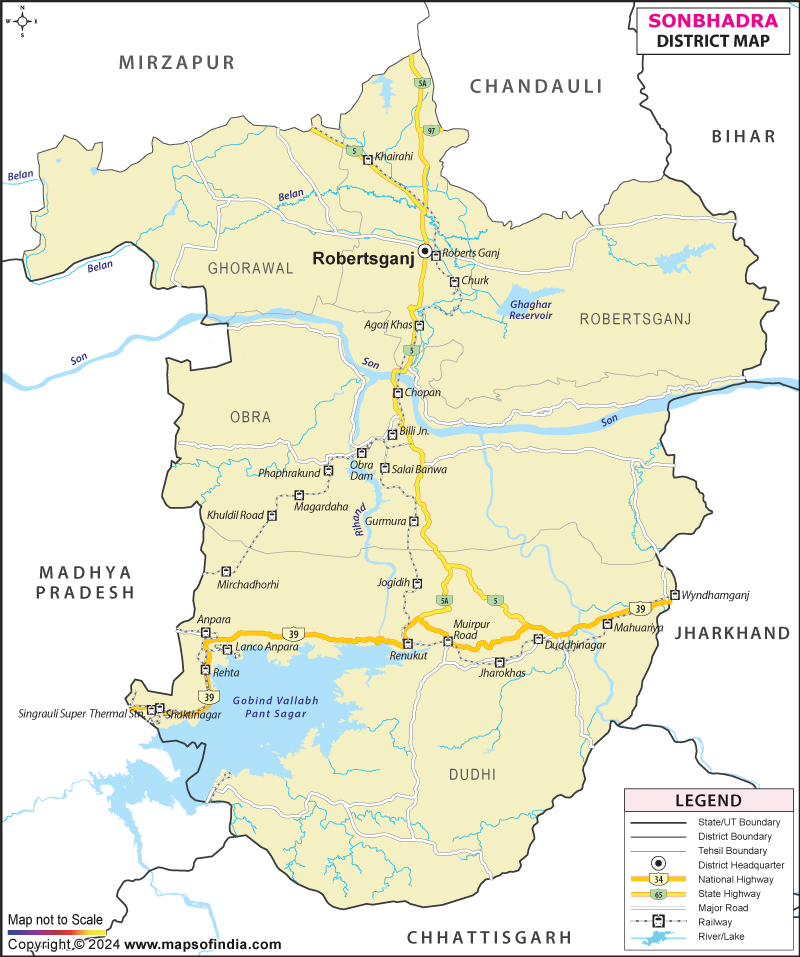
Sonbhadra is a district which we see at the very south of Uttar Pradesh. It is known across the country to be the only district in India which shares borders with four different states. Those states are Madhya Pradesh, Chhattisgarh, Jharkhand, and Bihar. Also which makes it stand out is that it has many power plants and coal mines which is the reason also that people refer to it as the “Energy Capital of India.
In this area the landscape is very different from that of the flat plains which characterizes the rest of Uttar Pradesh. What you will see are high hills, deep valleys, and thick green forest instead of just farm fields. The district is home to many ancient tribes which have lived in these mountains for thousands of years. It is a place which also has very old cave paintings as well as large modern dams.
History
The history of Sonbhadra is a very in depth and old story which goes back way further than many other Indian cities. In very old times this land was a quiet home to mountains and large dense jungles. Archaeologists report we have here some wonderful cave paintings that tell us early humans lived in these hills thousands of years ago. These paintings also show that the people at that time hunted animals and lived in small groups right in the Vindhya range.
As the ages went by which saw the rise of kings, Sonbhadra’s history became that of great tribal leaders. In the rough terrain which was full of hills it was the ideal setting to construct strong forts. The Vijaygarh Fort is the most noted of them. It is thought to be of very ancient construction and sits perched high on a hill top. Also it is referred to in the great old tale of Chandrakanta which makes it a legend in local culture.
In the course of Sonbhadra’s history a very important chapter is that of the Agori Fort which is near the confluence of the Son and Rehand rivers. That fort which saw rule of the Kharwar and Chandel dynasties at various points of time. It was the Kings of these dynasties who protected the forest paths and the river routes which in turn connected North Indian plains to South Indian areas. Today we are left with the ruins of these stone walls which tell us of the great skill of the builders from that time.
For a long time that region did not function as a separate district. It was a part of the Mirzapur district. But due to its large size which also included many mines and forests the government thought it should have a separate administration. In 1989 March 4 Sonbhadra was made a separate district. That was a big turn around which also brought in a local headquarters in Robertsganj for the local people’s issues.
The present day history of Sonbhadra is a part of what we may call the “Energy Revolution” of India. After 1947 when the country won independence, the Government realized that the rivers and coal resources here could fuel the entire country. It was at this time they built the large scale Rihand Dam which in turn created a huge lake. That project changed the landscape forever and at the same time saw the growth of new industrial towns which sprung up near the power plants as also the influx of thousands of workers from across India to live and work in them.
Today in Sonbhadra we see a blend of the past and present. You can find the ancient Karma festival which still plays out and large scale mining which goes on at the same time. Sonbhadra’s past and present remind us of its great natural resources. From the cave dwellers to today’s power plant engineers people have turned to these hills for what they can get out of them and what they need.
Culture
The culture in Sonbhadra is very distinct which is a result of the dense forests and the ancient tribes that have inhabited the area for what seems like forever. Also unlike the crowded cities’ pace, here life is a flow with the rhythms of nature and the seasons. Also at home to many tribal groups which include the Gond, Baiga, and Panika we see a great diversity. Each group has their own style of dress, song, and celebration which in turn makes the local heritage very rich.
Sonbhadra’s culture is a great respect for the earth and the forests’ spirits. What we see here is that the people do not look at trees and rivers as resources but as living entities which protect them. This connection is played out in their day to day doings and in their small village shrines. You will see that in many a time simple stones are placed under large trees which are in turn decorated with vermillion and flowers, which are in fact the local gods of the jungle.
In the tribe’s culture what is very exciting is the Karma Dance which they perform. This dance is a main feature of the Karma festival which we see as a means to bring us good luck and a healthy harvest. Men and women put on their best colorful clothes, silver jewelry, and peacock feathers as they dance in a circle to the tune of the ‘Mandar’ drum. It is a wonderful display which brings out the energy and joy of the tribal community.
In Sonbhadra culture art is present right on the village home walls. Many women paint beautiful designs of animals and plants on their mud walls which they color with natural colors. This tradition which goes back to the ancient times of cave paintings is alive in the present day. These drawings although for design also it is thought to bring peace and prosperity to the family that lives within.
The land is hilly which in turn causes the growth of special grains like Kodo and Kutki. Also they collect fruits and flowers from the forest which includes the Mahua flower that they use to make a variety of traditional snacks and drinks. At a village fair or “Mela” it is a usual site to see people eating together which is also a time for them to share what they have grown in their fields or gathered from the forest.
In Sonbhadra we also see very popular local markets which we call ‘Haats’. These aren’t like the large contemporary malls, instead what you get is an open air assembly of people from different tribes which come to trade their hand made baskets, wooden tools, and also the honey from the forests. These markets are the best to hear the local language and see in all the colorful traditional wear that has been the same for the past few hundred years.
The people of Sonbhadra are rooted in their past and their brave history. They live out of a very simple life which is at the same time filled with music, dance, and a strong community feel. Though we see the introduction of modern power plants in the area, the local people still practice ancient customs. This balance between the old tribal ways and the new industrial world which is present in the district makes it a very special place to visit.
Language
In Sonbhadra language is a mix of what you might expect from a district which is home to the meeting point of four states. Although Hindi is the formal language which is used in the schools and by the government, the local population speaks many varied dialects. What you see here is a great range which reflects many Central Indian cultures.
In the markets you will hear the most of a mix between Bhojpuri and Bagheli. That version of language in Sonbhadra is very melodic and polite. People use it for telling jokes, singing folk songs, and when they are bargaining for vegetables. It is a bit how the language is spoken in Bihar, but also has the gentle mountain quality from Madhya Pradesh.
In Sonbhadra we see many ancient tribes which have their own unique languages like Gondi and Kurukh. These languages have been used in the deep forests for thousands of years. Although many young tribal people today may speak Hindi to get a job, at home they still use their traditional mother tongue to pass down old stories and legends.
In large industrial areas which are near the power plants in these places we have English and Bengali also because of the large scale migration of workers from across India. But at the village level in Sonbhadra the true character of the language remains it is of the land that brings people from different states and tribes to be a part of a large tight community.
Geography
In terms of geography Sonbhadra is unique in that it is the only district which touches four states in India. From certain points in the district you can almost see into Madhya Pradesh, Chhattisgarh, Jharkhand, or Bihar. This makes the region a very much a junction point for trade and travel in Central India.
In contrast to the flat and dusty plains which you see in northern Uttar Pradesh, in Sonbhadra you find rugged hills and deep green valleys. The district is home to the Vindhya and Kaimur mountain ranges which means the ground is of a high altitude and rocky, thus you get great views of the forest from almost every hill top. It has a feel of a wild mountain district rather than a typical farming area.
In the geography of Sonbhadra one of the great elements is the large man made lake which we know as Govind Ballabh Pant Sagar. This lake came to be with the construction of the Rihand Dam. It is also one of the largest artificial lakes in the country and what you see is a vast blue sea set in between the hills. The view of that large expanse of water between the green mountains is a sight you do not want to miss.
In each district there is a large extensive forest which is home to many wild animals. These forests have trees of great value such as Sal, Teak, and Tendu. In some very remote areas of Sonbhadra’s geography which still is very much wild and untouched you can find out of the way waterfalls like the Mukha Fall.
Sonbhadra district have large deposits of coal, limestone and even some gold. It is the mineral wealth which has brought in many industries and mines. While the soil is rock which doesn’t great agriculture in all areas, what we have below the earth makes Sonbhadra one of the richest districts in the country.
In other words the land is a mix of ancient rocks, flowing rivers, and deep forests. It is a home to which nature has been very generous in what it gave the people in terms of beauty and wealth. As you look at the great Rihand Dam or the ancient Kaimur hills the district’s geography tells a story of power and natural wonder.
| Facts of Sonbhadra District | |
|---|---|
| State | Uttar Pradesh |
| District | Sonbhadra |
| Capital | Robertsganj |
| District HQ | Robertsganj |
| Population (2011) | 1862559 |
| Growth | 27.27% |
| Sex Ratio | 918 |
| Literacy | 64.03 |
| Area (km2) | 6788 |
| Density (/km2) | 274 |
| Tehsils | Dudhi, Ghorawal, Robertsganj |
| Lok Sabha Constituencies | Robertsganj |
| Assembly Constituencies | Duddhi, Ghorawal, Obra, Robertsganj |
| Languages | Hindi, Urdu |
| Currency | Indian Rupee (INR) |
| Religion | Mostly Hinduism |
| Rivers | Sone, Rihand, Kanhar |
| Lat-Long | 24.457151,83.000908 |
| Travel Destinations | Vijaygarh Fort, Naugarh Fort, Aghorigarh Fort, Sodharigarh Durg, Vir Lorik Patthar etc. |
| Government Colleges/Universities | Gurudwara Inter College, Rail Karmchari Inter College, Gov. Girls Inter College, Bhartiya Inter College, Govt. Inter College, G.N. Balika Inter College, R.S.M. Inter College etc. |
FAQs
Q1: Why is Sonbhadra called the Energy Capital of India?
Sonbhadra is home to many large thermal and hydro power plants. These plants produce a huge amount of electricity for Uttar Pradesh and other states.
Q2: Where is the head office of Sonbhadra district?
Robertsganj is the headquarters of Sonbhadra. It is the main center for administration, education and local business.
Q3: Which are the primary industries in Sonbhadra?
Power in the form of generation and mining is what mainly drives the economy in Sonbhadra. In the district coal mines and power plants are the primary sectors.
Last Updated on : May 08, 2026
