






Introduction
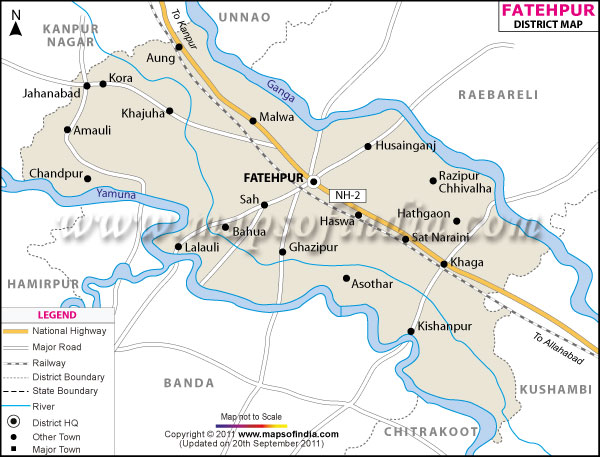
The district of Fatehpur in Uttar Pradesh is known for its rivers, rich plains, and culture. It is large, spanning over 4000 km and, due to the presence of river systems, has a flat terrain with abundant alluvial soil which makes the soil good for agriculture. Wheat, rice, pulses and oilseeds are the main crops of this region which sustains the economy and the farming community. The weather has a predictable pattern with extreme hot in summer, nourishing monsoon and a mild winter which then alters the terrain with extreme cold. The population of the region comprises seasonal farmers as well as seasonal fishermen. The socio-economic activities of the population is determined by their proximity to the water bodies. Borders that extend to the rivers of Fatehpur and Yamuna rivers are more than just physical boundaries. The rivers embody the culture of the people.
History
Fatehpur is located in the Indian state of Uttar Pradesh, in between the rivers Ganga and Yamuna. It is a region of complicated and useful timelines in Northern India, and thus holds significant historical importance. It is believed that the name Fatehpur also became generic as a result of the (fateh) victory of Ibrahim Shah of Jaunpur, over the local king Raja Sita Nand of Athgarhia. However, other name origin claims for the district suggest that it is after Fatehmand Khan, a sultan-alaundin officer, who is said to have constructed the town in the early 1500s.
These naming claims show the persistence and conquering nature of the history of this region. Beginning in the fifteenth century, with the arrival of Pashtun nobles building strongholds in the"doab" region of the Ganga and Yamuna rivers, the town began to develop. This area was a great geographical find because it was the center of the fertile and abundant crops of the Ganga and Yamuna rivers as well as their trade routes and movement. This is what brought rulers to Fatehpur.
This area of the town was the site of many trade and movement routes. Instead of just having one or the other, Fatehpur had many of both. During these times of great trade and movement, the checking and blending of many different architectural cultures built a great center of trade for many different types of temples, mosques, and others. In this time as well the town became a great control center for the growing Mughal Empire as it expanded and built a great administrative network.
With the ascendancy of the region's new controlling powers, the Mughals' dominance came to an end. In 1801, the Nawab of Oudh surrendered Fatehpur to the British East India Company. Fatehpur became a part of the British colonial administrative structures. Most of the agrarian practices and daily life rhythms were transformed by the revenue collection policies of the British. Trade and agriculture became the new front evidence of the transformed practices. Fatehpur's local pace and pre colonial Dominance remained intact, The bold and lively bazaars and other local patron customs of the formerly vibrant community survived to the end of the colonial periods.
Culture
Fatehpur has a strong history of culture with its traditions from the rural areas of the country, the religious diversity found there, the different seasons, and its various types of musical and festival celebrations. It has many different traditions from the Buddhist, Jain, Hindu, and Muslim religions, and then the traditions from the festival seasons, and the many different traditions from the years of coexisting with one another. The different cultures of coexisting with one another can be found everywhere, and in all different areas and religions.
The Jain and Buddhist temples along with the Hindu ones, also contain evidence of a high educational level in the arts and the decorative arts in the rural area of Fatehpur. Beginning in the twelfth century, a new settlement has provided the area of Fatehpur with the different types of architecture and along with that, the domes, arches, and minarets of the Indo Muslim styles of architecture, especially in the Faisalabad and Malwa areas, and are an interesting mixture with the architecture of old India.
The architecture of the Indo Muslim type with all the different types of domes and arches, and the minarets, have mixed with all other areas of the architecture of old India in a very artistic manner, and the use of the culture of the Semitic and Indo types of architecture. The architecture of the Indo Muslim type has made the area of Fatehpur, with all its different types of music and songs of the rural areas along with all the different branches of cultures that fatehpur has, have made and provided the areas of the temples and the culture of the area of Fatehpur.
The simplicity and the strong cultural and natural bond of the people of the village is seen in their daily activities as a rural village of India, for it is located in the bottom region of the Indian state of Uttar Pradesh, right above the Northern Indian state of Himachal Pradesh, located to the North, of Fatehpur. The state of Fatehpur is divided into many distinct regions. All the popularly known regions of India are divided into distinct social and economic classes.
Fatehpur district is characterized by consistent, daily traditions in music, dress, and worship complemented by modern influences. It should be noted that the traditions are not monumental, rather, they are present in daily life and through daily rituals.
Language
The linguistic diversity of Fatehpur is visible in the multiple languages spoken here. Hindi is the language with the largest number of speakers, and it is also the language of administration and offers the greatest accessibility. Awadhi is however popular among the masses. Engaging in Awadhi is not merely speech and communication. It is the principal and primary repository of the poetic tradition, songs, and the epic storytelling of the community, and the repository of all the oral traditions and stories. It is in Awadhi that the villagers sing the songs of the season, recite the stories of the place, and articulate all the sentiments that accompany the cycles of agriculture, the festivals, and the life of the family.
Awadhi has, for many years, been the language of worship and poetry. Tulsidas, the renowned poet of the middle ages, who penned the Ramcharitmanas ( a Sanskrit epic text of great importance), and in that way, added to the prestige of the dialect for many years. That prestige is still very relevant in Fatehpur.
What people sing, recite, and cite in conversational discourse, is that dialect. It is that dialect that has the comfort and linguistic proximity that, and that is the reason, it is the first language (idiom), of the household (home), of the market, and of the community (village) assembly, and that is the reason, in Hindi, it is not replaced. Urdu is another language that has an emergent presence alongside Awadhi and Hindi in Fatehpur, especially in the Muslim community. The usage of Urdu is predominant in poetry, literature, and day-to-day conversations in which it is intermixed with Hindi and Awadhi.
Geography
Between the Ganga River and the Yamuna River lies the humble district of Fatehpur, Uttar Pradesh. Fatehpur gains the rivers’ geologic and natural value. It also serves as a connector of two urban cities, Kanpur and Prayagraj. Fatehpur's location also allows for easy accessibility of shifts in trade, travel, and culture, thereby providing Fatehpur with trade settlement. Fatehpur resides in an alluvial plain with rivers that extend through the district. Because of the soil’s ability to provide for the agriculture of the district, farming is placed as the primary structure of the district’s economy.
Fatehpur's rivers allow for the growth of the district’s population while providing the district with the means of irrigation. It is common to see village settlements across the district's rivers and streams. Even with seasonal floods, the floods will provide the district with all of the means of fertility and sustenance for farming the district as a whole. Various streams and ponds also dot the landscape of the district. Fatehpur is a district that has a large population of people and also has a large presence of streams, ponds, and also has an abundant amount of other resources. Farmers will often see gentle rolling hills that are able to provide a break in patterns of natural structures.
Fatehpur lies in the Gangetic plain's climatic zone. Summers are hot; winters are cool and pleasant with the monsoons a welcome relief. The seasonal cycle integrates with agricultural patterns and cultural practices creating a social and cultural fabric. The river ecosystems and plains encourage and sustain communities, while proximity to the cities allows for a sustained flow of trade. The fertile river plains and the delicate ecosystems of Fatehpur are a transition zone that span backward in history and forward in agricultural development making it unique.
| Facts of Fatehpur District | |
|---|---|
| State | Uttar Pradesh |
| District | Fatehpur |
| District HQ | Fatehpur |
| Population (2011) | 2632733 |
| Growth | 14.05% |
| Sex Ratio | 901 |
| Literacy | 67.43 |
| Area (km2) | 4152 |
| Density (/km2) | 634 |
| Tehsils | Bindki, Fatehpur, Khaga |
| Lok Sabha Constituencies | Fatehpur |
| Assembly Constituencies | Ayah Shah, Bindki, Fatehpur, Husainganj, Jahanabad, Khaga |
| Languages | Hindi, Urdu, Awadhi |
| Rivers | Yamuna, Ganga |
| Lat-Long | 25.849337,80.897026 |
| Travel Destinations | Shri Tambeshwar Baba Mandir, Shkti Peeth Kalikaan Mandir, Shri Sai Mandir, Shri Moteshwar Mahadev Mandir, Shri Shakti Peeth Durga Mandir, Shri Panch Mukhi Hanuman Mandir, Shri Shive Mandir, Shri Jai Gurudev Sai Mandir, Eidgaah, Masjid E Natiyal, Masjid-E-Ayesha, Masjid-E-Noori, Peeli Masjid, Evanglical Church Of India, Indian Presbyterian Church etc. |
| Government Colleges/Universities | Mahatma Gandhi Degree College, Yugraj Singh Law College, Yugraj Singh Management College, Muslim Inter College, Thakur Yugraj Singh Degree College, Sadashiv Inter College, Asic Anglo Sanskrit Inter College etc. |
FAQs
Q1: What is the importance of the rivers which flow through Fatehpur?
The streams of the Ganges and Yamuna rivers have made a historical meeting place for all different traditions and cultures. The temples, shrines, and mosques of the Guptas and of the Post Guptas, have all made the rural district areas a place for all different types and branches of cultures. The rural area of Fatehpur has a high level of culture and art in both architecture and the decorative arts.
Q2: What is the climate of the region?
Fatehpur experiences extremely hot summers, extremely cold winters, and heavy monsoons. Their monsoons and their summers indicate a similar climate pattern to those along the entire Gangetic belt. In this belt, all forms of agrarian activity and daily life rely completely on the climate.
Q3: Which rivers flow through Fatehpur?
The Ganga flows through the northern boundary and the Yamuna flows through the southern boundary. The rivers are the lifelines of the agriculture and the culture of the region.
Last Updated on : May 08, 2026
