

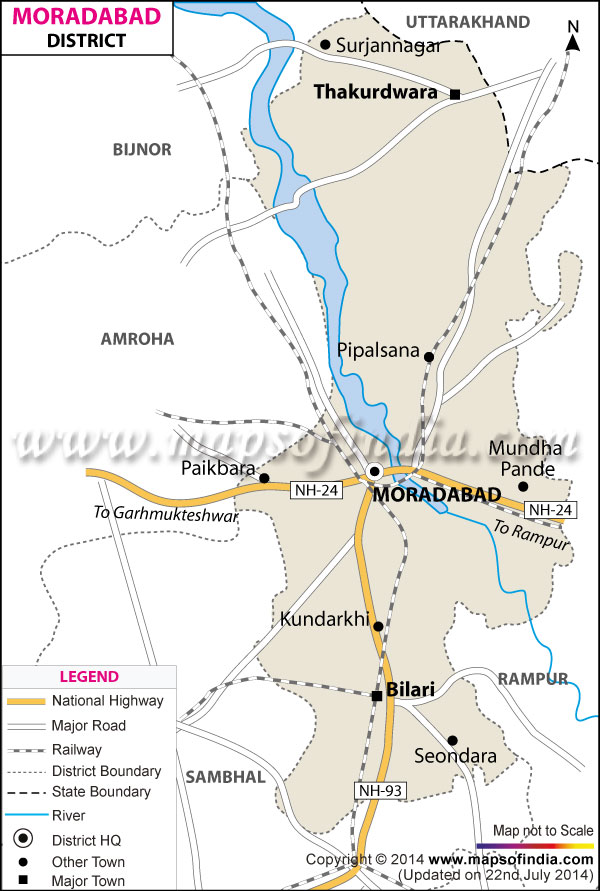





Introduction
Moradabad offers a rich history, rich culture, and rich craftsmanship, and it is often referred to as the 'Brass City of India', the city is also an exporter of brass handicrafts and it located in the western part of Uttar Pradesh, It is located on the banks of the Ramganga River. It is also known for its artistry worldwide. As you walk through the city you will hear the streets come alive as the sound of the pounding of metal calls to you. As you walk the streets of the city you will see many great brass crafts, a family business that has survived for centuries. Every great business has a great history to tell.
The architecture of the city shows Mughal empire influence and culture. Mughal architecture is present in the city through vibrant markets that are clearly modern and still have many bazaars and a great deal of history intact. The city has a great deal of history and so many communities. Every community has its own great and rich and diverse. The community is made up of different ethnic groups and rich in history, food, and also unique in its festivities. The city is like a dynamic, rich and modern new Moradabad, The brass city of new India remains a centerpiece for the city, the new and emerging markets are also a centerpiece for the city. The new and also emerging cultural and educational complexes are a great addition to the city also.
History
Moradabad has a past that's really complicated like the old brass things that people still sell in the markets. The city is on the banks of the Ramganga River in Uttar Pradesh. For a time it has seen a lot of different rulers come and go. Traders have come with ideas and craftsmen have made the city what it is today with their own hands.
The story starts in the time of the Mughals. According to sources Moradabad was founded in 1625 by Rustam Khan. He was in charge of the area under the emperor Shah Jahan. Rustam Khan named the city after his son, Murad. At that time the Mughal Empire was very strong and rich. Many cities grew as places for trade and government. It slowly became a busy city because of its good land and its location on trade routes.
Before the Mughals this area was not empty. It was part of a kingdom called Panchala, which is mentioned in old Hindu books. Over time it was ruled by groups, including the Delhi Sultanate. Like cities in North India it took ideas from each group that ruled it. You can still see this mix in the mosques, temples and narrow streets that tell stories from different times.
During the time of the Mughals, it became famous for making things out of metal. The city had craftsmen and could get the materials they needed. Brass became the thing that it was known for.
The 1800s brought a lot of change and uncertainty in the present day Moradabad The Mughal Empire got weaker and smaller groups took power. The British East India Company started to control more of North India. After a battle in 1764 the British had more influence in the area and slowly came under their control. The British changed the way the area was divided. It became the center of a district.
Moradabad changed a lot during the time the British were in charge. You can still see these changes if you look really closely. Back in the century the British built railway lines that connected to cities like Delhi and Lucknow. This made it a lot easier for people to travel and do business because everything moved much faster. Traders could send their goods to places outside the area and the people who made brass things did really well because of this.
People from Europe started to like the handicrafts made in India so the workshops got very busy. Small family businesses turned into working places and generation after generation of families made a living from working with metal. Around the time the British built courts, schools and government buildings in their own style, which gave some parts of Moradabad a different look.
Culture
Moradabad has a culture that feels down-to-earth. It's shaped by what people do every day, not by shows. Life moves slowly. Most traditions are kept alive quietly in families. People care about their relationships and social life is usually about neighbors, relatives and local markets where everyone knows each other.
One of the things about this place is its brass work. The city is also called Peetal Nagri. That's not just about work. Many families have been making metal things for a time and kids grow up watching their elders make intricate designs. Work and culture are the same here because making things is not about earning money but also about being proud.
Festivals are celebrated with warmth. During Diwali homes shine with lamps and sweets are shared between houses. Eid means markets, new clothes and special meals made with care. Holi fills the streets with color and laughter while weddings become celebrations with music, rituals and big gatherings. These events bring people together. Even those from different communities often meet and visit each other. The food is simple but tasty. Daily meals usually have roti, vegetables and dal. Special gatherings often have biryani, kebabs and rich curries. Evening tea is a tradition and it usually comes with long talks.
Clothing shows both old and new. Older people prefer sarees and kurta-pajamas while younger people mix styles with traditional clothes. Hindi and Urdu are spoken naturally in conversations making talks soft and respectful. Overall the culture here feels steady, practical and deeply rooted, in living.
Language
Moradabad has a language that's really mixed because of its history and the traditions that people share. The language that most people speak in the city is Hindi. It is used in schools, offices, markets and government work. People here speak a kind of Hindi that sounds natural and it has a local flavor because of how people use it every day, not because of what the textbooks say.
Hindi is not the language that people speak here mostly, rather Urdu is also very common. Many families in the older parts of the city speak Urdu at home and you can hear it when people get together to talk about poetry or during religious events or just when they are talking to each other. People often speak both Hindi and Urdu and they switch between the two languages without thinking about it. This mix of Hindi and Urdu makes the way people speak sound soft and polite and when people talk to each other every day they use words from both languages.
In the nearby areas people speak dialects like Khari Boli and some other languages that are common in Western Uttar Pradesh. These dialects sound a little different from the Hindi that people speak in the city and they have their own special words and expressions. The way people speak in the areas is usually clear and direct and it sounds like the way people speak in Western Uttar Pradesh.
Geography
Moradabad is characterized by the fertile agricultural plains of the Ramganga River, which is a tributary of the Ganga. The predominantly flat land is normal for the Gangetic plains, but there is an exception with some slightly varying stretches introducing a break in the flat and even stretch of land. With the exception of a short period of the year, there is a sharp increase in the humidity which is very high and can be over 40 degrees.
During the short season of flood, the rain falls from June to September. The dominant climate of the region is a subtropical one. The region offers great transport and road facilities as it lies strategically close to many of the major rail and road routes. The region lies in the middle of two great mountain systems which offers very early access to the mountain from the plains of the region.
Historically, that kind of placement has encouraged trade and cultural interchange, seen in the diverse communities and the bustling markets of the city. Most of Moradabad’s vegetation is due to human activity, dominated by artificial agriculture. Of the natural landscape, scattered greenery, mango groves, and trees by the road, offer a rural beauty. The Ramganga River's bird and fish population, and the river's banks, give the river an economic and ecological significance.
The geography of Moradabad is an amalgamation of all the fine- fertile - cultivable plains with the river and the extremes of temperature. It is this that has enabled the district to prosper as an agri zone and as a craftsmanship center, with the people and the land, in a fine balance, working to keep the tradition and progress.
| Facts of Moradabad District | |
|---|---|
| State | Uttar Pradesh |
| District | Moradabad |
| District HQ | Moradabad |
| Population (2011) | 4772006 |
| Growth | 25.22% |
| Sex Ratio | 906 |
| Literacy | 56.77 |
| Area (km2) | 3718 |
| Density (/km2) | 1284 |
| Tehsils | Bilari, Kanth, Moradabad, Thakurdwara |
| Lok Sabha Constituencies | Moradabad, Sambhal |
| Assembly Constituencies | Bilari, Kanth, Kundarki, Moradabad Nagar, Moradabad Rural, Thakurdwara |
| Languages | Hindi, Urdu, English, Khariboli, Haryanvi, Punjabi, Kumaoni |
| Rivers | Ramganga |
| Lat-Long | 29.027355,78.748398 |
| Travel Destinations | Sai Temple, Jama Masjid, Vidur Kuti, Raza Library, Mandawar Ka Mahal, Kanva Ashram, Pataleshwar Temple, Lord Shani Temple, Sita Temple, Kunj Bihari Temple, Bade Hanuman Ji Mandir, Braham Dev Ji Temple, Lord Venugopal Ji Temple, Shri Parshvanath Digambar Jain Mandir, Rambagh Dham, Najibudaulah�S Fort etc. |
| Government Colleges/Universities | Teerthanker Mahaveer University, Iftm University And Shri Venkateshwara University, Kedar Nath Girdharilal Khatri Pg College, Hindi College, Moradabad Institute Of Technology etc. |
FAQs
Q1: Where is Moradabad located?
Moradabad in the west of Uttar Pradesh which is along the River Ramganga. Its location has made it important in terms of trade and transport.
Q2: In which languages do people mainly speak in Moradabad?
Hindi is the primary language in this district which also sees great use of Urdu. In education and business we see the use of English.
Q3: What festivals are celebrated in Moradabad?
We see great celebrations of festivals like Diwali, Holi, Eid and Muharram; these events which also present a beautiful display of the city’s diverse culture.
Q4: Why is Moradabad important for exporters?
Moradabad is a prime export center for metal handicrafts in India. Its products are sold in European, North American and many other markets.
Q5: Does Moradabad have good transport connectivity?
Yes the district is a well connected one via railways and national highways. It also has access to Delhi, Lucknow and to many other major cities in the north.
Q6: What attracts tourists to Moradabad?
Visitors go to see the famous brass markets, historic monuments, religious sites and local handicraft workshops. The city’s past which is very rich also plays a role.
Last Updated on : July 27, 2026
