




Introduction
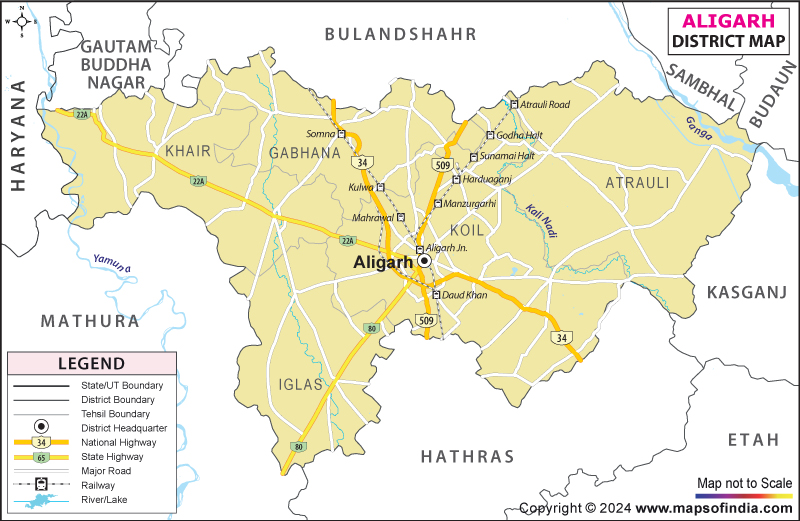
Aligarh district is strategically located in western Uttar Pradesh, clearly visible on the aligarh district map, whereby, trade, communication and political control have been aided in the past. It is surrounded by other districts like Bulandshahr district, Hathras district, Mathura district and Kasganj district, clearly visible on the aligarh district map. It has also improved its connectivity and economic connection due to its relative proximity to the national capital, Delhi. This geographical location, clearly visible on the aligarh district map has guaranteed that Aligarh is in touch with the larger regional processes and at the same time it has retained its own local flavor.
The presence of the Aligarh Muslim University, a central university in the district has also constituted one of the characteristics of this district as it has imparted national and international identity to the district. The university has not only created the landscape of the urban environment but the intellectual and cultural climate of the place as well. Indian and international students come to study here and this leads to a diverse and vibrant social environment. The small-scale industries, especially the manufacture of locks and hardware, are also significant in the maintenance of the economy of the district, in addition to education.
Aligarh district is largely rural, in spite of urbanization. A large percentage of the population still remains in Agriculture, as their major occupation. Fertile soil, irrigation facilities and existing links of markets have positively contributed to generation of agricultural projects over time. Aligarh district, therefore, is a combination of the traditional and modern, country life and city dreams.
History
The history of the Aligarh district is both layered and complicated, and covers the wider historical tendencies of north Indian history. The region used to be part of the cultural landscape of Indo-Gangetic plain in ancient times. Kol or Koil was one of the names of the territory in earlier times around the modern Aligarh. It was a territory of influence of different kingdoms of the ancient period which occupied fertile lands between the Yamuna and Ganga rivers.
In the early medieval times, the rulers of the Rajput were in control of the territories. As the Indian sub continent witnessed the growth of the Delhi sultanate in the thirteenth century, the region fell under the control of Muslims becoming part of new administrative and military systems. It was strategically located as it was situated on key routes between Delhi and other areas in the north of India. The local centre of governance and trade in the form of town of Koil was formed.
The region remained part of the imperial revenue system continuing to prosper under the Mughal Empire. The agricultural lands of the district were fertile and helped in making the empire prosperous and markets grew in the areas in response to agrarian surplus. Architectural traces and historical sources show that the region was still of administrative significance at this time.
A remarkable occurrence in the history of the district was one which happened later in the eighteenth and earlier in the nineteenth century. The Aligarh fort seemed to be the epicentre of the conflicts between Marathas and the British East India company. In the Second Anglo-Maratha war, in 1803, British troops seized the Aligarh Fort and this action became a critical action to firmly unite the British control in the north India. Later the district was added to the colonial administration system.
Social and intellectual transformation existed in the nineteenth century. The intention of the Aligarh Movement associated with Sir Syed and his associates was to establish a compromise between Islamic culture and modern science and this had a far-reaching impact on the politics and education of the colonial India.
The district experienced the national movements of the freedom fight and the politics of the Indian freedom movement. The university was involved in debates on constitutional reform, self-government and social change that involved students and thinkers of the university. In 1947, as India got independence, the reorganised state of Uttar Pradesh included Aligarh district. Administrative boundaries were also changed over time such as the creation of new districts out of the original territory.
During the decades after the independence Aligarh grew gradually as an educational and small-scale industrial centre. The lock making industry increased tremendously and it was able to supply its products to both the local and foreign markets in India. Meanwhile, the transport, communication and public services were increasingly enhanced, which changed urban and rural areas. The ancient heritage of settlements, medieval castles, colonial life and contemporary education measures and reforms still carry on shaping the identity of the district.
Culture
The Aligarh district is a culture of an interface between the rural culture, the urban institutions and crafts. The district is a western district of the state of Uttar Pradesh, clearly visible on the aligarh district map and it is a participant in the general cultural tendencies of the Upper Doab region. The agricultural seasons have a specific influence on the festivals, rituals and communal activities especially the village where the farming is still a significant part of the village life.
The major religious activities such as Diwali, Holi, Eid and Muharram are also celebrated enthusiastically which portrays plural social frame of the district. Such events are likely to bring together the families and neighbourhoods in shared viewing and celebration. The interaction of the society and the exchange of goods may be provided at the local fairs and seasonal markets, which enhances the communal bond.
Aligarh is perhaps the most unique in its cultural and economic aspects, which is the industry of locks. The craftsmen have been generations specialising in the manufacture of locks of all sorts of designs and methods. There are workshops, mainly owned by a family, which are distributed throughout the city and its surroundings. This craftsmanship tradition has brought about a feeling of professional identity and pride. The skills are passed down through a generation, which promotes continuity, but at the same time is able to adapt to the new market demands.
The food in the Aligarh district is a pointer to the rural prosperity and diversity in urban life. Wheat-based bread such as roti and paratha are also included in the staple food with lentils, vegetables and dairy foods. The food influences are also culinary based and can be seen in cities, like rich gravies and sweet meals. Food habits are also normally different in homes of rural and urban settings having shared regional attributes.
There is continuity and change in social structures of the district. Communities living in villages tend to have rather well developed kinship ties and patterns of traditional authority whereas urban families tend to have more chances of appreciating modern careers and education. The district therefore offers a cultural terrain in which the traditional ways are merged with the emerging desires.
Language
The linguistic nature in the district of Aligarh is similar to the one of the larger part of western Uttar Pradesh. Hindi acts as the major language of administration, education and everyday communication. Urdu also plays an important role especially in the cities and in connection with both literary and scholastic traditions associated with Aligarh Muslim University. The co-existence of Hindi and Urdu has influenced the discourse in the society, signs and cultural expression of the district.
In the rural locations, western Hindi, which is associated to Khari Boli is a commonly spoken local dialect. These dialects exhibit the unique phonetic and lexical characteristics that are associated with an agrarian environment of the area. English is spoken in post secondary education, official correspondence and in professional activities particularly in the university and the government offices.
Geography
The Aligarh district is geographically situated in the Upper Doab, clearly visible on the aligarh district map which is the region that is situated between the Yamuna and the Ganga rivers, clearly visible on the aligarh district map. Although the city of Aligarh is not traversed by the large rivers, the soils in the locality are alluvial and are formed, as a result of rivers systems, over time. The area is mostly flat thus it is favorable to large scale agricultural practices and transport infrastructure can be established comfortably.
The district climate is typical of the north Indian plains, being hot in summer, having monsoon and cool winters. There are high temperatures in summer and fogs in the morning of winter. The monsoon also supplies the crops with the necessary rainfall, which is complemented by the irrigation of the canals and tube wells. Water management is a factor that would contribute to the sustainability of the agricultural activities and avoid the waterlogging.
The rural economy is strategy based on agriculture. There are major crop such as wheat, paddy, sugarcane and pulses. Farmers have been able to produce several crops annually due to the availability of irrigation. The level topography and the road system of the district link villages to the markets of the Aligarh city and the rest of the economy and incorporates the rural producers into the larger economies.
The urban development has expanded the urban land of the historic city and the university campus. The urban area is characterized by residential colonies, commercial markets and small industrial areas. But leaving the city centre, the picture quickly transforms to outlands and farmlands, which illustrates the eternal significance of farming.
| Facts of Aligarh District | |
|---|---|
| State | Uttar Pradesh |
| District | Aligarh |
| District HQ | Aligarh |
| Population (2011) | 3673889 |
| Growth | 22.78% |
| Sex Ratio | 882 |
| Literacy | 67.52 |
| Area (km2) | 3788 |
| Density (/km2) | 1007 |
| Tehsils | Koil, Khair, Atrauli, Iglas, Gabhana |
| Lok Sabha Constituencies | Aligarh |
| Assembly Constituencies | Aligarh, Atrauli, Barauli, Chharra, Iglas, Khair, Koil |
| Languages | Hindi & Urdu |
| Religion | Predominantly Hinduism |
| Rivers | --- |
| Lat-Long | 27.900383,78.079734 |
| Travel Destinations | Aligarh Fort, Chacha Nehru Gyan Pushp, Naqvi Park, The Mangalayatan, Jama Masjid etc. |
| Government Colleges/Universities | Aligarh Muslim University, Mangalayatan University, Jawaharlal Nehru Medical College, Sir Ziauddin Dental College, Abdulla Girls College, Azmal Khan Tibiya College, D S College, S V College, Tikaram Girls College etc. |
FAQs
Q1: What is Aligarh district best known for?
Aligarh district is best known for its lock manufacturing industry and Aligarh Muslim University.
Q2: Where is Aligarh district located?
Aligarh district is located in the western part of Uttar Pradesh in the Upper Doab region, clearly visible on the aligarh district map.
Q3: What was Aligarh called in earlier times?
Aligarh was historically known as Kol or Koil.
Q4: What is the main economic activity in rural areas of Aligarh district?
Agriculture is the main economic activity in the rural areas of Aligarh district.
Last Updated on : May 08, 2026
