




Introduction
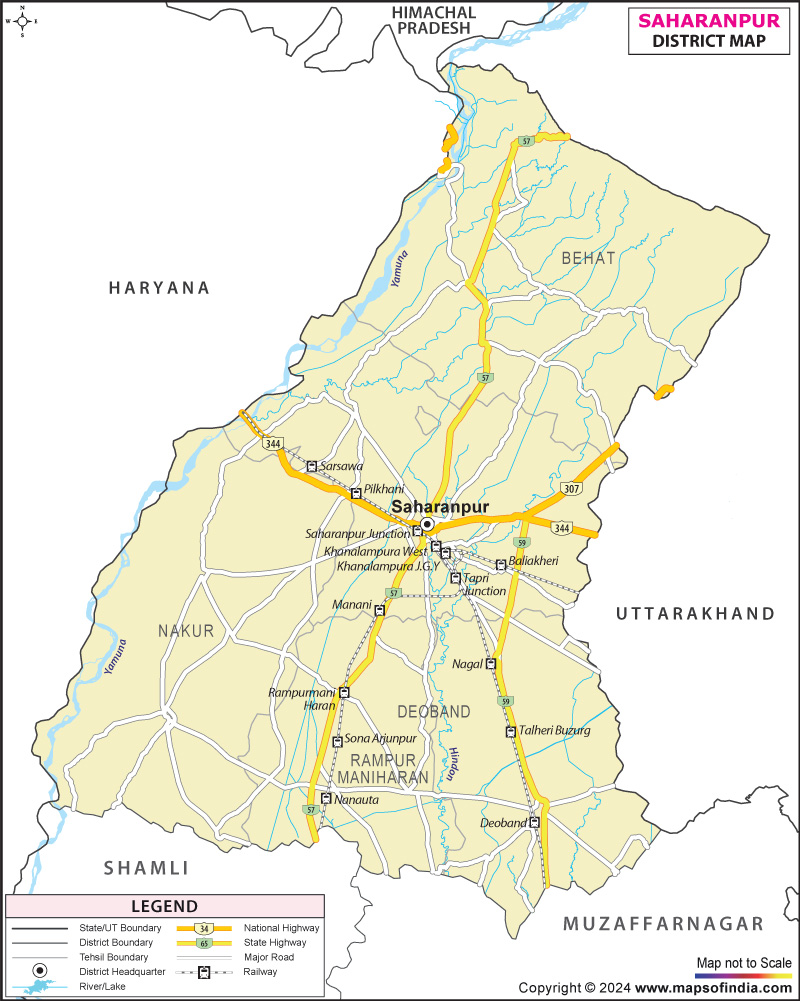
The Indian state of the Uttar Pradesh and specifically the Saharanpur district is the northernmost location of the Indian region of Upper Doab so far as existed between the rivers of Ganga and Yamuna. The district is ideally situated in terms of geography as it is at the confluence of fertile Indo-Gangetic plains and is the outer foothills of the Himalayas which is the Shivalk range.This is a middle ground, a place that has influenced its historical path, agrarian wealth and ethnic makeup. The administrative headquarters of both the district and the Saharanpur division is located in Saharanpur city which is also a major commercial and educational centre in western Uttar Pradesh.
The district is well-known as the wood-carving industry that takes national and international recognition on the complex craftsmanship. Outside the industry, Saharanpur continues to be heavily agricultural with sugarcane, wheat and rice as major crops since the region has fertile alluvial soil with favourable irrigation conditions. It also has the added strategy and economic significance of being close to the states of Uttarakhand and Haryana, which additionally place it at the intersection of both cultural and business flow. As a diverse population with long historical background, Saharanpur is a district in which the tradition and modern development mutually support one another.
History
History of the Saharanpur district dating back to ancient times has shown that during the earlier historic times, human settlement was found in the larger area. It lay in the fertile plains thus guaranteeing perpetual habitation since agrarian societies thrived by river systems and trade routes along the Northern India. Even in the earliest centuries, however, which are only covered by scattered records, the district was included in larger political units that ruled over the Gangetic plains in the Mauryan and Gupta and other regional dynasties.
Saharanpur is known in the medieval period when it was under the control of the Delhi Sultanate and subsequently Mughal Empire. The name of the district is commonly connected with the Sufi traditions and local historical grounds relate it to a Sufi saint, Shah Harun Chishti. The town later on became a venue of administration and trade in the region. The fertile Aryan lands (Doab) during the Mughal rule were well planned and the revenue resources were organized to exploit the productivity of the land.
The power dynamics changed in the region in the eighteenth century with the weakening of Mughal rule with the forces of Afghanistan, Rohilla and Maratha taking over and finally, the region fell into the hands of the British in the early nineteenth century. Saharanpur was added to the North-Western Provinces in the time of the British rule and became a significant administrative centre. During the colonial era, there were infrastructural development like roads, railway lines and canal networks that increased agricultural production and trade connectivity to a great extent.
Saharanpur was a full-fledged fighter in the revolt of 1857 when many people in the North of India rejected the English rule. The participants in the uprising included the local leaders and communities, which implied the assessment of the involvement of the district to the broad tendencies of Indian resistance. Regardless of the fact that the rebellion was suppressed, it left a great impact in the political consciousness of the region.
Among the very important events of the history of the modern times of the district was the establishment of Darul Uloom Deoband in 1867 within the town of Deoband in the district. It has become one of the greatest religious seminars in South Asia and impacted greatly on the religious philosophy and religious training that spread long across the Saharanpur frontiers. The intellectual legacy is the thing that makes it known to the world still.
Saharanpur became a part of the reformed state of Uttar Pradesh after independence of India in the year 1947. It transformed both administratively and economically through the decades and the Saharanur division was manufactured in 1997 having its Headquarters in Saharanur city. Since then the district has since made strides in increasing its population and urbanization, and it did not lose close ties with its historical and cultural heritage.
Culture
The Saharanpur district culture can be regarded as an ideal union of cultural activities designed decades of harmony of various peoples life. Festivals, fairs and religious holidays form part of the significant part of the social life as Hindu and Muslim holidays have been passionately celebrated and attended in many parts.
The dress of the district is conservative, and it points to greater North Indian brands, though rural and urban influences are to be met with. Saharanpur food is a mixture of western agrarian culture of Uttar Pradesh and Mughlai food and Awadh cuisine. Common meals are made using breads of wheat, lentils, and vegetables and dairy products, which are consumed daily, whereas special meals are made using elaborate desserts and savoury food, consumed during specific events.
The other influence on the cultural life of the district is via education institutes, religious centres and community organisations. Saharanpur cuisine is a blend of western agrarian culture of Uttar Pradesh and Mughlai and Awadhi cuisines. Breads made with wheat, lentils, and vegetables and dairy products, which are available throughout the year, are part of everyday meals, and elaborate desserts and savoury dishes are served during special events.
Another way in which the cultural life of the district is influenced is through educational institutes, religious centres and community organisations. Besides Darul Uloom Deoband, the district has a large number of schools and colleges that are able to enhance literacy and professionalism. Cultural continuity is also maintained with oral traditions, local music and community story telling which maintain common past and memory.
Language
Hindi is the dominant lingo in the Saharanpur district and is the major unit of administration, education and communication. The census of India 2011 indicated that the population of the district was largely Hindi speaking. Nevertheless, Urdu is not left behind in the social and cultural life of the district as it is spoken by a large percentage of the population and is commonly used in literature, religious and informal films.
The presence of Hindi and Urdu in Saharanpur is an indication of the centuries of mutual language development in the north of India. Whereas Hindi is written using the Devanagari writings, the Urdu language uses the Perso-Arabic writings, but the spoken languages tend to mix words and grammar, particularly in informal language. This fluidity of language promotes communication among societies and helps in an enrichment of the cultural expression.
Local dialects of Hindi at the expense of neighbouring areas, e.g. Haryana and Uttarakhand, can also be found in rural areas. Such dialectical differences introduce a complexity to the normal conversation and convey historical migrations and trade. The affects of Punjab are sometimes felt as a result of geographical closeness as well as historical engagement with states that have been close to it.
Language in Saharanpur is therefore according to a medium of communication but also an identity, tradition and cultural continuity. The primacy of language in the formation of community life is reinforced by literary meetings, religious teachings, learning lessons, etc.
Geography
The physical setting of Saharanpur can broadly be classified into two physical regions. The southern and central ones are made up of fertile alluvial plains which are characteristic of the Upper Doab region. The plains are very arable as they have good deposits of soil and also the irrigation systems are well established such as well-established canals and tube wells. One particular outstanding activity is the sugarcane farming with favourable climatic conditions and availability of processing units.
The north of the district, on the contrary, is slowly swelling towards the Shivalik Hills, the outermost range of the Himalayas. This area has a wave like topography in the form of forested blocks and seasonal streams flowing out of the hills. Topography provides ecological diversity due to the topographic variation, which affects the distribution of rainfall and vegetation cover. The district has a subtropical climate with hot summers, monsoon seasons, which receive most rainfall per year and cool winters.
The river systems in the district are very important in determining the geography and the economy of the district. Smaller rivers and seasonal streams cross the area aside the Yamuna, and provide irrigation and water replenishment to the ground. Saharanur agrarian economy has long been supported by fertile soil, sufficient rain and irrigation facilities.
The urban development is centred in the Saharanpur city and some tehsils in the district with the rural settlements constituting much of the terrain. The district is connected by transport networks such as rail and road networks to major cities like Delhi and Dehradun which strengthen the argument that it provides a gateway between the plains and the Himalayan foothills.
In general, the geography of Saharanpur is a combination of plains and hills, farming and industry, country lifestyle and city development. Its geographical location has has had a tremendous impact on its history, culture and economic orientation, as it is now a unique district of Uttar Pradesh.
| Facts of Saharanpur District | |
|---|---|
| State | Uttar Pradesh |
| District | Saharanpur |
| District HQ | Saharanpur |
| Population (2011) | 3466382 |
| Growth | 19.66% |
| Sex Ratio | 890 |
| Literacy | 70.49 |
| Area (km2) | 3860 |
| Density (/km2) | 939 |
| Tehsils | Behat, Deoband, Nakur, Rampur Maniharan, Saharanpur |
| Lok Sabha Constituencies | Saharanpur |
| Assembly Constituencies | Behat, Deoband, Gangoh, Nakur, Rampur Maniharan, Saharanpur, Saharanpur Nagar |
| Languages | Hindi, Urdu |
| Religion | Predominantly Hinduism |
| Rivers | Yamuna |
| Lat-Long | 29.835879,77.469292 |
| Travel Destinations | The Saharanpur Botanical Gardens, Ambedkar Memorial, Shri Hari Mandir, Gurdwara Sri Guru Singh Sabha, Shia Jamamasjid, Chota Imam Barha, Patheshwar Temple, Hari Krishna Mandir, Suparshvnath Jain Temple, Jain Temple, Bhuteshwar Temple, Bagheshwar Temple, Jama Masjid, Nau-Gaza Peer Shrine, Ojhria Peer Shrine, Shahjahani Mosque, Masjid Domazili, Masjid Imli Wali, Shri Baba Lal Das, Shakti Peeth Shakumbari, Guggha Veer/Gughal etc. |
| Government Colleges/Universities | Mahraj Singh College, Jv Jain Degree College, Munna Lal (Girls) Degree College etc. |
FAQs
Q1: What is the Saharanpur district most famous for?
Saharanpur is best known for its traditional wood-carving industry and high-quality handicrafts.
Q2: Where is the Saharanpur district located?
It is located in the northernmost part of Uttar Pradesh, bordering Uttarakhand and Haryana.
Q3: How does Saharanpur’s location influence its climate?
Its position between the Gangetic plains and the Shivalik foothills gives it a subtropical climate with hot summers, monsoon rains and cool winters.
Q4: Why is Deoband significant in the Saharanpur district?
Deoband is home to Darul Uloom Deoband, an internationally recognised Islamic seminary established in 1867.
Last Updated on : July 13, 2026
