






Introduction
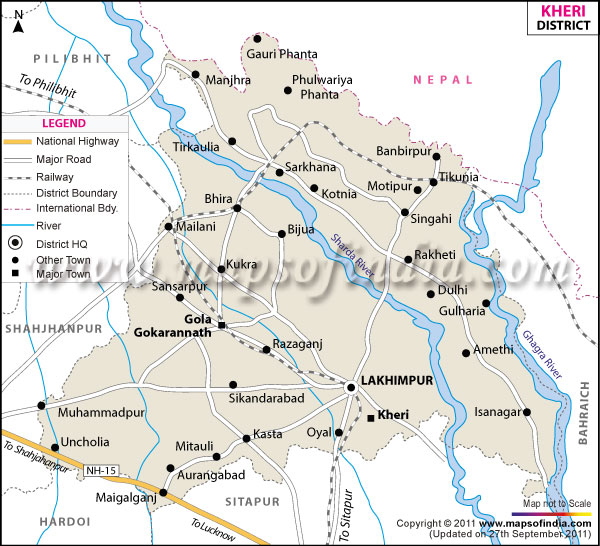
The district lies in the Terai region bordering the India-Nepal border which is marked by fertile plains rich forest and a diverse countryside. Its headquarters residence is in the town of Lakhimpur. The district is a significant portion of the state agricultural economy due to the area and variety of environment. In the study of regional planning literature or of geographical resources, the Lakhimpur district map generally offers a very necessary explanation of the large scale terrain and settlement pattern of this district.
The region is well known due to its agricultural productivity especially in the crops like sugarcane, wheat and rice. There are many sugar mills in the area which are adding to the local economy and job openings. Besides this, it is also home to the production of menthol mint that has gained greater significance to farmers over the recent years. Agricultural sceneries prevail in much part of the area and the Lakhimpur district map could be often used to reflect the vast network of villages and agricultural land that is the mainstay of the district economy.
History
The history of the Lakhimpur district mirrors the historical happenings of the north India at large. Settlement in the region can be traced back to ancient times when the fertile land and the water resources of the Terai plains affected the settlements in the area. According to the historical sources, the region belonged to the ancient cultural domain of Awadh. Throughout the centuries, the region was ruled by different dynasties and rulers and this influenced the culture and political identity of the region. The Lakhimpur district map can be frequently utilized in historical research and school textbooks to demonstrate the territorial limits which changed over time.
In the medieval period, various regional powers took control of the area and the area became a part of Mughal Empire. The Mughal regime brought about systematic types of financial systems and agricultural policies which promoted multiplication and settlement in the arable plains. The trade routes emerged all over the area and linked local markets to the greater urban centres. The Lakhimpur district map is commonly used by the historians to examine the manner in which these historical paths travelled across the district and helped it to develop.
The region became under the control of Nawabs of Awadh with the fall of Mughal Empires in the eighteenth century. There was reform in administration and additional agricultural growth initiated in Nawabi period. Most of the villages in the district owe their existence in this period. The map of the Lakhimpur district assists the scholars to comprehend the ways in which settlements extended through this time, how the district had become incorporated into the administrative organization of the Awadh.
Lakhimpur joined the British colonial government in 1856 after the annexation of Awadh in the year 1856. The colonial masters restructured the administrative units and brought about new tax systems. Roads and railways slowly enhanced the infrastructure that connected the district to other regions of the entire of northern India. Lakhimpur district map emerged often on the administrative records of the colonial governance as valuable source of governance and taxes.
The district also experienced the larger political and social movements that defined the struggle of India to attain independence. Local communities were taking part in the national movements of self-rule and social reform. Despite the fact that the area was mostly rural, there was a slow but steady political consciousness and engagement in the early twentieth century. Historical archives and educational resources tend to use the map of the Lakhimpur district in order to place these developments in context with the wider geography of the district.
The district remained within the state of Uttar Pradesh which achieved independence in 1947 after India gained independence in 1947. The development of the region by agricultural reforms, irrigation and rural development projects slowly changed the landscape. Lakhimpur district map has been highly utilized as an administrative tool in developing the development projects, land management and distribution of the resources during the post independence era.
Culture
The cultural life of Lakhimpur district is the tradition of the Awadh region mixed with the rural local customs. Community meetings, religious activities and holidays are a major focus in their lives. Most of the citizens are Hindu and there are significant proportions of Islam and Sikhs and these provide a rich social culture. Religion and cultural sites in the district are frequently indicated on the Lakhimpur district map to assist the visitor and the researcher to find significant temples, mosques and shrines in the district.
There are some traditional festivals which are enthusiastically practiced like Diwali, Holi and Dussehra. At such events, there are bright decorations as well as music and communal festivities in villages and towns. This is due to the fact that Muslim communities observe policy festivals like Eid with equal zeal, and it demonstrates the interreligious co-existence tradition within the district. The Lakhimpur district map can be used as cultural tourism materials to direct the travels of those wishing to explore culturally important spots by attending such festivals.
The culture of food in the district is a manifestation of agricultural prosperity in the area. Breads made of wheat, rice, lentils and vegetables of the season are some of the staple foods. Dairy foods are very common and traditional sweets made in the form of festivals and celebrations. The local markets are significant in the distribution of agricultural products and hand made products. These are the markets that are frequently depicted on the map of Lakhimpur district that shows that they are the centres of economic and social life.
In addition to the fact that agriculture determines the economy, it also shapes the social pace of life. The speed of rural practice and the festivities of the community is set by seasonal cycles of planting and harvesting. Harvest festivals are a time of thanksgiving and socialization. The projects in cultural documentation can use the Lakhimpur district map in order to learn how the agricultural territories are related to specific cultural practices.
Language
In Lakhimpur district, language is used as a form of language diversity in the Awadh region. Hindi is the main official and administrative language and is commonly used in the field of education, government and communication. As census shows, the language most spoken by the majority of residents in the district is Hindi.
Awadhi is also spoken as a dialect along with Hindi. Awadhi is a local language that is part of the wider Hindi language continuum, and possesses a rich literary and cultural tradition in northern India. Awadhi is informally used in many rural communities within the Lakhimpur district, but in formal instances, Hindi is used. The distribution of dialects in various parts of the district is analysed using the Lakhimpur district map when conducting linguistic surveys.
The Urdu language is also used by communities of the population especially by the Muslim communities. The existence of several languages is a manifestation of the historical relations and multiculturality of the district. Educational institutions and schools tend to be taught in Hindi and English, which guarantees the contact with the rest of the national and international environment.
The district is highly tied with the cultural identity and language. The folk songs, oral traditions and local storytelling tend to be in Awadhi language and keep the cultural heritage of the region. The Lakhimpur district map can be utilized by linguists researching the regional dialect of various areas to determine the linguistic patterns based on the geographical area and the distribution of settlements.
Geography
Lakhimpur district is characterized by the district being located in the Terai region of the northern part of Uttar Pradesh. The district is near Himalaya feet hills and borders Nepal. Such a geographical location affects the climate, plants and patterns of farming in the region. The Lakhimpur district map can be a clear illustration of the closeness of the district to the international borders and other neighbouring districts in the context of geographical studies.
The district is mostly made of flat alluvial plains due to the rivers that have their source in the Himalayan region. These are fertile plains which are conducive to large scale agricultural production and offer a high population of rural people. The region has major crops that are wheat, rice, maize, barley and sugarcane. The Lakhimpur district map could be used by agricultural planners in order to determine irrigation networks and agricultural areas.
The rivers are significant in determining the geography of the district. The region has several rivers and seasonal streams, which are used in irrigation and recharge of ground water. Meanwhile, rivers also cause floods during the monsoon season at times. The Lakhimpur district map can also prove useful in hydrological research to trace river systems and prone areas to floods.
The area is also rich in forest and wildlife areas. The code of the environment researcher is normally the Lakhimpur district map to identify the forest reserves and the ecological zones that are under protection as the climate of the district is usually subtropical with hot summers, a monsoon season with heavy precipitation and moderate winters. Such a climate regime favours year long agricultural output. The Lakhimpur district map is used frequently in meteorological and agricultural research to determine the variations in climate in various areas of the district.
The territory of the district comprises of hundreds of villages, small towns and agricultural settlements located on a huge territory. These settlements are linked to bigger urban centres of Uttar Pradesh by transport networks. Road and rail transport is a vital component in aiding trade and movement. The Lakhimpur district map can be used by the infrastructure planners to comprehend the topography of transport pathways and governmental units.
| Facts of Lakhimpur Kheri District | |
|---|---|
| State | Uttar Pradesh |
| District | Lakhimpur Kheri |
| District HQ | Padrauna |
| Population (2011) | 1042137 |
| Growth | 25.38% |
| Sex Ratio | 894 |
| Literacy | 60.56 |
| Area (km2) | 7680 |
| Density (/km2) | 1226 |
| Tehsils | Dhaurahara, Gola Gokaran Nath, Lakhimpur, Mohammdi, Nighasan, Palia |
| Lok Sabha Constituencies | Kheri, Dhaurahra |
| Assembly Constituencies | 8-Dhaurahra, Gola Gokrannath, Kasta, Lakhimpur, Mohammdi, Nighasan, Palia, Sri Nagar |
| Languages | Hindi including Awadhi |
| Religion | Predominantly Hinduism |
| Rivers | Sarda, Ghaghara |
| Lat-Long | 28.168875,80.633354 |
| Travel Destinations | Naseeruddin Memorial Hall, Eidgah, Shiv Temple Gola Gokarannath, Frog Temple, Sai Temple, Shiv Temple (Devakali) etc. |
| Government Colleges/Universities | St. Don Bosco'S College, Manu Law College, Guru Nanak Degree College, Royal Prudence Degree College etc. |
FAQs
Q1: Where is Lakhimpur district located?
Lakhimpur district is located in the northern part of Uttar Pradesh near the India–Nepal border.
Q2: What is Lakhimpur district known for?
The district is widely known for its agriculture, especially sugarcane cultivation and sugar mills.
Q3: Does Lakhimpur district share an international border?
Yes, Lakhimpur Kheri district shares a northern border with Nepal, influencing trade, culture and regional connectivity.
Q4: Which natural region does Lakhimpur district belong to?
The district lies in the Terai belt, a fertile ecological zone located at the foothills of the Himalayas.
Last Updated on : May 08, 2026
