






Introduction
Sant Kabir Nagar along with eastern Uttar Pradesh, retains the unique charm that rural India possesses. THE the name of the 15th century mystic poet and saint reflects Kabiir legacy of simplicity and devotion. Sant Kabir Nagar is divinely blessed with the swirling fertile fields of the core agrarian Ghaghara river basin. The district's economy is agrarian and dominated by small villages and towns, Kherana, Laura, Turkaulia, and Market Khalilabad, where weekly fairs and traditional craft are woven into the fabric of folk songs.
It is famous for its handlooms, particularly those of exquisite and brilliantly colored. Sant Kabir Nagar also has pilgrimage fairs and events that attract visitors seeking spirituality and about Kabir's units of division on caste. It is a rural district where life thrives around a Vata (Banyan) tree, a miscellany of wisdom and timeless stories that sustain India as a spiritual country. The city along with the whole of rural India should exist on the cartographic shrine as a living monument of spirituality with a great culture and rich heritage.
History
Even though Sant Kabir Nagar became a district in 1997, the history of the place goes back a long time. Kabir spoke out against following rituals and the divisions between castes. He believed in one God. Thought that people should devote themselves to him in a simple way. His poems were straightforward and fearless. The British introduced a system of taxation which affected farmers deeply. They had to pay taxes and the way land was owned changed.
During the freedom movement the region played its part. News of events reached even the small villages. The ideas of leaders like Mahatma Gandhi inspired people. The Non-Cooperation Movement and the Quit India Movement saw people from areas of Basti and Gorakhpur participating. Although it was not a district at that time, its people were part of the larger movement towards independence. Young men joined protests. Some were even arrested. The desire for independence spread through schools and gatherings.
After India became independent in 1947 the area that is now Sant Kabir Nagar district was still part of Basti district. Over time the population of the district. The people needed better administration. Small villages in the district turned into towns. The people of the district Kabir Nagar district got roads, schools and health centers. It took a long time.
Agriculture was the thing that kept the economy of the district going. Sugarcane became a crop in some parts of the district and small industries started to come up.
In 1997 the district was officially formed. It was made from Basti district. Khalilabad was made its headquarters. The people of the district felt happy and proud to have a district named after Kabir. It reminded them of the roots of the district.
The people of the district have always been a mix of communities. Hindus and Muslims have lived together in the district for a time. The teachings of Kabir about unity are still remembered in the traditions of the district. Village fairs around Maghar are very popular. People tell stories. Sing folk songs about Kabir and his simple ideas. Many families in the district still keep booklets of his sayings in their homes.
Culture
Sant Kabir Nagar has a culture which is diverse and vivid. People here follow customs that have been around for a long time. The city is simple yet peaceful. One may not find fancy places but there is no shortage of fields, local fairs and everyday habits that people still care about.
Kabir's ideas about being equal and being devoted without rituals are still heard in songs and gatherings. In Maghar, where Kabir spent his days, people from different religions visit his samadhi. During times people sing simple bhajans and dohas of Kabir without using many instruments. The message of Kabir is more important than how it's performed. This unity quietly shapes how people live together in the region.
Village life is part of cultural practices here. Most families do some kind of farming. They celebrate festivals with joy even if they don't have much. Holi brings colors and laughter to narrow streets. Diwali lights up mud houses and brick homes. During Eid families make food and visit each other. These times bring people together. Make community ties stronger.
When there are weddings and festivals you can hear people singing folk songs and traditional music. Most people talk in Hindi. They also use some Awadhi and Bhojpuri words, which makes the local language sound very nice and down to earth. Many villagers still wear clothes. Men wear kurta-pajama or dhoti while women wear colored sarees. Modern fashion is slowly coming into towns, like Khalilabad. Traditional clothes are still respected.
The culture of Sant Kabir Nagar moves at its pace. It's quiet but steady. It values faith, family and community life over showing off. Kabir's teachings, farming seasons and village bonds all come together to give the district its yet meaningful cultural identity.
Language
The majority of the population uses Hindi. This language is used in all forms of administration, education, and in all forms of communication. This is the language of choice in schools, government offices, and in the print media. Therefore, it is the dominant language in the sociolinguistic space of Sant Kabir Nagar.
Furthermore, in some communities where there is a major cultural and literary tradition, a dominant place is afforded to Urdu. The place of Urdu is evident in the poetry, religious discourse and the literature of the locality. This also adds to the cultural richness of the district. There is also the presence of Hindi-Urdu diglossia. However, a dominant place is afforded to the Bhojpuri dialect. This dialect is used in all the informal interactions in the family, markets, and in the village.
This dialect is the carrier of all the folk songs and oral traditions and the warmth of informal conversations. Most of the folk performances, festivals and marriages in the villages also use the Bhojpuri dialect in a rural setting of Sant Kabir Nagar. This district uses both Hindi and Urdu in order to connect itself with the interstate and intercountry realities. On the other hand, the use of Bhojpuri dialect gives the people a feeling of closeness and also a sense of identity. This diversity of languages and dialects help to create a smooth transition in use of formal and informal style of language.
The multilingual setting portrays the history and the social texture of the district as well. Sant Kabir Nagar (named after Sant Kabir), has been a confluence of varying traditions. The literary and devotional usage of Hindi and Urdu posits Kabir's advocacy of cross-border communitarianism. Besides, the use of Bhojpuri is testament to the retention of the oral tradition of the area. All these languages exemplify modernity and tradition - Hindi and Urdu signifying the new means of expression, while Bhojpuri epitomizes the cultural legacy.
It is commonplace to see communicative preferences of people change along the lines of situational contexts. For example, teachers may use Hindi, poets may use Urdu, while folk singers of the Bhojpuri genre may use the language during the harvesting festival. Such dynamics of language use deepen the cultural richness of the district, and provide the essence of different identities. The multilinguality of Sant Kabir Nagar is an indicator of the social unity in the district and is an illustration of the language 's cultural and communicative role combined.
Geography
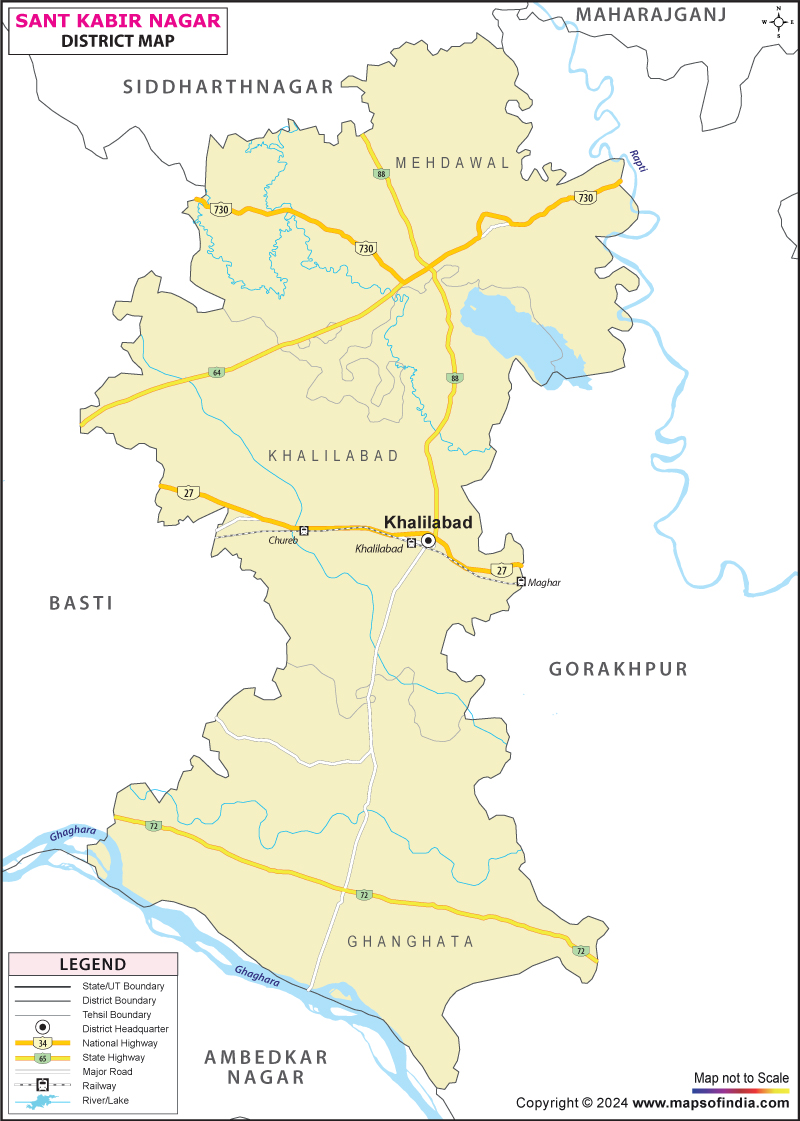
The district of Sant Kabir Nagar is located in eastern Uttar Pradesh and has a geographical layout that is highly interdependent with rural life and the courses of the rivers in the region. The area is roughly 1,646 square kilometers and is a segment of the Gangetic flood plains and has a slightly sloping terrain and highly alluviated soils that have supported agriculture from the earliest of times.
In the region of Santkabirnagar, the Ghaghara River and its effluents, including numerous smaller rivers and ponds, have a major influence on the ecology and the pattern of human inhabitants. The predominant cultivation of the area is in alluvium, of which wheat, rice, sugarcane and pulses. One of the most remarkable features of the city is the Bakhira Bird Sanctuary. This is the largest natural wetland in Eastern Uttar Pradesh. It has a hand loom industry which adds to the economy and culture of the district. The National Highway 28 goes across the district and connects to Gorakhpur and Lucknow which makes transportation easier.
The rivers, wetlands, and fertile plains also serve a livelihood purpose, but also draws inspiration and spiritual imagery with the legacy of Saint Kabir who is the namesake of the district. Santkabirnagar's geography is a union of land and water. The district is a living art with a fusion of culture, ecology and agriculture, where the natural aspects shape human life giving a sense of spirituality and history.
| Facts of Sant Kabir Nagar District | |
|---|---|
| State | Uttar Pradesh |
| District | Sant Kabir Nagar |
| District HQ | Khalilabad |
| Population (2011) | 1715183 |
| Growth | 20.77% |
| Sex Ratio | 972 |
| Literacy | 66.72 |
| Area (km2) | 1646 |
| Density (/km2) | 1014 |
| Tehsils | Ghanghata, Khalilabad, Mehdawal |
| Lok Sabha Constituencies | Sant Kabir Nagar |
| Assembly Constituencies | Dhanghata, Khalilabad, Menhdawal |
| Languages | Hindi, Urdu |
| Rivers | Kuwano, Kathinayya |
| Lat-Long | 26.765231,83.02288 |
| Travel Destinations | Bakhira, Hainsar, Maghar, Tama(Tameshwar Nath) etc. |
| Government Colleges/Universities | Hr Post Graduate College, Govt. Mahila Degree College, Smt. Prabha Devi Mahavidyalaya, G.P.S. Mahavidyalaya etc. |
FAQs
Q1: What is the main occupation of people living here?
Agriculture is the occupation of people here. Most families are dependent on farming for their livelihood. People here grow crops like rice and wheat and sugarcane because the soil is very fertile and good for farming.
Q2: What language do people speak in this district?
The main language people speak in schools and offices is Hindi. In life people also speak local dialects that are influenced by Awadhi and Bhojpuri languages.
Q3: When did this district come into existence?
The district was formed in the year 1997. It was created by separating it from the Basti district so that the administration and development of the area can be improved.
Last Updated on : May 08, 2026
