|
||||||||||
 | ||||||||||
|





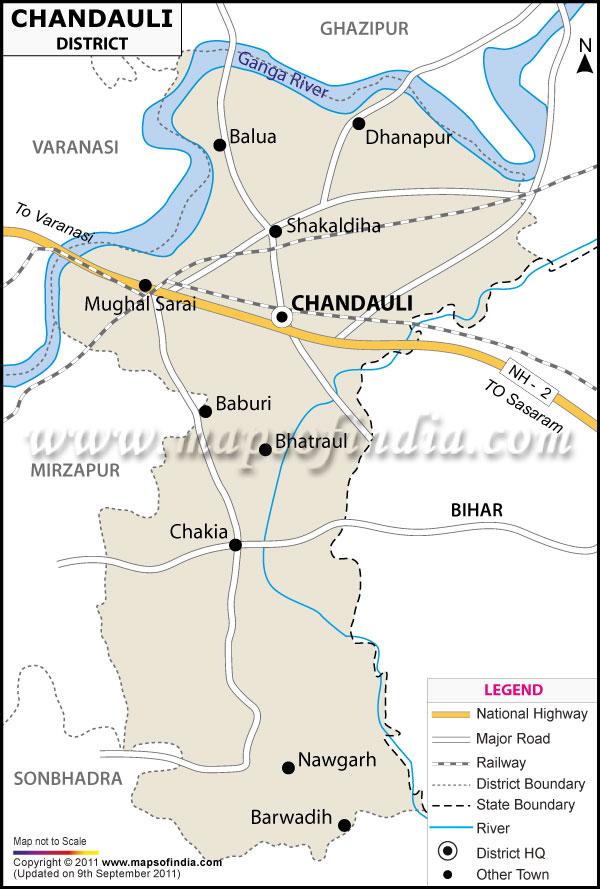
| *The Map showing the National Highway, Major roads, other Roads, District Headquarter, Town, etc in the Chandauli District, Uttar Pradesh |
About
Chandauli is situated in the south-eastern part of Uttar Pradesh. It is popularly known as the "Dhaan Ka Katora" (the rice bowl) of the state. This claim is based on the highly fertile Gangetic plain, which forms a large part of this district where the main crop cultivated is paddy and the local black rice, which is cultivated by the farmers in this area. The district town is named after the district headquarters town, Chandauli. During the early days of the formation of the district, it was officially called but for a very brief period and was soon rechristened as Chandauli. Chandauli was created from part of Varanasi district and was officially formed as a separate district on 20 th May 1997. The district is part of the Varanasi division, with administrative headquarters at the town of Chandauli. The district is bounded by the Ganga River to the north, with the Karmanasa and Chandraprabha rivers flowing through the district. The districts bordering Chandauli are Bihar to the east, and the districts of Varanasi, Ghazipur, Mirzapur, and Sonbhadra.
History & Culture
Early Roots and Freedom Movement
Chandauli's surroundings were part of the Kashi cultural sphere for many centuries. The hills, forested ridges and rivers in and around this region served as a transit corridor between the alluvial plains of the Gangetic river and the tableland region lying to the south. Kashi's rulers exercised control over much of this corridor, and forts and observation posts emerged along the hills bordering the Naugarh territory. The Chindwara hills flanked these outposts, providing a natural firebreak, and also offered a lush environment for later tales to be woven around. This way, Chandrakanta, a Hindi fantasy classic, is known throughout the region, even today, with the Naugarh and Vijaygarh hills forming its core; an old rest house in Naugarh still bears this name. The district was also involved in the freedom movement. During the Quit India Movement of 1942, the inhabitants of this belt participated in its struggle against the Crown. A martyr memorial exists at Dhanapur to remember those who sacrificed themselves in the movement. These remembrances form an important part of the celebration of local schools and village mills.
Saints, Faith, and Tradition
Chandauli is the home town of Baba Keenaram, the Aghor Acharya of the seventeenth century, who was born at Ramgarh in the district. People who follow him come from all over the country to visit the places linked to his life. The district is also home to places of worship for other religions. The tomb of Baba Latif Shah attracts the followers of different communities and the Kali temple at Chakia is a renowned religious site. It illustrates the nature of religious practice among Hindu and Muslim communities. The Karmanasa river has its legend. Formerly believed that the mere stroke to them from the waters of the Karmanasa earned the destruction of a man 's merits and following the superstition, many families did not discharge them at that time in it for his religious rites. At present the waters of the Karmanasa dam irrigate the fields.
Festivals and Daily Culture
The calendar of festivals is based on the Hindu calendar as well as the farming year. While the festivals of Holi, Diwali, Dussehra and Chhathi are celebrated in every village, the Chhathi festival is observed with particular zeal on the Ganga banks and in the ponds of the villages, while there are popular myriads engaged in pilgrimages to the local temples on the occasion of Nag Panchami, Kajari Teej and the Sawan fairs during the rainy months. The Muslims take part in the celebrations during Muharram and Eid, and the two communities appear to piggyback on each other's celebrations. Village wrestling akharas continue to be crowded, and weekly markets provide a safe social space as much as a trading place.
Economy
Overview Chandauli's economy is mostly farm-centred. Over 50% of the working population is occupied in agriculture or some activity connected to it. Industry is pale in front of other districts of the state, one reason why the district was included in the backward districts' category in 2006 and later in the aspirational category. But there are other sources of income like rail trade, government employment and a budding food processing industry.
Agriculture and Allied Activity
The main crop in the kharif is paddy with wheat having the highest acreage in the rabi season. Besides these, pulses, oilseeds , maize vegetables, sugarcane and other crops are also cultivated to a marginal extent. Delays such as: canals and tube wells are the main sources of irrigation and are used all over the districts. Also, fishery, dairy and katcha rearing are other sources of additional household income. Recently, black rice has been established as an important crop here. Sown in 2018 by a few farmers, the number of growers increased rapidly in subsequent years. It was included in the state's One District One Product scheme. Some has been exported, and the grain has a premium for its colour and nutritional qualities. Even so, farmers still refer to milling and marketing facilities as constraints.
Government Sector
Most of these jobs are salaried and stable, coming from the government. The government gives jobs from the district administration, revenue, and police departments, among others, from schools, colleges, health centres, panchayat offices and development blocks. Programs like MGNREGA (Mahatma Gandhi National Rural Employment Guarantee Act), rural housing and drinking water schemes provide villagers with wage work. He has said that the aspirational district programme has put a greater emphasis on nutrition, learning in schools, health services, irrigation, and skills.
Public Sector
Public employment is generated overwhelmingly by the railways. Banking, post offices and water and electricity supply enterprises also provide employment.
Services Sector
The service sector has been developed around the railway stations and National and state highways. Private schools, tutorial centres, clinics , mobile and digital service shops have mushroomed in the large towns. Rice mills is the biggest small industry and stone and building material work is located in some portions of Chakia and Naugarh.
Tourism
Chandraprabha Wildlife Sanctuary
Chandraprabha was the first wildlife sanctuary in Uttar Pradesh; it was declared in 1957. 78 sq km of land area straddles the Chakia and Naugarh blocks on the northern slopes of the Kaimur range. The sanctuary was declared in part for the transmission of asiaic tunes, which were introduced here in the late 1950s. Although the transmission attempt was not successful the sanctuary retains a diverse community of land animals including: leopards, hyenas, jackals, foxes, sloth bears, and chinkars. The sanctuary's avians include: peafowl, jungle fowl, eagle, and parakeets. The vegetation here is most spectacular during the monsoons and early winter when the forest is lush green and the cascades are flowing in full spate. The sanctuary is about 55-70 km from Varanasi.
Rajdari and Devdari Waterfalls
Rajdari and Devdari are the most famous waterfalls in the district and are located within the sanctuary. Water from the Chandraprabha River flows over the rocks onto the rock ledges, making pools for the water to fall into, while the noise through the forest can be heard from afar. They are busy during the rainy season and weekends, and families visit there for a picnic. The face of Devdari has been recognized as having vultures nesting there. Road users need to be aware of the wet rocks and the deep pools during the monsoon time. Aurwatand, also referred to as Small Devdari, is another waterfall site in the same area.
Dams and Reservoirs
The Chandraprabha Dam is located just below the waterfalls, providing a peaceful lakeside perspective on the waterfalls' might. The Latif Shah Dam on the Karmanasa (completed in 1921) is one of the older dams in India providing irrigation and drinking water. Naugarh Dam is also known for its tranquil setting and sunset views. These sites provide attractive short day trip destinations from Varanasi or Mughalsarai.
Heritage and Religious Sites
The Dhanapur Martyr Memorial memorializes the 1942 movement martyrs. Pilgrimage visits are made to the tomb of Baba Latif Shah at Chakia and to the nearby Kali temple, and to Baba Keenaram's associated shrines. In Naugarh itself and in the hills above it there are ruins of old fortresses and rock-shelter paintings of an early date that together make a history trail for the nature visitor. Even the Pandit Deen Dayal Upadhyaya Junction itself is of interest to railway buffs and history enthusiasts, as the leader after whom it was renamed passed away just south of the station in 1968.
Demographics
Population
2011 Census: Chandauli district had a population of 1,952,756. Of that, 1,017,905 were males and 934,851 were females. The population growth of the district increased by about 18.8 per cent during the 2001-2011 census. The density was 769 persons per square kilometre. The population then lives around 171 lakh or nearly 88 percent lives in rural areas while 2.42 lakh or about 12 percent in towns. The sex ratio was 918 females per 1000 males. When calculated for anyone above age seven, the literacy rate is 71.48 per cent. Male literacy, when calculated on the same basis, is 81.72 percent and female literacy is 60.35 percent. To be confusing, the district portal includes a different, and lower, overhead percentage of 60.2 per cent based on the entire population. Each source should be checked for which calculation it is using. The city needs to address the disparity in male and female literacy and the education program for girls continues. The majority and official language spoken is Hindi, and Bhojpuri is the local dialect. A minority speaks Urdu.
Administration
Tehsils Chandauli district belongs to the Varanasi division. It was divided into three tehsils in the 2011 Census: Chandauli, Sakaldiha, and Chakia. Since that time, the district has been subdivided, and the current list of five tehsils comprises: Chandauli Sadar, Chakia, Sakaldiha, Naugarh, and Mughalsarai. One Sub-Divisional Magistrate and one Tehsildar supervises each of the five; though, when consulting earlier material, the three-tehsil list may be seen.
Development Blocks and Villages
There are nine blocks in the district; Barhani, Chahaniya Chakia, Chandauli Dhanapur Naugarh, Niyamtabad Sahabganj, Sakaldiha; block offices administer the work of rural development and the panchayat. There are 11 towns and 1629 villages in the district (as per census listing). As per the 2011 Census of India, the figures for village and town areas are also listed separately here; the subdivision may sometimes show some variation in different historical records. The gram panchayats handle the local body "public assembly", nagar panchayats and a nagar nigam's one lakh in Mughalsarai oversee the urban areas.
| Facts of Chandauli District | |
|---|---|
| State | Uttar Pradesh |
| District | Chandauli |
| District HQ | Chandauli |
| Population (2011) | 1952756 |
| Growth | 18.83% |
| Sex Ratio | 918 |
| Literacy | 71.48 |
| Area (km2) | 2541 |
| Density (/km2) | 768 |
| Tehsils | Chakia, Chandauli, Sakaldiha |
| Lok Sabha Constituencies | Chandauli |
| Assembly Constituencies | Chaika, Mughalsarai, Sayidaraja, Sakaldiha |
| Languages | Hindi, Urdu, Bhojpuri |
| Rivers | Ganga, Karmanasha, Chandraprabha |
| Lat-Long | 25.182573,83.292446 |
| Travel Destinations | Chandraprabha Lake, Bhaisoda Lake, Naugarh Lake, Mushakhard Lake, Latifshah Lake, Rajdari Waterfall, Devdari Waterfall, Aurvatard Waterfall, Karmanasha Waterfall, Chandraprabha Wildlife Sanctuary etc. |
| Government Colleges/Universities | Pt. Ramadhar J.Tiwari College Of Polytechnic, Maa Bhawani P G Collage, Haji Muhammd Ayub Memoriyl Inter College, Balmiki Inter Collage, Shri Saraswati Inter College etc. |
FAQs
1. How many villages are there in Chandauli district?
The census-based listing shows 1425 villages.
2. What is the population of Chandauli district?
The 2011 Census recorded 1,952,756 people.
3. What is Chandauli district famous for?
It is famous for paddy and black rice, which earned it the title "Dhaan Ka Katora."
4. When was Chandauli made a separate district?
It was created on 20 May 1997 from Varanasi district.
5. Which rivers flow through Chandauli?
The Ganga, Karmanasa and Chandraprabha rivers flow through the district.
6. Which is the nearest airport to Chandauli?
Varanasi airport is the nearest, about 65 kilometres from the sanctuary area.
7. What is the best time to visit Rajdari and Devdari falls?
The monsoon and early winter, from July to November, are best.
Last Updated on : November 13, 2026
