






Introduction
The Banda district is a significant administrative and cultural area that is situated in the South of Indian state of Uttar Pradesh. It is in the region of historical Bundelkhand, a region that is rugged in nature, has its unique culture with long history. Banda is the administrative, commercial and educational centre of the region with the district headquarters in it. The Banda district borders several other districts of Uttar Pradesh such as Fatehpur, Hamirpur, Mahoba and Chitrakoot.
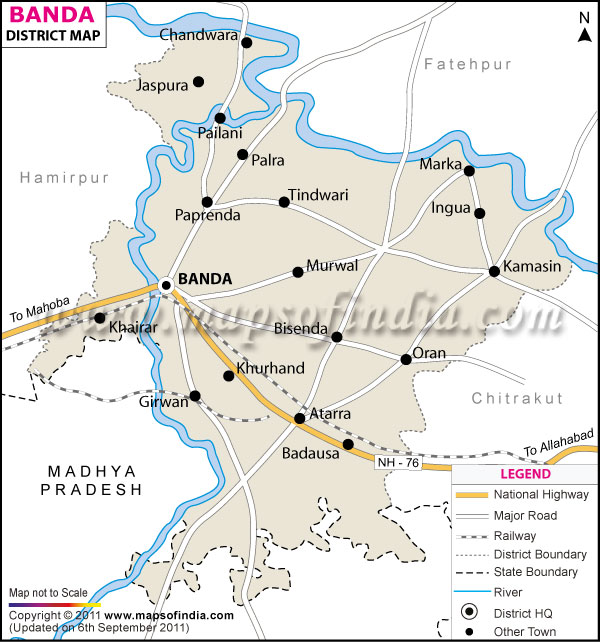
It is also an important district because of its cultural connection to great figures of the history and religious customs of the Indian North. All the visitors, researchers and students can use the Banda district map in order to shed light on the administrative designations and the position of its towns, rivers and transportation systems. The Banda district map is also an effective tool in geographical analysis and scholarly analysis of pattern of settlement and connectivity of the regions.
Banda district, being a part of Bundelkhand region is the amalgamation of ruralism, historical richness and socio-economic changes. The Banda district map is often featured in the educational sources to demonstrate the location of the district in the southern Uttar Pradesh area and its relations with the surrounding areas. With time, Banda has been slowly built up as regards the infrastructure, education, and public services although agriculture still remains the most prevalent economic activity. Banda district map can also assist planners and administrators to visualise development initiatives and development of infrastructures within the district.
History
The history of the Banda district is connected with the history of the wider history of the Bundelkhand. The region has experienced the governance of many dynasties and political forces within many centuries and each brought its flavor into the culture and history of the district. Olden history indicates that, during the ancient times, the area was a state of the Chedi kingdom and subsequently fell under the jurisdiction of other ruling dynasties in subsequent times.
In the medieval era, the area was dominated by the Chandela leaders, which were characterized by their architectural success, and a good administration of the area. The Chandela Dynasty had a major role in establishing the culture and political background of Bundelkhand even the part that is now known as Banda district. The study of history tends to use the Banda district map as a method of determining the area of Chandela influence within the territory.
There was a following rise of the Bundela Rajput as a political force in Bundelkhand. They issued forts, temples and settlements in the region under their rule. Banda was a very important administrative and military hub in this period and this location was strategic. When historians are studying the political geography of Bundelkhand, the Banda district map is often consulted to learn the relative location of different forts and settlements on the terrain.
The changes in Banda district during the colonial time included the manipulations of the administrations, the development of the infrastructures and the development of the trade networks. Development of roads, institutional buildings, and administrative buildings were being made progressively. The Banda district map which was made by the colonial authorities shows the initial efforts of the British administrators to gather the tehsils, villages and the revenue divisions of the district.
The district also contributed to the political and social movements which came up in India struggle to achieve its independence. The locals and leaders engaged in nationalism movements against colonialism. In 1947, India attained its independence and hence Banda district became a part of the state of Uttar Pradesh and it remained an administrative district of Bundelkhand region.
In modern historical studies, the Banda district map is still used by the researchers to learn about the evolution of settlements, trade fatriges, and changes in the territories of districts in the past. These works point out the mechanisms of interaction between geography and political authority during the history of the district.
Culture
The culture of the Banda district in itself shows the influences of the region of Bundelkhand, of which it has its peculiar social habits, folklore, festivals and forms of art. The culture of the district has evolved over the centuries as a result of interaction of various communities, historical factors and the way of the rural life.
The olden days festivals like Diwali, Holi and Navratri are celebrated with much enthusiasm throughout the district. Such festivals are related social events that unite groups and integrate common cultural values. The prevalence of religious festivals comprises of local fairs, temple reunions and community small events that represent the spiritual background of the area at depth.
The other peculiar feature of the district culture is the folk literature and oral tradition. A tradition of stories, ballads and devotional songs has existed within the Bundelkhand region and the tradition is several generations old. These cultural manifestations can be found to embody the concept of courage, loyalty and life in the country.
Another part of the cultural heritage of the district is handicrafts and local crafts. Traditionally artisans make their products based on the available local resources e.g. stone, wood and clay. These art forms represent the killing arts and art of rural society.
The district is influenced by a multiplicity of communities and social groups that shape social structure such as traditional agricultural communities and artisan groups. The cultural practises in different villages are usually slightly different and all of them are related to the variety of cultural identity of the Banda district.
The cultural patterns in the district are said to be understood in a very easier way any time an analysis of Banda district map, demographic and settlement data are taken to the consideration. The map assists the researchers and planners to visualise the distribution of cultural centres, towns and rural settlements in the district.
Language
Language is a significant source of formation of social and cultural identity of Banda district. Hindi is the major language in the district and the official language of administration, communication in education and government.
Together with the standard Hindi, other local inhabitants speak the Bundeli dialect that is predominantly used. Bundeli is a local language related to the Bundelkhand region and has a great linguistic proximity with Hindi. Through informal communication, in daily lives, most people use Bundeli language in their informal discussions but in official contexts, they use standard Hindi. A smaller number of people also speak Urdu especially within some communities and at urban regions. The two languages can be seen as a sign of the linguistic diversity that is common to most districts in northern India.
Bundeli dialect is particularly significant in rural regions where most people use it in their daily conversations, folklore and local songs. The dialect is full of terms and phrases which denote the historical and cultural context of the Bundelkhand area. Educational institutions in the district are mainly using Hindi as the medium of instructions but English is also taught in schools and colleges as one of the national education systems. Such a bilingual learning setting can assist the students in bridging both the local and the national language environment.
The Banda district map is commonly used by linguistic researchers to study the variation in language patterns in various areas in the district. With the help of map, it is possible to see where Bundeli is more common and where Hindi is more popular with respect to communication. In such a manner, language in the Banda district is a composition of the regional dialects and the standard forms of language which portrays both the traditional cultural influences and the current developments in education.
Geography
We have a combination of uplands with rocky outcrops as well as fertile plains somewhere between them which characterise the geography of the Banda district. The district is located in south Uttar Pradesh and is a part of the semi-arid scenery, which characterizes most of Bundelkhand. The river system is one of the significant geographical peculiarities of the district. The northern boundary of the district is Yamuna River which serves as a major drainage system used in the area. The district is also fed by rivers like the Ken and Baghein which are also used in irrigation and agriculture.
The landforms are undulations with irregular uplands scattered with low points that can get wet throughout the monsoon season. These topographical characteristics shape the pattern of settlement in the area, farming activities and communication paths in the district. The land use of the district is mainly agricultural. Wheat, pulses, barley, oilseeds and millets are some of the crop varieties that have been cultivated on fertile soils and with the supply of river water. Farming is the main occupation of much of the people, and country settlements are very numerous in the district.
The map of the Banda district is especially helpful to comprehend the structure of rivers, roads and villages in the area. The Banda district map is usually studied by geographers and planners in order to assess the water resources, farming areas and means of transporting goods.
The district also hosts a number of towns and hundreds of villages all over its administrative subdivisions. Such settlements are linked by a road system and local transport networks. The map of the Banda district can be used to show the spatial distribution of these towns and villages in the district. The geography of the Banda district, as a whole, exhibits more of the general environmental features of Bundelkhand that is a mixture of rugged landscape and fertile valley river basins that sustains agriculture and rural economies.
| Facts of Banda District | |
|---|---|
| State | Uttar Pradesh |
| District | Banda |
| District HQ | Banda |
| Population (2011) | 1799410 |
| Growth | 17.05% |
| Sex Ratio | 863 |
| Literacy | 66.67 |
| Area (km2) | 4408 |
| Density (/km2) | 404 |
| Tehsils | Atarra, Baberu, Banda, Naraini |
| Lok Sabha Constituencies | Banda |
| Assembly Constituencies | Baberu, Banda, Naraini, Tindwari |
| Languages | Hindi including Bundeli |
| Religion | Predominantly Hinduism |
| Rivers | --- |
| Lat-Long | 25.483571,80.333011 |
| Travel Destinations | Bamdeo Temple, Maheshwari Devi Temple, Kalinjar Fort, Bhuragarh Fort, Rangarh Fort, Nawab Tank, Four Stone Pillar, Khatri Pahar etc. |
| Government Colleges/Universities | D.A.V. Inter College, Khanqah Inter College, Government Inter College(Gic), Government Girl Inter College(Ggic), Saraswati Vidya Mandir Inter College, Government Mahila Degree College, Raja Devi Degree College, B.P.M.P.Omer Inter College, Aadarsh Inter College etc. |
FAQs
Q1: Which administrative division does Banda district belong to?
Banda district is part of the Chitrakoot Dham administrative division of Uttar Pradesh.
Q2: What is the significance of the Ken River in Banda district?
The Ken River is important for irrigation, agriculture and supporting rural livelihoods in the district.
Q3: What type of climate does Banda district experience?
Banda district experiences a semi-arid climate with hot summers, monsoon rains and cool winters.
Q4: What is the role of Banda city in the district?
Banda city serves as the administrative headquarters and main commercial centre of the district.
Last Updated on : May 08, 2026
