




Introduction
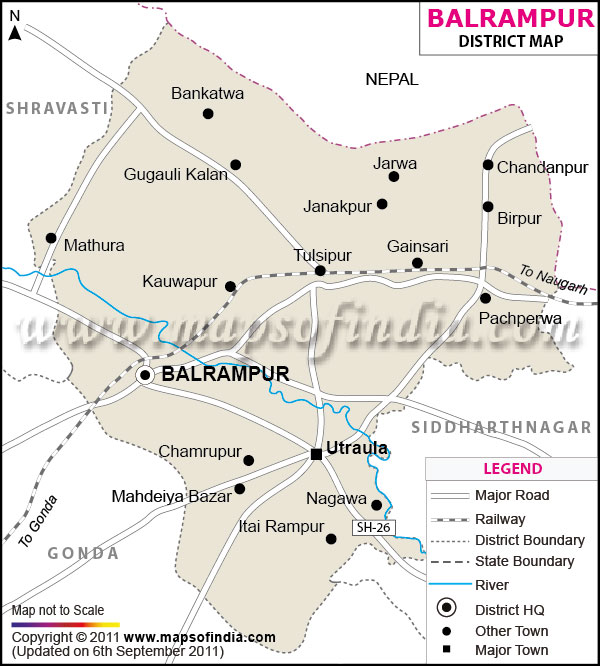
Balrampur is located in the Northeastern part of Uttar Pradesh on the border of Nepal. Because of the district’s close distance to Shravasti, an ancient capital of the Kosala kingdom which was a center of Buddhism, it has a rich spiritual history. The district is also part of the Awadh region of Uttar Pradesh and has an extremely rich culture which is reflected in their folk songs, fairs, and festivals, all of which are a greater part of the agricultural cycle. The average cuisine of the area and the spoken language are a combination of the three dialects of Hindi, Urdu, and Awadhi. The area was a princely state of the Balrampur Rajas and has now grown into a modern district headquarters.
History
Balrampur has a long and rich history influenced by a variety of geo-political and cultural changes which take place in the Gangetic plains and is located in the north-east border of Uttar Pradesh and the border of Nepal. The closeness of Shravasti to Balrampur, placed it off the Buddhist circuit, and the area is still dotted with the ruins and monasteries that speak to its ancient past. The location of a stupa and the Jetavana monastery, of which the Buddha was a resident, links it to one of the most significant periods of Indian history. As time went on, the area witnessed the coming and going of Hindu dynasties and then Rajput clans who established their dominance over the fertile plains.
Local lore claims that possibly a descendant of the Bal dynasty, or some tellers of the story, say that its founding is linked to Maharaja Balram Singh of the eighteenth century, the Ruler of Balram State. Balrampur’s imprint by the Rajputs, mostly the Kalhan and Chauhan, is seen in the region’s construction of the forts, temples, and administrative buildings. During the medieval period, it became a melting pot of cultures where Buddhism, Hinduism, and later Islam all harmoniously coexisted.
The region’s architecture, and the folk traditions that have been passed down through generations, all tell the story of the Martyrs (nationalists), Saints, and common people. It fell within the imperial structure of the Mughals and drew agrarian revenue from its rich farmland, The region was very close to the Awadh Province which brought about the fast assimilation of the newly introduced administrative and poetic frameworks of Lagaan, a revenue collection system, the Revenue Collection System of the Nawabs of Lucknow as well as the Persian Culture.
The region's modernization was done by Maharaja Balram Singh and his successors. They established an educational and medical system and established a trading system. Their legacy is still remembered with a princely touch in Balrampur. The British brought changes to the region once more. The annexation of Awadh by the British in 1856 meant that it had to experience direct colonial rule. The taluqdars had to resist direct rule at first, but then were able to adapt to direct rule by managing the colonial bureaucracy, mostly by holding on to their estates. The region became a hotspot for agrarian struggles, especially with the colonial economy and unsustainable taxation. The situation also contributed to the growth of state-sponsored modern education and also a political system.
The emerging situation also politically integrated the region, and Balrampur also became part of Indian Nationalist Movements. The combination of princely rule and the emerging nationalistic ideology provided a new integrity to the Balrampur region within the colonial order. The balanced combination of agriculture in the region with the production of sugarcane, rice, and wheat aided in the development of the new district headquarters established.
Awadhi culture continued to thrive. Balrampur continued to be a place where modern civilization and ancient spirituality existed. Balrampur’s history is preserved in the district’s monuments and ruins, but more importantly, in the minds of the people. The district is where the footsteps of the Buddha are heard, the footsteps of the Rajput rulers, the footsteps of Nawabi culture, where the footsteps of the colonial rulers of the agrarian democracy and where the agrarian traditions of democracy are sustained. Its history is of many layers, each of which tells its story.
Culture
Balrampur district displays a unique culture because of its variety of ancient Buddhist and medieval customs and rhythms of everyday ethnology in Awadh. Due to its closeness to Shravasti, which is one of the most significant Buddhist sites, the area has a certain enticing spirituality, and pilgrims have visited the area throughout history from all across Asia. Monasteries, and stupas as well as remains of antiquity, evoke the teachings of the Buddha. The teachings are embedded in the consciousness of the people of Balrampur, which is why it is known to the people of the district as a land of peace and meditation.
Balrampur, along with the spiritual culture, has also developed a rich folk culture. The culture of everyday life in the city is most closely associated with Awadh. Folk songs are the most important songs in a community. At harvest and at weddings and during festivals, women are the most conspicuous singers, and in the oral tradition, songs of love, and celebration known as kajri and sohar are most popular.
The dances called nautanki and jhumar which are performed at fairs and festivals, and the dances of the folk singers, and the music all incorporate and blend together to bring along with them the humor and laughter of the people, and to keep the oral tradition alive. The purpose of such performances is not simply to entertain, but also to give people values and to pass on the history and collective memory of the people from one generation to another.
The Balrampur fairs, food, fields, and temple fairs embody the culturally fused food and communal spirit of the rich culture of Balrampur, and collectively serve to celebrate the diverse religion of the city and the schemas of agrarian recurrences, of the above urban heart and rural heart of India. The spirit of food and the rich religion of it give birth to the balletics of the beloved name of developed Balrampur. The distinguished and rich culture is shaped by the food of the divinely lavender and rich temple fairs and the fairs of Balrampur, through the food and the culture of our rural heart and the rich culture and spirit of food centered, the heart of India. The language and literature completes the structure with its strong identification and value.
Language
The cultural complexity of the eastern part of the Indian state province of Uttar Pradesh is replicated in Balrampur. Hindi is predominantly used in formal communication, government communication, educational institutions, government administrations, and branches of the administration as well as the vernacular of the Balrampur people. The vernacular of the region has Hindi as the primary language, though it is more of an administrative dialect.
The dialect is used in the vernacular of folk songs in the Balrampur, of sayings, and of the oral tradition and is therefore culturally significant. When the people of the village celebrate a festival or a marriage, the dialect is adequately used in the songs of the folk music categories of kajri, sohar, and birha. Urdu is a dialect of Balrampur, located in the middle of progressive Balrampur. It has Indo-European Vernacular in the vicinity of Bihar. The Indo-European Vernacular stretches beyond the Indo-European Vernacular of the Bihar Vernacular.
Geography
Balrampur is located in the north-eastern region of Uttar Pradesh, bordering Nepal. It is within the Terai belt which is characterized by alluvial plains with vegetation and swamps, and the presence of the Himalayan foothills. The plains are rich in soil and although the flooding during the monsoon is a disadvantage, the area is well suited for agriculture. Rapti is the most significant river in the area, and while it is beneficial for agriculture during the dry season, the floods during the rainy season are a disadvantage.
Other small rivers and streams in Balrampur's rivers add to the lush vegetation but also the total vulnerability to flooding of the area. The weather is similar to the weather experienced in the Gangetic plain. It experiences dry and hot summers with the temperature going over 40°C and during the winters it goes below 10°C while at night. The months of June to September are rainy months with enough rainfall to enrich the dry land and support the farming of staple crops like sugarcane.
The annual flooding from the rain fosters greater resilience and bracing for impending floods each year is a part of life for the river-adjacent village residents, however, life is not only conditioned by adversity. The consistent cycle of floods and rains is dominantly influential in the shape of life throughout the entire district, forming communal relationships and customs as well as developing diversified and adaptive agricultural techniques. It is not only about traversing the fields and the rivers; it is also a border district, and constitutes the frontier of the country with Nepal.
| Facts of Balrampur District | |
|---|---|
| State | Uttar Pradesh |
| District | Balrampur |
| District HQ | Balrampur |
| Population (2011) | 2148665 |
| Growth | 27.72% |
| Sex Ratio | 928 |
| Literacy | 49.51 |
| Area (km2) | 3349 |
| Density (/km2) | 642 |
| Tehsils | Balrampur, Tulsipur, Utraula |
| Lok Sabha Constituencies | Shravasti |
| Assembly Constituencies | Balrampur, Gainsari, Tulsipur, Utraula |
| Languages | Hindi, Urdu, Awadhi |
| Rivers | Rapti |
| Lat-Long | 27.425414,82.314262 |
| Travel Destinations | Temple Of Pateshwari Devi, The Sobhnath Temple, Shwetambar Temple etc. |
| Government Colleges/Universities | --- |
FAQs
Q1: How did Balrampur get its name?
Local traditions suggest the town was named after Maharaja Balram Singh, a ruler of the Balrampur estate in the eighteenth century, though some link it to older clan names.
Q2: What is the economy of Balrampur based on?
Agriculture is the backbone of the district, with sugarcane, rice, and wheat as major crops. Sugar mills and small industries also contribute to the local economy.
Q3: What is the climate like in Balrampur?
The district experiences hot summers, heavy monsoon rains, and cool winters. Floods during the rainy season are common because of the Rapti River.
Q4: Which languages are spoken in Balrampur?
Hindi is the official language of the city, but Awadhi is also spoken in everyday life. Urdu and Bhojpuri also influence the local linguistic culture. This reflects the district’s diverse heritage.
Last Updated on : May 08, 2026
