




Introduction
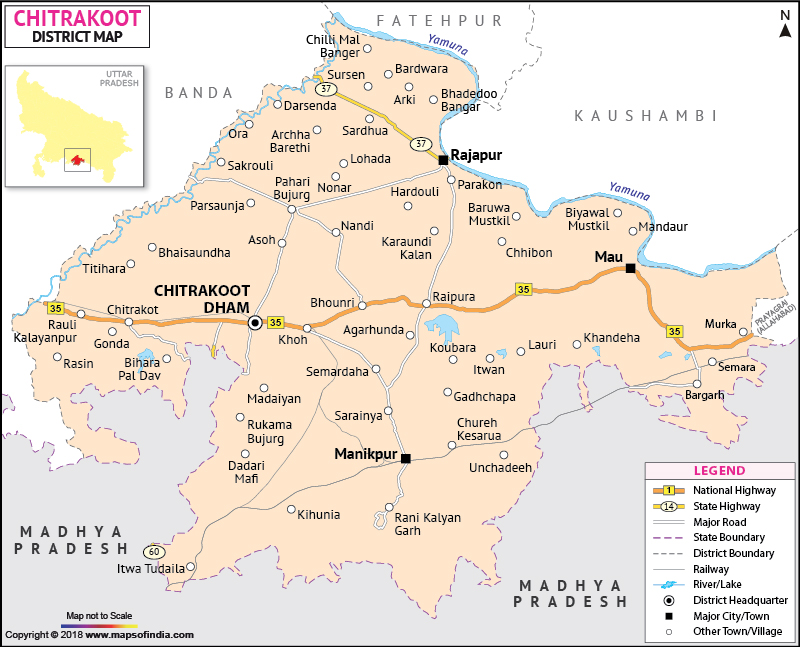
The district is a section of Bundelkhand region, which has its unique cultural practices, semi arid terrain as well as rich historical background. It was founded in 1998 by splitting the Banda district into the district whose administrative base is at Karwi. Chitrakoot is also covered by a common boundary by the adjoining state of Madhya Pradesh and Chitrakoot region as a whole, clearly visible on the chitrakoot district map, which is joined together by common religious and cultural affiliations.
Chitrakoot occupies a unique role in the religious fantasy of India. It is also venerated in Hinduism as the wooded area that Lord Rama, accompanied by Sita and Lakshmana, spent a large part of their fourteen-year exile as told in the Ramayana. This association has constructed the identity of the district centuries and it still affects its economic and social life by pilgrimage and religious tourism. Thousands of worshipers flock to the sacred places in the district especially during the major Hindu festivals.
Chitrakoot is a significant place though it has a spiritual preeminence. The major activity is agriculture and the settlements are usually small towns and villages as opposed to major cities. A shortage of water and an inadequate industrial infrastructure are development issues peculiar to the larger Bundelkhand area. But the cultural vibrancy, geographical sanctity and continuity of history, make this area a special and important part of Uttar Pradesh.
History
In addition to the mythological connections this Chitrakoot was a part of the larger tract of Bundelkhand in which there were the reign of various historical dynasties. During the early medieval times, Chandela dynasty became a decent force in South central India. They were able to exert their political and cultural influence on much of Bundelkhand, as well as the regions of modern Chitrakoot. Chandelas are most famous with regard to the temples of Khajuraho, but their domain was a much wider geographical scope.
In the medieval times the land was conquered by the Delhi Sultanate and later by the Mughal Empire. Due to its hilly terrain and wooded hills, Chitrakoot failed to become a big administrative centre with these regimes. However, due to its religious significance, temples, heritages, and pilgrimage remained active. The relative isolation of the area also enabled it to have a strong local nature despite the changing political power at the upper levels.
The Bundelkhand region became affected by the presence of the Marathas that took over major part of central India in the eighteenth century. The region was at one time included in the British administration territories in nineteenth century. The concealed aim of British administration was mainly collecting revenue and the drought-affective climate of Bundelkhand gave frequent challenges to the stability of agriculture.
The region had been incorporated in Uttar Pradesh after India became independent in 1947. Upon realising that this was a rather underdeveloped piece of land that required better local governance, the state government gave Chitrakoot a status of a separate district in 1998. Since that time, administrative work has focused on increasing infrastructure, increasing access to education and healthcare, and dealing with environmental issues. The history of the district therefore has been a stratified history whereby religious tradition, local dynastic politics, colonialism and contemporary state building collide.
Culture
Devotion, pilgrimage, rhythms of the rural society largely influence the cultural life of Chitrakoot. The axis of the cultural calendar of the district implies religious observation. Pilgrims also come all year round to give honor at sacred places that are related to the exile of Lord Rama. Kamadgiri is one of the greatest landmarks which is considered to be the spiritual center of the area. The followers of this faith come to perform a circumambulation or parikrama around this hill, which they believe is a great religious virtue.
The Mandakini river, clearly visible on the chitrakoot district map passes through the town of the Chitrakoot and it is a geographical feature as well as a deity. Its banks are also sites of ritual bathing and prayer and evening aarti rituals. The religious spirit of the district is reflected in sight of the lamps on the surface of the river during religious celebrations.
Huge crowds of people attend major Hindu festivals, such as Ram Navami, Diwali, and Makar Sankranti. Fairs that are organised in these events produce dynamic social interaction, trade and performance spaces. Cultural texture of these events is added with traditional music, devotional singing and recitations of sacred texts. Religion stories do not exist only in form of rituals but are passed on through folk songs and oral narratives.
The culture of Chitrakoot other than its divine side is a mirror of the culture of Bundelkhand. Farming activities are intertwined with the rural life, and the time to put the seed in the ground and the time to take the harvest are celebrated by the festivals. Community events, marriage ceremonies and village fairs ensure that society is well tied together. Local market have small scale handicrafts and pilgrimage paraphernalia which offer an additional source of income to artisans and small traders.
The district continues to have a very traditional nature, in spite of slow modernisation. Social organisation is still influenced by extended families, village councils and local customs. Education and better connection has brought new effects, but it is the religious belief and agrarian routines that continue to form the core of day to day life.
Language
The official and administrative language of Chitrakoot district is the Hindi language used in the government offices, schools and formal communication. Bundeli is commonly spoken in its daily use as well as along with the regular Hindi language. One of the regional dialects of Hindi group of languages, Bundeli, is known to the Bundelkhand region, clearly visible on the chitrakoot district map, and has a rich oral tradition. People in Bundeli speak a language that has folk songs, proverbs, and local expressions that demonstrate their historical experiences and realities of their surrounding environment. The integration of Hindi and Bundeli as well as the same is testimony to the integration of the two languages into the larger language system of Uttar Pradesh, as well as, the regional identity.
Besides Hindi and Bundeli occasional influences of some other local forms of speech are sometimes heard by migration and administrative contact with next-door districts in Uttar Pradesh and with the neighbouring provinces on the other side of the modern Madhya Pradesh border. The educational institutions encourage the use of standard Hindi as the main medium of instruction and this factor has led to its increased use by the younger generations especially in formal and written side. Meanwhile, Bundeli still survives in local regions, local markets and performances, having a great oral tradition of folk ballads, devotional songs, and traditional signals intimately connected to the character of Chitrakoot and the general Bundelkhand.
The language-tradition and language-modernity mix has been identified either in this balance of the linguistic environment of Chitrakoot district. Though the official communication, media and digital platforms are largely using standard hindi, on the daily level of communication in villages and small towns, fluidity between Hindi and Bundeli languages is common, depending on situation and audience. Not only does this type of code-switching show practical flexibility, but it is a stratified cultural identity, where local language still serves as the symbol of the belonging and common ancestry in the Bundelkhand area.
Geography
Chitrakoot is geographically located in South of Uttar Pradesh in Bundelkhand plateau, clearly visible on the chitrakoot district map. The topography is characterized by rolling plains that have rocky crunches, small hills, and forest. The district borders on the south Madhya Pradesh, and its topography seemingly extends the Vindhyan range which dominates much of central India. The topography also leads to the scenic beauty as well as the agricultural difficulties of the area.
The main river that is related to Chitrakoot is the Mandakini river, clearly visible on the chitrakoot district map that has a great religious and ecological significance. The district is crossed by seasonal streams and smaller rivers and the supply of water usually relies on the monsoon rainfall. Its climate is usually subtropical and this has very hot summers, a monsoon season, which supplies most of the precipitation in a year, and relatively mild winters.
The land use is majorly dominated by agriculture where crops like wheat, pulses, and oilseeds are grown on seasonal patterns. The quality of soils differs in more productive alluvial belts along riverbanks and stony and less fruitful soils in uplands. The frequent droughts in the past have influenced migration and economic factors that impacted agricultural productivity.
Though not big, forested regions also provide the local biodiversity and are also interwoven with the sacred geography of the district. Forests and plotted areas are frequently connected to mythological events, and a combination of physical space and spiritual story. Patterns of settlement are well adapted to the natural environment, the villages were located close to the water bodies and arable land.
To conclude, the culture of Chitrakoot cannot be discussed outside the context of its geography. Hills, rivers and forests of the district are not only physical objects but rather part of the collective memory and religious tradition. This interaction of the environment and belief remains to be the characteristic of the area and Chitrakoot is the place where the landscape and the legend go hand in hand.
| Facts of Chitrakoot District | |
|---|---|
| State | Uttar Pradesh |
| District | Chitrakoot |
| District HQ | Chitrakoot |
| Population (2011) | 991730 |
| Growth | 29.43% |
| Sex Ratio | 879 |
| Literacy | 65.05 |
| Area (km2) | 3415 |
| Density (/km2) | 315 |
| Tehsils | Karwi, Mau |
| Lok Sabha Constituencies | Banda |
| Assembly Constituencies | Chitrakoot, Manikpur, Mau |
| Languages | Hindi, Bundeli |
| Religion | Predominantly Hinduism |
| Rivers | Yamuna |
| Lat-Long | 25.110472,81.072807 |
| Travel Destinations | Ram Ghat, Hanuman Dhara, Kamadgiri, Gupt Godavari Caves, Sphatik Shila, Kamtaji Temple, Sati Anusuya Temple, Chitrakoot Falls, Bharat Koop, Bharat Milap Mandir, Ganesh Bagh etc. |
| Government Colleges/Universities | Goshwami Tulshidas Government College, Chitrakoot Inter College, Government Girls Inter College, Government Inter College etc. |
FAQs
Q1: Why is Chitrakoot considered important in Hindu tradition?
Chitrakoot is believed to be the place where Lord Rama spent part of his exile, making it a major pilgrimage centre.
Q2: When was Chitrakoot district formed as a separate administrative unit?
Chitrakoot was established as a separate district in 1998 after being carved out of Banda district.
Q3: What is the primary economic activity in Chitrakoot district?
Agriculture is the principal occupation of the majority of the population.
Q4: Which river flows through the town of Chitrakoot?
The Mandakini river flows through the district, clearly visible on the chitrakoot district map and holds both geographical and religious importance.
Last Updated on : May 08, 2026
