






Hathras Introduction
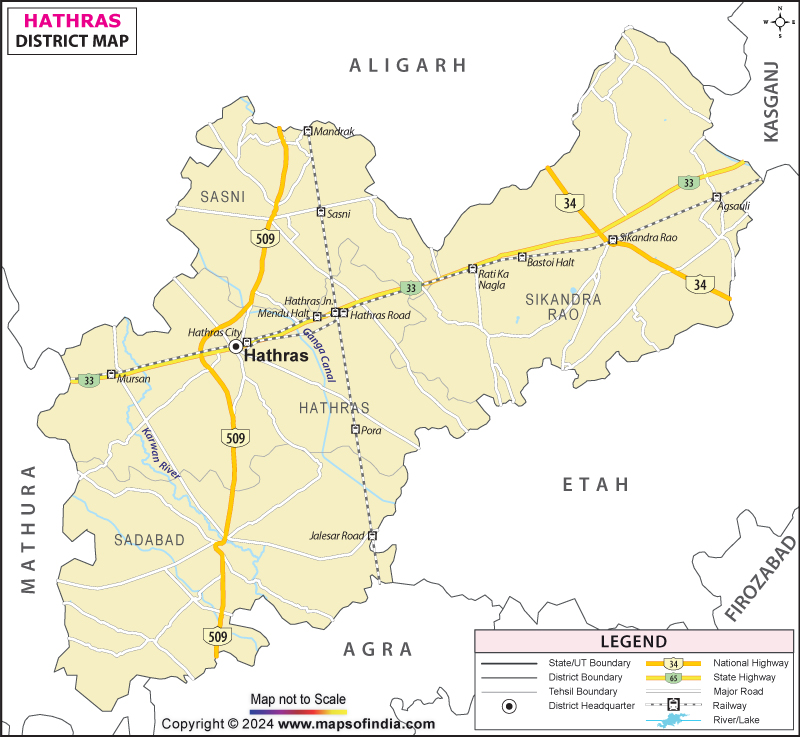
Hathras district occupies the western part of the Indian state of Uttar Pradesh and is also a significant portion of the cultural and historical environment of the area. The district is situated in the bountiful Western Indian plains of the country and borders the districts of Aligarh, Mathra and Agra. The district and the city in which it is located has been shaped throughout the history by different political, cultural, and economic processes, due to its proximity to such historically important cities.
The City of Hathras serves as administrative headquarters and is the main center of governance, business and social life in the district. The transformation of the region has taken place over time and has developed a mixture of urban population and rural villages that adds to the social and economic landscape. Agriculture has continued to remain the mainstay of the population with trade and small scale industries having a share in the local economy.
Over the last several decades, the district has experienced slow evolution of education, infrastructure and transportation. Improvement of road networks, schools, and colleges have exposed residents to more opportunities besides linking the district more closely with other urban centers. Nevertheless, the situation has not changed and the district still has a very close relationship to its traditional rural and cultural background.
Hathras History
The historical evolution of the Hathras district is logically connected with the general political and cultural changes which occurred in northern India. It is a fertile land with a good climate that has made the place to be inhabited by people over a long period of time. The early communities were established probably near small-sized rivers and open plains where agriculture and commerce could be practiced.
In the ancient times, the region became a part of the cultural sphere related to the region of Braj that occupies an important position in the Hindu religious traditions in regard to Krishna. Consequently, religious narratives, ways of pilgrimage, and temple customs shaped the early culture of the region. The small towns and villages gradually began to appear and this was the basis of the social organization in the region.
The formation of the dynasties that ruled North India, led the region into the influence of diverse dynasties that ruled during the medieval period. The spread of the Delhi Sultanate introduced administrative and political transformations in the country such as taxation and administrative systems which connected the villages to the bigger political organizations. The primary economic activity remained agriculture that sustained the local communities and the ruling elites.
Subsequently, with the reign of the Mughal Empire, the territory became part of the imperial system of administration. Mughals developed land systems of revenue wherein they were able to tax agricultural lands. The fertile land in the area rendered it useful in farm yields especially grains among other crops which sustained the local markets and trade networks.
The eighteenth and nineteenth centuries saw the advent of radical political developments in northern India due to the decline of the Mughal Empire and rise of colonial influence. The area later came under the rule of the British administration that brought new administrative and revenue systems as well as infrastructure developments. This was achieved through developing roads and railway networks which allowed trade and communication between different districts.
In the nineteenth century, the northern region of India was characterized with a lot of unrest, most notably the Indian Rebellion of 1857. Even though the strength of the rebellion was different in different parts of the country, it was a significant turning point in the history of colonialism and gave rise to significant modification in the British policies towards governance.
The territory of this region was integrated into the state of Uttar Pradesh after the independence of India in 1947. The modern day district was subsequently formed through administrative realignment. The development programs by the government and agrarian reforms and advancement in education slowly influenced the present social and economic environment in the district.
Nowadays, the district is a mixture of the historical tradition and modernization. Although the region is still affected by urbanization and development in the infrastructure, its villages, temples, and cultural ways help it to maintain some activities of the past.
Culture
The Hathras district is highly cultured with the customs of the Braj region. Religious traditions, festivals, and local traditions have a significant influence on the social life of the people inhabiting the district. There are community meetings, festivals in the temple and village fairs which allow people to interact socially and express their culture.
Another significant part of cultural life is traditional fairs. These fairs are also linked to religious places or seasonal celebrations and visitors come from nearby villages. They consist of handicraft stalls, food, clothing, and household goods stalls, folk music, and performance.
Music and folk traditions are very important in the district's cultural heritage. Folk songs are sung in weddings, feasts and in farm festivals. These songs tend to narrate stories in terms of devotion, country life, family relations and past myths. Oral tradition helps communities to hold on to stories and cultural ideas whose lineage is generations long.
The food of the district is reminiscent of the agricultural heritage of the area. Foods made of wheat like roti and paratha are wide as well as food made of lentils, vegetables and dairy products. Dishes that are made during festivals such as laddoo, peda, and jalebi are common in local markets and households.
Dress in the area practices are similar to those common in the northern parts of India. The men mostly wear kurta pajama or dhoti whereas the women mostly wear sarees or salwar-kameez. On festivals and weddings, the dressing of people has more embroidery or ornaments.
Language
The linguistic diversity about Hathras district is manifested in the language. The most used language is Hindi, which is used in administration, education, and day-to-day communication. It serves as a shared language upon which members of other communities can communicate and carry out business.
Besides regular Hindi, the local people also speak the Braj Bhasa which is the regional form of this language determined by the cultural beliefs of the Braj region. Braj Bhasa is a long literary tradition that has been employed in devotional literary work dedicated to Krishna. It is used even nowadays in colloquial speech and cultural manifestations like folk lore.
The lingual environment of the district also contains Urdu basically in the form of literature and culture. In historic times, Urdu poetry and literature has been significant in the north of India and the language is still relevant in the artistic and cultural trends in the area.
The English language has gained relevance in learning, management and career. It is taught in schools and colleges which have English in their curriculum so that students can interact with both national and international opportunities. Consequently, a good number of the younger residents know both English and Hindi.
The fact that several languages and dialects exist helps to create a diverse linguistic atmosphere in the district. In most cases, individuals alternate languages depending on the context; at school, at the market, or in the family.
Geography
The topography of Hathras district is typical of plains which are usually fertile in much of northern India. The district is on the great Gangetic plain which is a geographical area with centuries of deposition of sediments by rivers into it. The deposits have created fertile soil that supports the agricultural practices and the human life.
The area is mostly flat in topography; thus, it is favourable to agriculture as well as transport. Agricultural land is found all over the countryside, with farmers producing wheat, rice and sugarcane and pulses. Farming is the basis of the rural economy, which is a source of livelihood for a lot of families.
The area itself is subtropical. Summers are generally hot and dry and the temperatures are generally over 40°C. Rainfall which is received in the monsoon seasons between June and September is important in both agriculture activities and replenishment of water. The winters are not severe and also favor certain crops.
The natural vegetation in the district are primarily grasses, shrubs and trees which are characteristic of the plains. The conversion of much of the land into agricultural fields has occurred over the time but there are still spots of natural vegetation in the rural areas.
The district has transport networks like roads that link it with the other neighboring cities like Agra, Mathura, and Aligarh. Railways enable the transport of laborers, farm produce and business items. Such relations have significant influence on facilitating trade and economic development.
The geographical aspects of the area such as fertile land, plain areas, and transport networks have led to the development of villages and farming settlements. These aspects are still present in the economic and lifestyle of the region.
| Facts of Hathras District | |
|---|---|
| State | Uttar Pradesh |
| District | Hathras |
| District HQ | Hathras |
| Population (2011) | 1564708 |
| Growth | 17.12% |
| Sex Ratio | 871 |
| Literacy | 71.59 |
| Area (km2) | 1752 |
| Density (/km2) | 851 |
| Tehsils | Hathras, Sadabad, Sasni, Sikandra Rao |
| Lok Sabha Constituencies | Hathras |
| Assembly Constituencies | Hathras, Sadabad, Sikandra Rao |
| Languages | Hindi, Urdu |
| Rivers | --- |
| Lat-Long | 27.498527,78.018608 |
| Travel Destinations | Hathras Fort, Dauji Maharaj Temple, Bhadra Kali Temple, Bagharya Temple, Teerathdham Mangalayatan etc. |
| Government Colleges/Universities | Saraswati Degree College, Ss Memorial Degree College etc. |
FAQs
Q1: What are the local tourist attraction sites?
Tourists usually add the tour with trips to attraction places like the nearby cities of Mathura and Agra which have religious and historical sites.
Q2: Is this land fit to be used in rural tourism?
Yes, the area provides the possibilities to see the village life, farming, and local traditions in an authentic way.
Last Updated on : May 08, 2026
