






Introduction
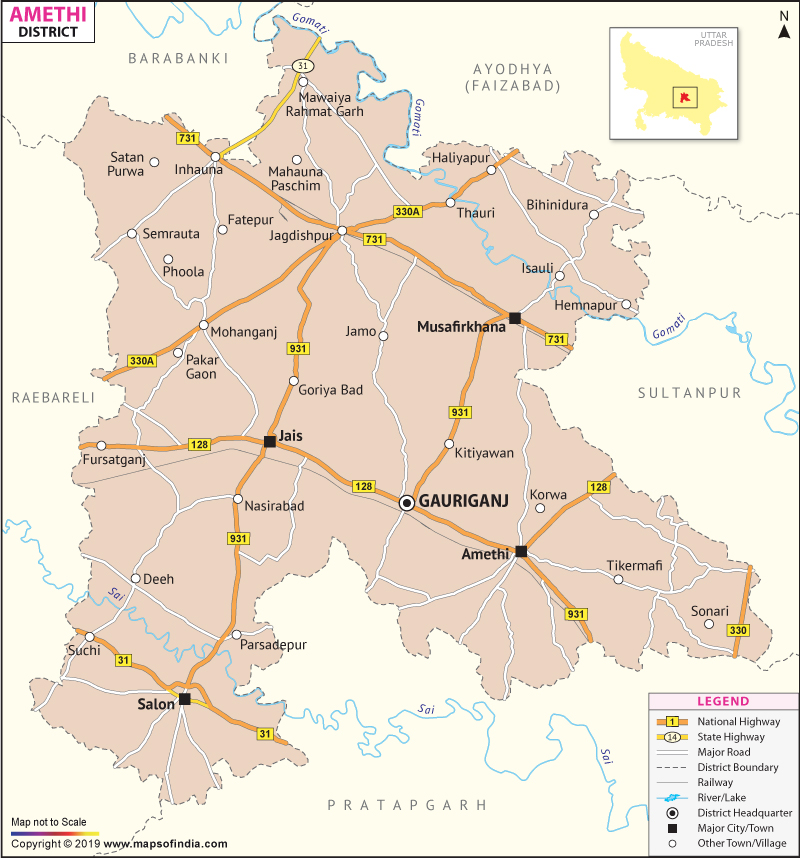
Amethi is a district in the northern state of Uttar Pradesh. What we see of this place is in great part due to its large role in Indian politics. But Amethi is more than a political stage. It is home to farmers, ancient temples, and a very distinct way of life. In 2010 Amethi became a separate district. Before that which land was included in it was part of Sultanpur and Raebareli. It is at a distance of 130 km from Lucknow the state capital. Because of its location it serves as a bridge between the large cities and the quiet rural India.
History
The Amethi’s past is a story which stretches from ancient times into the present day. In the early days what is now Amethi was a part of the great Kosala kingdom. Many people think we have a sacred past because of the proximity of the area to Lord Rama’s birthplace. For many hundreds of years local Rajput kings ruled over the villages and they built strong mud forts to protect their people.
In the history of Amethi one of the most important elements is the story of the king of Amethi. These local rulers did very well and were looked up to by the villagers. What we now know as the district used to be an old town called Raipur-Amethi which was the primary base of these kings. Also today you can see the ruins of their old buildings and temples which tell of the great past the area had.
During the reign of the British we saw great courage from the people of this land. In 1857 when India rose up against foreign rule for the first time the local leaders and the peasants joined the struggle. They did not agree with the large taxes and the foreign government’s rules.
In the second half of the 1960s Amethi’s modern history changed. It was at that time the Gandhi family took root in our soil. We saw in leaders like Sanjay and Rajiv Gandhi the beginning of Amethi’s rise to the world stage. Due to its association with great leaders the district saw the coming in of the BHEL factory and the HAL aircraft unit which in turn transformed Amethi from a mere village to an industrial center.
On the 1st of July in 2010 the government gave Amethi its own identity in that they made it into a separate district. Up until that time the land was divided between the districts of Sultanpur and Raebareli. By doing this they improved health care, education and road infrastructure in the area. This was a large step in the history of Amethi which also saw the local administration begin to very much focus on the betterment of its citizens.
In today’s times as you traverse the streets of Gauriganj or Amethi you see a blend of the past and present. In the same area which saw the construction of ancient temples that have stood the test of time also stand the modern factories which are the work of recent past. This place’s history goes beyond that of kings and political leaders; it is the story of the hard working farmers which stretch back for generations.
Culture
In Amethi there is a strong tie to the past in the Awadh region. What we may term as “Lihaj” is that people here are very polite and very respectful in their interactions. In the villages life is simple and centered around the community which is very much the core of what life is here; people know their neighbors and in times of hardship the community pulls together. That warmth and hospitality is what truly defines the local residents.
Folk music and storytelling is what transmits the culture in Amethi to the youth. At weddings women get together to sing “Sohar” and “Banna-Banni” which have been passed down for generations. These songs tell of family unity and the beauty of rural life. Also in the evenings it is the practice of the elders to sit under large Neem trees and tell the tales of local Rajas and heroes.
In the small markets of the district traditional crafts are present. We see potters which are making clay lamps and vessels and weavers which are creating simple yet strong cotton fabrics. Although many modern shops have opened up in the area the people still prefer to buy hand made items from local artisans at the weekly “Haats” or village markets. This support for local production which in turn supports the artists keeps the traditional skills alive.
In essence, we see that which is native to Amethi is a very connected to the earth. People take great pride in their farming heritage and local language, Awadhi. As the district modernizes with the introduction of new schools and industry, the base culture of Amethi still turns to family and faith and a very peaceful lifestyle. It is a place where traditions do not just play a role but are lived out every single day.
Language
In Amethi, language is what truly defines its culture. Although Hindi is the formal language used in administration and schools, what lives in the hearts of the people is Awadhi. That is a very old and gentle language which is a part of the heritage of Uttar Pradesh.
In Amethi what is special is the sweet quality of its language. In Awadhi speech is made to sound more gentle. For instance instead of the standard Hindi phrase for how are you (Kaise ho? a local may ask “Ka haal-chaal ba? or “Kas ahaa?. This way of speaking is a reflection of the humble and kind nature of people which is a feature of the Awadh region.
Even out that they do things differently. They tend to put in an element of respect into every sentence. In Amethi which is home to a mix of communities you also will hear many Urdu words thrown in with the local speech. This mix creates a rich "Hindustani” feel which is at once easy to understand yet very distinct from the Hindi you find in big cities like Delhi.
Amethi language also has a rich literature. We have great poems and holy books like the Ramcharitmanas which are in the Awadhi language. This is very source of pride for the local people. Today also during weddings and festivals women sing traditional folk songs in this dialect thus they are passing down their ancient heritage through voice.
Geography
Amethi’s geography is characterized by the flat and fertile plains of the Indico-Gangetic Plain. It is a part of the central region of Uttar Pradesh which has very rich and deep soil. The district is like a huge green table top which has very few hills or high points. That flat ground which is a feature of this area also makes it one of the best farming regions in India which you can tell by the vast fields which go on for miles.
In the geography of Amethi water plays a great role. The primary river is the Gomti which borders the district. Also we see many small streams and an extensive canal network which takes water from the rivers to the thirsty farms. As the land is very flat water moves slow which in turn creates many small ponds and wetlands which in turn is home to local bird and fish species.
The type of soil in this area is Alluvial which we see as a result of fine silt and clay that has been brought in by the rivers over the course of millions of years. That is very productive soil which is also a mineral rich. It acts like a sponge which the monsoons fill up thus allowing for crop growth even in the dry season. This is what has put Amethi at the front in growing wheat, rice and also that which we know as pulses.
In that area we seem to have three primary seasons. Summers are very hot and dry which in turn makes the land look dusty and brown. Then the monsoon which is between June and September comes in and transforms the Amethi geography into a lush bright green paradise. Winters are cool and dry also, early in the morning you see thick fog which covers the fields that does seem to be good for the winter wheat crop.
Nature has given that district a great many trees. We see large groves of Mango and Mahua trees all over. These trees do more than produce fruit; they provide shade for farmers and homes for many birds. Also in the district are small patches of forest which have Babul and Neem trees growing in them. These green areas do their part in keeping the air clean and they also provide wood and medicine for the villagers.
| Facts of Amethi District | |
|---|---|
| State | Uttar Pradesh |
| District | Amethi (Chhatrapati Shahuji Maharaj Nagar) |
| Capital | Gauriganj |
| District HQ | Gauriganj |
| Population (2011) | * |
| Growth | * |
| Sex Ratio | * |
| Literacy | * |
| Area (km2) | 2330 app. |
| Density (/km2) | * |
| Tehsils | Amethi, Gauriganj, Musafirkhana, Tiloi, Salon |
| Lok Sabha Constituencies | Amethi |
| Assembly Constituencies | Amethi, Gauriganj, Jagdishpur, Salon, Tiloi |
| Languages | Hindi, Urdu, Awadhi |
| Currency | Indian Rupee (INR) |
| Religion | Mostly Hinduism and Islam |
| Rivers | --- |
| Lat-Long | 26.157595,81.806552 |
| Travel Destinations | Hanumangarhi, Saint Malik Muhammad Jaisi Tomb etc. |
| Government Colleges/Universities | Rajarshi Rananjay Sinh College Of Pharmacy, Rajarshi Rananjay Post Graduate College etc. |
FAQs
Q1: When did Amethi become a separate district?
Amethi became a separate district on 1 July 2010. It was formed out of the lands of neighboring Sultanpur and Raebareli districts which at that time saw this as a step toward greater development of the area.
Q2: What do we know about the special “Munj” craft in Amethi?
The “Munj” craft which includes the making of beautiful baskets, mats, and home decor items from a special species of wild grass that grows by the river banks. This green craft is a traditional skill which has been handed down through many village families.
Q3: Which poet is known in connection with this region?
The great Sufi poet Malik Muhammad Jayasi who wrote the epic “Padmavat” was from Jayas which is a town in the Amethi district. To this day his tomb is a very respected site which people visit to pay homage to his literary work.
Last Updated on: May 08, 2026
