






Introduction
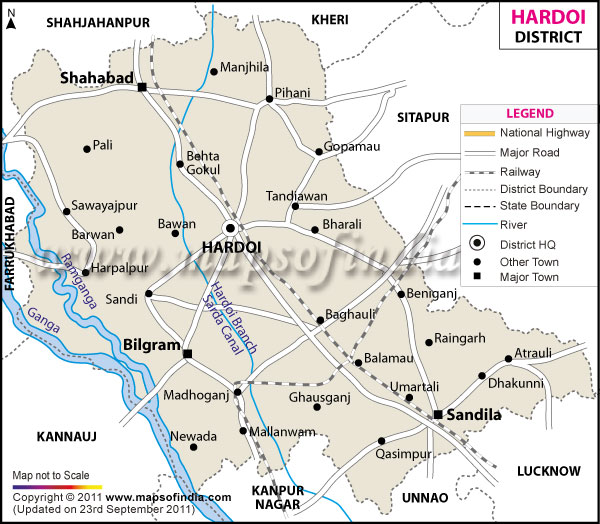
Hardoi district is a region in the central region of the Indian state of Uttar Pradesh which is historically an important administrative and cultural region of the fertile plains of the Ganga basin. The district is a part of Lucknow division and is between a number of historically important areas like Lucknow, Sitapur, Shahjahanpur and Unnao. Since it lies in a strategic location, being at the crossroads of the Doab region between the Ganga and Gomti river systems, the region has permanently been used as a hub for trade and farming, cultural and professional exchange.
The major contribution that Hardoi has been associated with is its rural scenery, ancient rural practices and its historical links with different dynasties that took power in northern India. The district comprises a blend of traditions with the changing socio-economic development. Most of its population lives in villages with agriculture being the major occupation. The agricultural economy is dominated by wheat, rice, pulses and sugarcane crop which implies that the agricultural economy relies on fertile alluvial soils and seasonal rivers.
The area also resembles the cultural nature of the wider Uttar Pradesh where regional folk, Islamic, and Hindu cultures blend. Community life is extremely dependent on such activities as religious holidays, local fairs and rural markets. Modernization, better transportation, and education have changed the social fabric of the district over time, yet have retained firm connections with the historical fabric of the district.
Though Hardoi might not be known as well as certain other large cities in the state, it still makes a huge contribution of agricultural and cultural diversity to the region. The towns and villages of it retain many temples, shrines, and historic sites, which the centuries of habitation and political shift gave their modern look. Administrative governance and rural development projects in Uttar Pradesh are also significant in the district.
History
The historical development of Hardoi dates back to the times of ancient times when the Gangetic plains was one of the first centers of settled agriculture as well as civilization in northern India. Archaeological and literary records have indicated that this area was also home to a number of ancient kingdoms that prospered within the Indo-Gangetic basin. It was a good place to live and do trade because it was rich in soil and it was also close to major river networks.
The region was also affected by the emergence of different Rajput clans, which dominated huge pieces of land in the northern part of India, during the early medieval period. The early settlement of the district is frequently referred to in local traditions and folklore as the warrior lineages which built forts, temples and administrative centres in the environs.
The onset of the Delhi Sultanate in the 13th century was a significant shift in politics. As the Sultanate expanded in northern India, the area came under its administrative rule. New trade paths and new systems of revenues introduced changes into the economy and Persian and Indo-Islamic cultures began to mix in with the local ones.
Hardoi became more ordered and agricultural under the Mughal Empire. The Mughal governments came with regular land revenue policies and promoted agricultural activities in the fertile areas of Gangetic plains. A number of towns emerged as local trading posts, which connected the rural production of agriculture with the bigger urban markets like Lucknow and Delhi. At that time, irrigation systems, wells, and small canals were built to facilitate farming.
The weakening of the Mughal rule in the eighteenth century gave way to the emergence of the regional powers in the northern region of India. Considering that most areas of Uttar Pradesh today were under the sway of the Nawabs of Awadh, the region followed suit. Their reign enhanced the ties with the cultural and political activity of Lucknow that was a flourishing center of art, music, and architecture.
Along with the British colonial development of the nineteenth century came radical administrative developments. The British made the district part of its provincial system of government following the annexation of Awadh in 1856. There was the introduction of new infrastructure like roads, railways and revenue offices. The local communities were also involved in the extended political processes that formed the struggle of India to achieve independence during the colonial era.
The region of Awadh in the 1857 revolt had numerous locales of resistance against British rule. Although the rebellions were different in geographic regions, they were all manifested by high discontent with colonial rules and social instabilities.
Following the independence of India in 1947 Hardoi joined the state of Uttar Pradesh of the republic of India. The decades after independence saw slow progress in the infrastructure, education and agricultural productivity under the development schemes initiated by the government. The district is now expanding and still has remnants of its complex and stratified history.
Culture
The cultural life in Hardoi is an expression of the larger cultural traditions of central Uttar Pradesh in which the rural norms, religious beliefs, and communal festivities define the essence of real life. The cultural identity of the district is also based thoroughly on agriculture cycles and seasonal celebrations, as well as deep family ties.
Such social life elements as fairs, local markets called melas are also significant. Such ceremonies usually occur at or around temples or shrines, and bring together people of the neighboring villages. Not only do they host religious events, but artisans, farmers and traders sell their merchandise including handicrafts, farming equipment, customary clothing and the traditional sweets.
Folk music and oral traditions are still relevant components of cultural expression. Marriage, harvest and seasonal music are usually sung in the rural homes. Instruments like the dholak and harmonium are used in these performances, which make the performances lively at the time of community events.
Another important element of everyday life is traditional food. Agriculture has a very big impact on local food habits with wheat constituting the major staple food. There is much consumption of rotis, lentils, vegetables of the seasons, and dairy products. Among the delicacies that are made during festivals and special events are ladoos, jalebi and peda which are made in homes and also in local markets.
There are also the small-scale rural industries and handicrafts that lead to cultural identity. Despite the fact that the district is not characterized by a great popularity of bigger craft traditions, local masters make some pottery and weaved objects and farm tools that people use in their daily life. These artifacts represent skillful experience over the years.
Hardoi social structure is majorly based on the extended families and villages. Conventionally established practices with regard to marriage, rituals and collaborative effort by the community are still relevant, but urbanization and education are slowly transforming these trends. The process of cultural change is ongoing due to the exposure of the younger generations to new ways of life without losing touch to the traditional values.
Language
Hardoi language is a blend of standard Hindi and local dialects that have been developed in the Gangetic plains over a period of hundreds of years. The administrative, education and formal language is the Hindi language. It is also the most dominant in the schools, government institutions, as well as in the official documents.
In addition to the standard Hindi, additional local dialects are very common in normal speech. Awadhi is one of the most widespread dialects and its history can be traced in central Uttar Pradesh to a great extent. Awadhi emerged as a spoken and written language in the period of the middle ages and it is still used in shaping the speech pattern of rural people.
Another language that is significant in the district especially in the Muslim communities is Urdu. Previously linked with the culture of the courts, literature, and the culture of expression in newly-born India, Urdu is still present in poetry, religious speech, and in classical education.
In villages, the individuals tend to alternate the dialects with the situations. An individual can speak a local dialect at home and speak Hindi at school or office and know Urdu in cultural or religious places. Such linguistic diversity indicates the years of historical cultural interaction in the region.
It is also in language that oral traditions are retained. The folk songs, proverbs and story telling traditions are normally done in the local dialects, which contributes to keeping the culture alive to the new generation.
Geography
The Hardoi geographical terrain is that of flat alluvial plains as found in the central Gangetic area. The tract is located in what is one of the most prolific agricultural areas of the northern part of India as the result of centuries of river deposition and flooding.
The area has a few rivers which affect the physical landscape and the cropping practices. Ganga River runs through the southwestern boundary, enriching the soil of the area, and providing a source for irrigation. There are other smaller rivers and seasonal streams which also recharge the ground water and sustain agriculture.
The soil in most of Hardoi is of alluvial deposits of soil which are very permeable when it comes to crop farming. There are various crops that are grown all year round by farmers and they include wheat, rice, pulses, mustard and sugarcane. The farming season is mostly like the rabi and kharif seasons, which are based on the availability of rain and irrigation.
The weather of the district is usually subtropical. Summers are hot and dry but usually the temperatures become over 40°C in the months of May and June. The rainy season extends between June and September and it is a period of most of the annual rainfall. Winters are comparatively cold and enjoyable thus making the season friendly to agriculture as well as traveling.
The vegetation in the area mainly comprises cultivated area, tree groves and sparsely spaced natural vegetation around the riverbanks. Mango and neem trees are widespread in the rural landscapes, which gives a cover and makes the ecological balance in the village environments.
Hardoi is linked to other areas and cities of Uttar Pradesh via transportation networks. The roads and railway lines connect the region to Lucknow and the remainder of the urban centers which makes it easier to carry on trading, transportation of farm goods, and the availability of markets.
The economic and social life of the district is still determined by its geography. Availability of fertile land, water sources, and primarily rural environment of the place guarantee that agriculture is the mainstay of the local economy and the business of the people.
| Facts of Hardoi District | |
|---|---|
| State | Uttar Pradesh |
| District | Hardoi |
| District HQ | Hardoi |
| Population (2011) | 4092845 |
| Growth | 20.44% |
| Sex Ratio | 868 |
| Literacy | 64.57 |
| Area (km2) | 5986 |
| Density (/km2) | 683 |
| Tehsils | Bilgram, Hardoi, Sandila, Sawayajpur, Shahabad |
| Lok Sabha Constituencies | Hardoi, Misrikh |
| Assembly Constituencies | Balamau, Baligram-Mallanwan, Gopamau, Hardoi, Sandi, Sandila, Sawajipur, Shahabad |
| Languages | Hindi, Urdu |
| Rivers | Ramganga, Ganga |
| Lat-Long | 27.298571,80.191555 |
| Travel Destinations | Nemisharayan, Sandi Bird Sanctuary, Naimisha Forest, Mallawan, Shahabad, Sandila etc. |
| Government Colleges/Universities | Maharana Pratap Government Post Graduate College, Cane Society Nehru Degree College, Arya Kanya Degree College, Patel Shri Teekaram Degree College, Mahaveer Prasad Mayavati Mahavidylya, Shri Mahipal Singh Degree College etc. |
FAQs
Q1: When is the most appropriate time to visit Hardoi?
Hardoi is best visited during the period of October and March. The weather is favorable and comfortable during these months. Summer is excessively hot, and the monsoons are rainy.
Q2: Is Hardoi an appropriate location for rural tourism?
Yes, Hardoi can be a good place to visit as far as rural tourism is concerned. Tourists are able to view the farming and village life, village communities, and local markets. The nature and cultural heritage provide an alternative to the existence in big cities.
Last Updated on : May 08, 2026
