




Introduction
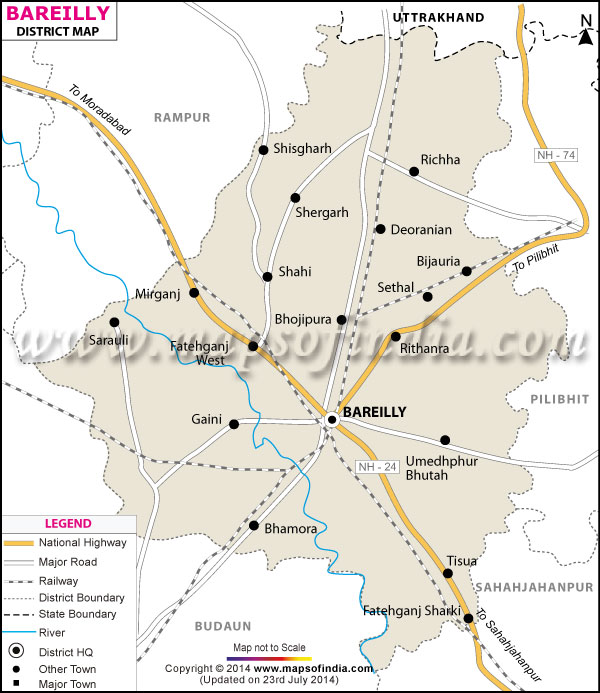
Bareilly is an ancient city in the northern Indian state of Uttar Pradesh, clearly visible on the bareilly district map, in the Rohilkhand region of Northern India between the Ramganga River and Himalayan foothills, clearly visible on the bareilly district map. Bareilly boasts a rich cultural heritage and has its origins back to the ancient times and became renowned during the Mughal reign. During the 18th century, it was established as the capital of the Rohilla Afghans such as Hafiz Rahmat Khan. The city was subsequently put under British rule and had a significant part to play in the Revolt of 1857. Today, Bareilly is a significant commercial and educational hub, also known due to zari embroidery and bamboo products, as well as, the traditional surma (kohl). The fact it has numerous Shiva temples also brings it the title of Nath Nagri. A mixture of the ancient and new developments, Bareilly is still a noteworthy urban center in the western part of Uttar Pradesh.
History
The history of Bareilly dates back to ancient times, where allusions to the area indicate that the area was part of a kingdom named Panchala in the Mahabharata. Archaeological evidence points to the early settlements in and around the region pointing to its long history of human settlement. Bareilly, however, became even more prominent in the medieval period, in the times of Delhi Sultanate, and then the Mughal Empire. Two such factors were its strategic positioning in the fertile Rohilkhand area thus making it significant both as an administrative and military hub.
Bareilly joined the Mughal Empire in the 16th century under Emperor Akbar but he was placed in the Subah of Delhi. Civilization was thriving because of agricultural output and trade routes to the north of India. In the first half of the 18th century, with the weakening of the Mughal rule, the Afghan chiefs referred to as Rohillas were free to form control over the land. Bareilly under Hafiz Rahmat Khan made its capital of Rohilkhand and grew to become the hub of Afghan culture and political influence. The Rohillas made a permanent impression on the social and architectural life of the city.
The city of Bareilly fell under the rule of the Nawab of Awadh in 1774 after the Rohilla War which was backed by the British East India Company. This was soon followed up by the increase of British influence and by 1801 the area was handed over to the Company. As part of the development under British rule, Bareilly was made the headquarters of a district, which consisted of administrative buildings, railways and cantonments.
Bareilly was a strong contributor in the Revolt of 1857. It had grown into a major center of the rebellion in Rohilkhand as guided by Khan Bahadur Khan, a descendant of Rohilla rulers. The revolt was later crushed by the British troops which resulted in harsh reprisals and more restrictive colonial policies.
At the end of the 19th and the beginning of the 20th century, Bareilly remained a commercial and educational center. The growth in this city became widespread immediately after India got independence in 1947 with great growth in population, trade and infrastructure.
Culture
The Bareilly culture is a product of a harmonious mix of Hindu, Islamic and local culture as a result of centuries of historical evolution. Among other events, the culture of Bareilly has one of the most unique characteristics in terms of religious diversity. The city is also commonly referred to as the Nath Nagri due to its numerous ancient Shiva temples with the most famous being the Alakhnath Temple. Bareilly concurrently has been a key seat of Islamic knowledge and piety. It relates to the Barelvi movement of Sunni Islam which was established by Ahmed Raza Khan Barelvi and his teachings are still followed by millions of adherents in South Asia and others. Such coexistence of religious traditions makes the city pluralistic and rich.
Celebrations are done in an energized fashion and communal harmony. Hindu festivals like Diwali, holi and Navratri are celebrated the most and Eid, Milad-un-Nabi and Muharram are celebrated especially by Muslim population. Local fairs and religious meetings increase social cohesion as well and hold on to ancient customs.
Bareilly is also famous for handicraft and traditional industries. Embroidery on zari-zardozi, bamboo, furniture and surma (kohl) are all common in the city. These crafts are more than just a sign of artistic prowess but they are a crucial component of the local economy. Bareilly's work on embroidery is especially appreciated in Indian bridal suits and ceremonial clothes.
Language
Bareilly has a convoluted history and a mixed culture that has been reflected in the linguistic landscape. Being located in the Rohilkhand region of Uttar Pradesh, Bareilly has been a crossroads of diverse communities and this diversity is evident with reference to its language. Hindi is the main spoken language in the city, mostly in Khari boli dialect which is used in schools, administration and everyday speech. Written in the Devanagari script, Standard Hindi is commonly used in schools, governmental offices and the media.
The language of Bareilly also is rather significant in terms of Urdu. Because of the important place of the city in relation to the Mughal and Rohilla times the Urdu language grew to be an important language of culture, literature and religious discussions. The impact among the leaders such as Ahmed Raza Khan Barelvi boosted the role of Urdu particularly in the Islamic scholarship and poetry. Urdu in the city is still maintained in its beauty and literary richness through Mushairas (poetic meetings) and religious literature.
Regional dialects, including Rohilkhandi are used in rural and semi-urban communities in and around Bareilly besides Hindi and Urdu. This dialect has strong pronounced patterns and vocabulary which is influenced by both Hindi and Urdu, as well as some remnants of older local dialects. Meanwhile, English is a link language in the institutions of higher learning, business, and the professional field.
Hindi and Urdu are used in the daily life of Bareilly because of which the city reaches a certain bilingualism. A lot of the people living in the area are comfortable with the two languages, mixing words and phrases. This linguistic unity is an extension of the cultural blending of the city, in which language serves as a marker of identity and also a point of connection between peoples.
Geography
Geography of Bareilly is very crucial in determining the composition of its history, economy and settler pattern. Bareilly is found in the Rohilkhand of the northern part of Uttar Pradesh, clearly visible on the bareilly district map and is surrounded by the plains of the Ganga basin and the foothills of the Himalayas, clearly visible on the bareilly district map. The city rises on an average height of approximately 170-178 meters above the sea level, and lies on the territory of the banks of the river of Ramganga, clearly visible on the bareilly district map, which is a major branch of Ganges. This strategic position has long been in use facilitating agriculture, trade and communications.
Bareilly is a constituent of the Indo-Gangetic Plain, clearly visible on the bareilly district map which is among the most productive areas of India. Soil is mostly alluvial which has been created through centuries by rivers and therefore can be used in farming very effectively. The rural areas around the area have a high production of crops like wheat, rice, sugarcane and pulses. Accessibility of water sources from the Ramganga river and subterranean aquifers have also contributed to the increase in agricultural output.
Bareilly has a hot and damp subtropical climate. Summers which stretch through a period of April to June are usually hot which reaches to more than 40℃. Monsoon season brings moderate to heavy rainfall which comes in late June and extends to September and replaces the water sources and aids in the farming practices. Winters on the other hand are not very hot and are at times misty, some days as low as 10℃.
The geographical setting of the city also places it like a central bridge between western Uttar Pradesh and Uttarakhand Kumaon region. It acts as a point to access Himalayan foothills and it has evolved to be a transportation hub with access to a good road and rail system. The rapid growth in population has progressively changed the agricultural land to residential and commercial areas as a result of urban development.
| Facts of Bareilly District | |
|---|---|
| State | Uttar Pradesh |
| District | Bareilly |
| District HQ | Bareilly |
| Population | 903668 |
| Growth | 22.93% |
| Sex Ratio | 887 |
| Literacy | 58.49 |
| Area (km2) | 106 |
| Density (/km2) | 1084 |
| Tehsils | Aonla, Baheri, Bareilly, Faridpur, Meerganj, Nawabganj |
| Lok Sabha Constituencies | Bareilly, Aonla (partly) |
| Assembly Constituencies | Aonla, Baheri, Bareily, Bareily Cantt., Bhojipura, Bithari Chainpur, Faridpur, Meerganj, Nawabganj |
| Languages | Hindi, English, Urdu, Punjabi, Kumaoni |
| Rivers | --- |
| Lat-Long | 28.368444,79.429679 |
| Travel Destinations | Madhinath Temple, Dopeswarnath Temple , Alaknath Temple, Trivatinath Temple, Ganga Temple, Army Service Corps Museum, The Panchala Museum, Ramnagar Fort, The Ahshar Viharm Gandhi Udyan, Executive Park etc. |
| Government Colleges/Universities | Rohilkhand University, Rani Awanti Bai Lodhi Govt. Girls College, Dr. Ram Manohar Lohia, Govt. Degree College, Bareilly College etc. |
FAQs
Q1: What is Bareilly famous for?
Bareilly has been renowned for the zari-zardozi embroidery and bamboo products, furniture and the traditional surma (kohl). It is also referred to as Nath Nagri due to the numerous temples of Shiva.
Q2: Is Bareilly safe for tourists?
Visitors are not normally afraid of Bareilly. Like any city, one should take general precautions while traveling.
Last Updated on : May 08, 2026
