




Introduction
Ballia is a significant administrative district found in the East of the Indian state, Uttar Pradesh. Ballia has generally been known to be rich in agricultural land, thick rural settlements and rich cultural background basing on Bhojpuri-speaking area of the Northern part of India. The district has its headquarters in the town of Ballia, where it acts both as an administrative centre, trade centre and educational centre in the district.
The region is near to the border of the state of Bihar and is surrounded by major rivers which have also determined the past settlement patterns and agriculture and trade. The district is heavily fertile with two large rivers, the Ganga and the Ghaghara (also referred to as Saryu), encircling most parts of the district and fertilizing the soil growing through regular alluvial deposits. These are the geographical characteristics, which have led to the historical reliance of the district on agriculture as the economic activity.
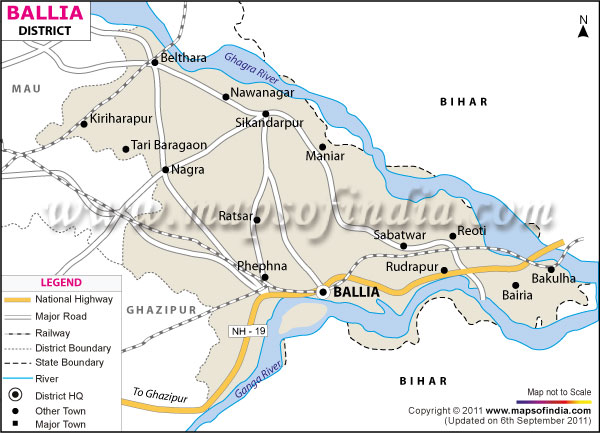
The contemporary readers and researchers tend to look at the regional planning and infrastructure with the help of sources like Ballia district map that helps them depict administrative boundaries, transportation nets, and river systems in the district. The Ballia district map has frequently been used as a valuable source of information regarding the trends of population in the region and linguistic impact.
History
The Ballia district is as old as the history of the Gangetic civilisation that was flourishing along the fertile plains of northern India, which included the area of Ballia district. The archaeological and literary sources indicate that the area was inhabited centuries ago, because of fertile soils and water sources included in the area by the Ganga and Ghaghara rivers. The name Ballia, according to local traditions, was thought to have been derived out of the word, Ballua, which means sandy soil of the area. Other explanations indicate that the region was referred to as Balian, which was later changes to Ballia with the course of time. These linguistic meanings indicate how the settlements and cultural identities of the land have developed throughout the history.
In the early history era the area was a part of a number of significant kingdoms that were in control of the northern India. It was affected by the Mauryan Empire, the Gupta Empire and subsequent regional dynasties which dominated the Gangetic plains. The rich land and the river routes allowed the region to be useful in agriculture, trade, and administration. During the time of the medieval there were several kingdoms in North India that governed Ballia and later the Mughal Empire. This is the time when the region was brought together through administrative incorporation into larger provincial arrangements and country communities retained their traditional agriculture and village institutions.
The district acquired a special status in the twentieth century where the Indian freedom movement recognized the district. Ballia briefly proclaimed independence to the British control in August 1942 in the Quit India Movement led by local freedom fighter Chittu Pandey. The district was over a brief time governed by a parallel national government before it returned to the rule of British forces. This historical development helped to make Ballia even more known as a place of resistance against colonial rule and made the latter even more confident as a political courage symbol.
A historical examination of the area usually depends on the instruments like the Ballia district map to learn how the administrative boundaries evolved during the historical background. Ballia district map enables the historians to follow the development of the territorial organisation of the district in the course of the British rule and the Indian independence. Using the Ballia district map and past data, researchers will have a more significant chance of understanding the trends of settlement and government in the region. The mention of the Ballia district map is still among the key sources of historical discussion in which to locate key towns, rivers, and historical sites of interest in the history of the district.
Culture
The Ballia district culture is an amalgamation of the traditional rural culture, religion and literary work. The district lies in the cultural region of the Bhojpuris, with lots of commonality with other neighbouring districts of the eastern and western side of Uttar Pradesh and Bihar. Festivals, fairs, folk songs and local food constitute a significant element of the local life.
The Dadri Mela is an annual and huge fair held in the district during the winter season; it is one of the most remarkable cultural events. The fair draws thousands of visitors in the vicinity districts, and it is a critical trading centre, social, and cultural performance centre. These fairs in the past have been critical in the rural economies as farmers, traders and artisans across the regions were brought together.
Ballia has also given birth to a number of great scholars and writers who had a contribution to the Hindi literature and culture studies. Some of the notable personalities, who have been related to the district, include Hazari Prasad Dwivedi, Amar Kant, and Bhairav Prasad Gupt. Their literature works have been significant in the development of the contemporary Hindi literature and intellectualism.
Village traditions such as folk music, marriage traditions as well as different seasonal festivals have a great impact on the everyday cultural life of the district. Bhojpuri folk songs usually accompany the festivities like weddings and harvest festivals as the emotional and social life of the village community.
The Ballia district map is often used in cultural research to determine the location of villages, religious centres and marketplaces where cultures are practised. The rural areas connected to the major cultural gathering points through transportation means are also seen in the Ballia district map. The Ballia district map has been employed in most researches to perceive how geographical elements affect cultural exchange in the entire district.
Language
Along with being the main source of shaping the identity of Ballia district, language also has an important function. The district is located in the Bhojpuri language region and the most popular language in the local community is the Bhojpuri language. Though Hindi is the official language of administration, language people use in their daily village and town to day lives is in Bhojpuri.
The Bhojpuri is a language of Indo-Aryan branch and with millions of speakers in the eastern side of Uttar Pradesh, western side of Bihar and the neighbouring regions. The use of the language in Ballia takes place in the languages of the house, folk songs, local theatre, and informal. The script is traditionally scripted in the Devanagari script, but the Kaithi script was also in use in historical literature.
The Hindi language is still prevalent in the District in terms of education, administration and official communication. Hindi is the predominant language in government institutions, schools, and official documentation and English is sometimes used in tertiary education and electronic communication. Cultural diversity of the district can also be observed because a small part of the population speaks Urdu.
Studies of linguistics often use the Ballia district map to witness patterns of dialect variation in various areas of the district. The Ballia district map assists researchers to determine those aspects in which the Bhojpuri dialects are blended with the neighbouring linguistic influences. With the help of Ballia district map, scholars can have a more clear idea on the influence of the geographical closeness to Bihar and the other districts on the language patterns.
Geography
Ballia district is the most eastern in Uttar Pradesh and it is a part of middle Gangetic plains. The geographical area of the district is about 2,981 square kilometres and the average altitude of the district is common to that of alluvial plains of northern India. Two major rivers the Ganga and the Ghaghara have a great impact on the geography of the district. The rivers also create natural boundaries to most parts of the district and also provide fertile alluvial soil when they come into season. This has led to agriculture being the main source of the local economy with production of crops like rice, wheat, and pulses being grown extensively in the region.
Ballia terrain may be generally classified as upland and lowland. These divisions influence trends of settlement, agricultural activities and land use. The floods of the rivers usually touch the low land near the rivers and slightly high land is more accommodating to permanent settlements and farming.
The district has a normal subtropical climate with hot summers, monsoon season and cold winters. The annual maximum temperature in the summer can go up to forty-five degrees Celsius whereas the winters are relatively warm and pleasant. The monsoon rain is very instrumental in supporting agriculture in the district.
The region geographical analysis can be done with the map of Ballia district which shows clearly the boundaries of the district, river systems and neighbouring regions. The district map of Ballia also helps locate the transportation routes to the district like road and railway lines that link the district to other regions of Uttar Pradesh and other Bihar regions.
The Ballia district map is often used by researchers investigating environmental and agricultural patterns to be able to comprehend the impact of rivers on the land use and settlement patterns. The Ballia district map is still a significant source of information in planning and development studies as this map can be used to analyse the spatial organisation of the Ballia district and the natural features of the district.
| Facts of Ballia District | |
|---|---|
| State | Uttar Pradesh |
| District | Ballia |
| District HQ | Ballia |
| Population (2011) | 3239774 |
| Growth | 17.31% |
| Sex Ratio | 937 |
| Literacy | 70.94 |
| Area (km2) | 2981 |
| Density (/km2) | 1081 |
| Tehsils | Bairia, Ballia, Bansdih, Belthara Road, Rasra, Sikanderpur |
| Lok Sabha Constituencies | Ballia, Salempur, Ghosi |
| Assembly Constituencies | Bairia, Ballia Nagar, Bansdih, Belthara Road, Phephana, Rasara, Sikanderpur |
| Languages | Hindi, Bhojpuri, Urdu, English |
| Religion | Predominantly Hinduism |
| Rivers | Ghaghara, Ganga |
| Lat-Long | 25.834505,84.187431 |
| Travel Destinations | Surha Tal, Bhrigu Temple etc. |
| Government Colleges/Universities | Saheed Mangal Pandey Govt. Girls Degree College etc. |
FAQs
Q1: Why is Ballia called “Baghi Ballia”?
It earned this name because the district briefly declared independence during the Quit India Movement in 1942.
Q2: What are the major rivers in Ballia district?
The Ganga and the Ghaghara rivers are the two major rivers surrounding the district.
Q3: What is the main economic activity in Ballia district?
Agriculture is the primary occupation for most residents of the district.
Q4: Which cultural fair is famous in Ballia district?
The Dadri Mela is one of the most famous annual fairs held in the district.
Last Updated on : May 08, 2026
