

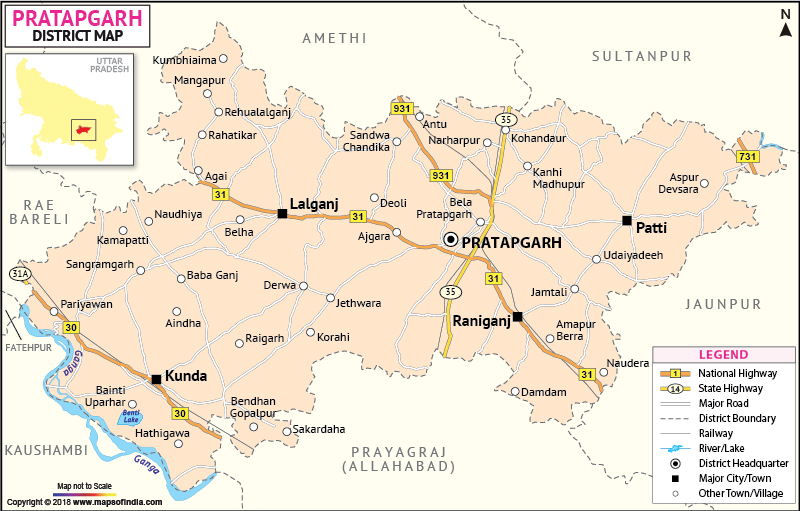





Introduction
Centering on the eastern side of Uttar Pradesh, Pratapgarh is an assimilation of the past, present, and the rural touch. The district is famous for the cultivation of the Indian gooseberry “Aonla” and has an abundance of mango orchards. Pratapgarh is a location where life is slow; however, the district's weekly markets, and fairs, and life in the district is dominated and illustrated by agriculture or gatherings at harvest festivals. The historical movement of politics and social activism in Pratapgarh has illustrated the cultivation of thinkers and leaders of the agriculture dominated districts. As the commuting practices and networks of the district improve, the district remains agriculture dominated with a large network of culturally rich and socio-religiously rich temples. Pratapgarh integrates and is the centerpiece of the fabric of the entire cultural landscape of Uttar Pradesh and is rich to the extent of providing knowledge on the understudied fabric of landscape in culturally rich Uttar Pradesh.
History
Pratapgarh has an interesting past. The story of the region is not about one ruler or one event. It grew slowly over years. Many small kingdoms, empires, local landlords and the freedom movement shaped it.
Once, this area was part of a larger cultural area known as Kosala. It subsequently came under the control of the Mauryas and the Guptas. There are no large structures left from this time. The ancient mounds, broken sculptures and remains of temples, as well as the thousands of years of human habitation, are a testament to this. The soil located between the Gomti and the Ganga rivers is very fertile, which is reason enough for people to settle in the area.
In the period different Rajput clans ruled the area. The name Pratapgarh is believed to be connected to Raja Pratap Singh. He was a ruler who built a fort here. "Garh" means fort. Many towns in India have this word in their names because they grew around forts. These forts were not always stone structures. Many were mud forts or brick-built enclosures that offered protection.
As the Delhi Sultanate grew, the present day district became part of its network. Later the Mughals ruled it. Under Mughal rule the area was divided into numerous administrative units. The main source of the economy in the region was agriculture. Farmers grew wheat, rice, pulses and oilseeds but the land revenue system was strict. Apart from its demerits, it had a silver lining as well. It helped in better record-keeping and therefore resulted in some form of stability.
In the century after the Mughals became weaker, local zamindars gained power. Many big estates emerged. Their influence was seen in the construction of havelis, temples and ponds. These landlords played a role in village life. They collected revenue, settled disputes and sometimes maintained private armies.
By the 19th century the British East India Company had taken control of Awadh. After 1856 it came under administration. The revolt of 1857 also happened here. Many local leaders and soldiers joined the uprising. Though it was eventually crushed it left a memory. Stories of bravery were passed down in families.
Under British rule it became a district with clear boundaries. Roads were built and courts were. Schools slowly began to open. Heavy taxation and strict land policies caused hardship. Peasants often struggled with debt. This led to protests and participation in bigger national movements.
In the 20th century it became a ground for active in the freedom struggle. Leaders inspired by Mahatma Gandhi’s ideas motivated people to boycott goods and join peaceful protests. Baba Ram Chandra was another prominent figure. He worked among peasants. Raised his voice against unfair land practices. Meetings were held in villages. Farmers spoke openly about their problems.
After India became free in 1947 it became part of Uttar Pradesh. The old zamindari system was abolished. Land reforms were introduced. Over time new schools, colleges and small industries appeared. It remained largely rural but slowly connected with the economy.
Fairs are organized during festivals. People from other areas come to visit. Oral traditions, folk songs and local legends keep the memory of times alive. Elders in villages still speak about battles, famous landlords and the days of the freedom movement. It is also famous for its amla or Indian gooseberry. It is known across the country.
This shows how closely the land and the people are connected. History is not filled with royal tales or giant monuments. It is a history shaped by farmers, local chiefs, freedom fighters and ordinary families. The fields, ponds and village paths have seen changes. Empires. Fell, but the life of the people continued.
Culture
Pratapgarh's culture is really about life, farming and spiritual things. People live off the land. Farming is not just an activity here, neither it is about making money, it is also about how people live their daily lives. The soil is fertile and supports a variety of plants.
The culture is also about religion and spiritual things. There is a temple in the district called the Bela Bhawani Temple. A lot of people visit this temple during festivals. When there are festivals people also have fairs near the temple. These fairs are fun with music and people performing. The Sai River that flows through this place is also valuable to the people. They have associated rituals and stories about the river showing how much they care about nature and their faith.
The language people speak in Pratapgarh is important to who they're. Most people speak Hindi. They also speak a local language called Awadhi. Awadhi is the language of folk songs, poetry and everyday talk. It makes the culture feel happy and close. A lot of stories and traditions are kept alive in Awadhi. People tell these stories during festivals. When they get together with their families.
Language
If you sit in a village courtyard in Pratapgarh and just listen you will hear different sounds. They sound a bit like Hindi. Hindi is the language here. It is used in schools, offices, courts and newspapers. Kids learn to read and write in Hindi and government work is done in Hindi.
When people talk to each other every day they mostly speak Awadhi. They might say they speak Hindi. What you hear in the markets and fields sounds different. Awadhi is a language. It has its way of making sentences and its own words. The accent is warm and friendly. Even a simple hello sounds more personal in Awadhi.
Older people speak Awadhi. They tell stories, share sayings and sing songs in Awadhi. During weddings or religious events traditional songs are often sung in Awadhi. It feels more natural and emotional. Many expressions can't be translated into Hindi without losing their meaning. Urdu is also spoken here. Not as much. Some families use it more than others. Many Urdu words are used in speech. You will hear them in poetry and polite conversation.
Younger people in towns use some English words. Students mix Hindi with English when talking about school, phones or jobs. When they go home and talk to older people they speak Awadhi again. That is how language works here, changing slowly but keeping its roots.
Geography
Pratapgarh lies in the eastern part of U.P. and shows a gentle transition between the fertile plains of the Ganga division and the cultural heartlands of Awadh.
Due to the alluvial soil, agriculture has made its firm base in the district. The crops grown in the district include wheat, paddy, pulses and sugarcane. However, Pratapgarh is mostly known for its mango orchards and aonla( Indian gooseberry ) which under the region’s specific conditions of climate and soil give the district a unique identity in the agricultural map of U.P.
Hot summers and cool winters are a given for those who live in the Gangetic plains, just like the annual monsoons that bring relief to the farmers and townsfolk by rehydrating their fields in the irrigation-farming cycle. Canals and tubewells are a constant year round irrigation to the fields. The rainfall feeds the irrigation cycle, and the annual rhythm that the farmers follow are intertwined with the rhythm of the social and cultural life in the region with multiple fairs and festivals happening around the times of planting and harvesting.
Pratapgarh has a Greenish cover which comes from the numerous, but not very dense, forests and their Orchards Groves. Along with many other fruit-trees, Mango trees are particularly prominent and the numerous orchards provide both economic and social value as they serve as common gathering places for song, dance and other pastimes.
The Groves also provide cool shaded roads, and the region has many clusters of agrarian villages. The many water bodies in the region are also important, as is the Sai river which has historically provided irrigation water for the surrounding settlements, now provides abundant irrigation water to support the agrarian settlements by reducing the population dependence on the river itself.
| Facts of Pratapgarh District | |
|---|---|
| State | Uttar Pradesh |
| District | Pratapgarh |
| District HQ | Pratapgarh |
| Population (2011) | 3209141 |
| Growth | 17.50% |
| Sex Ratio | 998 |
| Literacy | 70.09 |
| Area (km2) | 3717 |
| Density (/km2) | 854 |
| Tehsils | Kunda, Lalganj, Patti, Pratapgarh, Raniganj |
| Lok Sabha Constituencies | Pratapgarh |
| Assembly Constituencies | Babaganj, Biswanathganj, Kunda, Patti, Pratapgarh, Rampur Khas, Raniganj |
| Languages | Hindi, Awadhi, Urdu |
| Rivers | Sai, Ganga |
| Lat-Long | 25.903703,81.781425 |
| Travel Destinations | Belha Devi Temple, Aushaan Devi Temple, Baba Belkhar Nath Dham, Bhakti Dham Temple, Shri Ram Janki Hanuman Mandir, Maa Chauharjan (Barahi) Devi Temple, Kamakshi Devi Temple, Shani Dev Temple, Ram Janki Mandir, Old Hanuman Mandir, Ram Janki Mandir, Surya Mandir, Radha Krishna Temple, Inhan Devi Mandirkaali Maata Mandir etc. |
| Government Colleges/Universities | Hemwait Nandan Bahuguna Post Graduate Degree College, Mdpg College, P B College, Shiv Pati Devi Yamuna Prasad Mishra Balika Inter College, Govt Polytechnic, Dev Narayan Inter College, G. V. Inter College, S.B.P. Inter College, Shivram Intermediate College, Government Girls Inter College, M. P. S Intermediate College, R. S. B. Inter College etc. |
FAQs
Q1: What is the region known for?
The region is famous for its amla, which is also called gooseberry. This fruit is really good. People all over the country get to eat it. People in the region make lots of things from amla like murabba and sweets and pickles. These amla items are a part of what the region is known for when it comes to farming.
Q2: What languages are generally spoken here?
In schools and government offices people speak Hindi. This is the language.. When people talk to each other at home they usually speak Awadhi. This is the language that people understand. Some people also know Urdu and a few English words in towns where more people come to visit.
Q3: What is the primary occupation of the people?
Most people in the region are farmers. They grow wheat, rice, pulses and oilseeds and vegetables that're in season. Lots of families depend on farming to make a living. Either they are farmers themselves or they do jobs that are related to farming so farming is a part of the region's amla and other things.
Last Updated on : May 08, 2026
