




Introduction
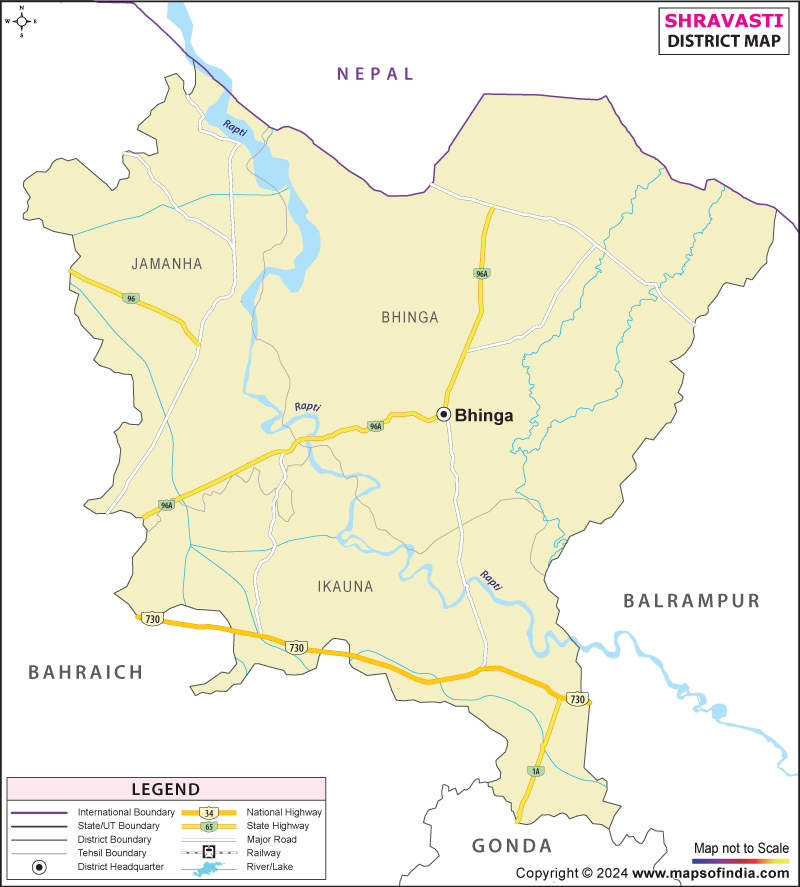
The district was created in 1997 and made a separate administrative entity in order to concentrate development of the rural-based region that is agrarian in nature. It has its administrative base in a small town named Bhinga which also serves as the political and administrative centre of the district. Despite the fact that Shravasti is nowadays characterized by the rural nature and its agrarian economy, it has an enormous historical and spiritual baggage dates back to the antiquity.
The district is named after the ancient city of Shravasti which was one of the greatest urban centres of the historic India in the early period. This pre-historic city was a great hub of religion, commerce and administration over two thousand years ago. The archaeological ruins of this glorious past are contained on the territory of the present day Shravasti district, especially at the places known usually as Sahet and Mahet.
Although Shravasti, with its distinctive position in the cultural and religious imagination of India and further, is a less urbanised district of Uttar Pradesh. The sector of agriculture is still the most important sector of the local economy and the social life of the region is determined by the rhythm of the rural life. Meanwhile, its ancient connections still have effects on its identity and image in the eyes of others.
History
The fact that Gautama Buddha was also strongly associated with Shravasti is most famous about it. Buddhism states that Buddha lived a good part of his monastic life in Shravasti after enlightenment. It is said that he gave many discourses there especially at the Jetavana Monastery, which was to be one of the most renowned monastic complexes of the ancient world. Numerous key events in Buddhist texts are established in Shravasti which serves to strengthen its centrality to the Buddhist tradition. The religious importance of the city has been supported by archaeological digs of Sahet-Mahet which revealed monasteries, stupas and inscriptions.
Jain also respects Shravasti. It is considered as the sheath of birth of Sambhavanatha who was the third Tirthankara of the Jainism faith. Shobhnath Temple is the monument of this association that brings Jain pilgrims to their place. So, Shravasti appeared as not only a political centre but a spiritual centre, which affected various religious traditions.
The ancient city started to decline slowly after it enjoyed a period of prosperity and this could be attributed to the change in political control, trade routes and invasion. The cityscape that had thrived centuries ago was brought down to rubble and was forgotten. Only in the nineteenth century, in the course of the British survey works, the old site was discovered and analyzed. This has been followed up by excavations of major structural remnants that affirm textual allusions in Buddhist and Jain writings.
Shravasti, however, continued to be a part of administrative units in the modern times before it was constituted as a separate district in 1997. This restructuring of the administration was to solve developmental problems in this area. Although modern Shravasti is a socio-economically impoverished rural district like much of northern India, historical legacy still features on the international agenda and tourist attraction particularly in predominantly Buddhist countries.
Culture
The religion and culture of Shravasti district shows a good combination of the old religious practices and modern rural life. Most people are Hindu and it is easy to find traditional Hindu festivals like Diwali, Holi, Dussehra and Navratri being celebrated with zeal in both the villages and towns. Such festivals are characterized by communal meeting, songs of devotion, seasonal fairs and rituals by holding in the local temples. The time of the year is also a significant determinant of the cultural practices and the harvest time is accompanied by its own celebrations and songs.
Another dimension of the culture of the district is Buddhist heritage. The archaeological sites of the Buddha are visited by pilgrims of other countries like Sri Lanka, Thailand, Myanmar, Japan and South Korea. The Jetavana region has monasteries built by the various Buddhist countries, of the reverence of Shravasti world over. The Prasad of Gautama Buddha is held on the occasion of Buddha Purnima, the anniversary of his birth, which attracts both national and foreign tourists.
The cultural diversity of the district is enhanced by the large Muslim minority. Islamic holidays like Eid-ul-Fitr and Eid-ul-Adha are celebrated and celebrated with strictness and local mosques are a significant centre of community life. The co-existence of various religious groups has predetermined a social environment, which is characterised by the daily contact and common local traditions.
The Awadhi tradition is close to the Folk culture in Shravasti. The oral histories and moral stories are carried through generations through folk songs, which people sing in weddings, harvest festivals and religious meetings. Conservative dress, particularly in the countryside displays the general trends of the eastern Uttar Pradesh as men are adorned with the kurta-pyjama or dhoti whereas women are adorned with sarees or salwar-kameez. Local food is very basic and mostly vegetarian with foods like wheat, rice, pulses and vegetables grown in the area forming the staple food, although non-vegetarian food is also made in most households.
Craft practices in the district are low-level compared with the urban centres, though local craftsmen are involved in handicraft and agricultural tool manufacturing in small scale. Weekly markets are colorful social and economic areas where the villagers share products, news and stories. By doing this, culture in Shravasti does not exist in monumental heritage but becomes a part of the lives of the people.
Language
The Shravasti district has the same kind of language found in eastern Uttar Pradesh. The official language of administration, education and official communication is Hindi. The government offices, schools and legal institutions work mainly in Hindi and it is widely used in functions.
The Awadhi dialect is in the middle stand as well with the normal Hindi. The Awadhi is a local Indo-Aryan dialect that has a rich oral and literary culture. It is folk-song language in the villages, proverbs, village theatre and the colloquial speech. The rhythm and words use of Awadhi provide a cultural taste to the speech patterns of the district. Awadhi is still the most spoken language in many rural families and homes by the elderly residents.
Urdu is another language also; it is spoken mostly by the Muslim communities. It is applied in religious matters, poetry and some educational institutions. Though English is not a widely spoken language in the rural areas, it is studied in school and is also spoken in college and other formal letters that may be necessary.
Geography
Shravasti district is situated in a fertile area, the Terai region, near the Himalayas foothills. It is majorly a flat land with few undulations formed by river systems and seasonal water flows. The geographical location of the district provides it with a trans-boundary nature where the ecological and cultural interactions take place on both sides of the border.
The weather of Shravasti is hot and humid during the summer seasons, there is a moderate-heavy rainy season and cool weather in winter. May and June are characterized by rather high temperatures, whereas the period of December and January is cooler and is accompanied by fog in the mornings. Forested patches, though small in size, have species which are characteristic of Terai belt such as sal and other such deciduous trees.
Land use is dominated by agriculture and most villages are enclosed by farmed lands. Landscape of the rural area with ponds, canals and small villages characterizes the visual image of the district. The natural environment of Shravasti is still alive and keeping the population alive even with the developmental problems and this links the present and the ancient past of the country.
Besides Rapti River, Shravasti district is also marked with a system of minor streams, irrigation channels and seasonal waters, which contributes significantly to agriculture. Ground water sources are also extensively exploited by using tube wells and hand pumps especially in the villages where the canal irrigation is not a possibility. The land is prone to various patterns of cropping because the fertile alluvial plains are fertilized yearly by the silt deposits. Crops that farmers usually grow in the season of rabi include wheat and mustard and those that are grown in kharif season are paddy and maize. The reliance on rains however implies that the changes in the rains can have great impact on farm productivity and the livelihood of rural people.
The geographical and socio-economic environment of the district is also predetermined by the fact that it is located near the Indo-Nepal border. Cross-border movement, which is controlled by appointed points, helps in exchange of local trade and culture. The topography along the boundary with the North is typical of Terai such as slightly marshy areas and tracts of grasslands. Despite the fact that the level of industrial development is still low, Shravasti is connected with the neighbouring districts, including Bahraich and Balrampur, with the help of road networks, which permit the access to the regional markets. In general, the geography of Shravasti is a blend of fertile plains, riverine systems and borderland features which altogether determine its environmental and economical nature.
| Facts of Shravasti District Map | |
|---|---|
| State | Uttar Pradesh |
| District | Shrawasti |
| District HQ | Shravasti |
| Population (2011) | 1117361 |
| Growth | -5.02% |
| Sex Ratio | 881 |
| Literacy | 46.74 |
| Area (km2) | 1640 |
| Density (/km2) | 572 |
| Tehsils | Bhinga, Ikauna |
| Lok Sabha Constituencies | Shravasti |
| Assembly Constituencies | Bhinga, Shrawasti |
| Languages | Hindi, Urdu, Awadhi |
| Religion | Predominantly Hinduism |
| Rivers | Rapti |
| Lat-Long | 27.610539,81.9627 |
| Travel Destinations | Maha Mangole Temple, Maha Veera Temple, Maheth, Saheth, Shakti Peeth, Gandha Kuti, Jetavana Monastery etc. |
| Government Colleges/Universities | Mahamaya Government Degree College etc. |
FAQs
Q1: What is Shravasti district best known for?
Shravasti district is best known for its association with Gautama Buddha and its ancient role as the capital of the kingdom of Kosala.
Q2: When was Shravasti district established as a separate district?
Shravasti district was officially established in 1997 after being carved out of Bahraich district.
Q3: Which river is most important in Shravasti district?
Rapti River is the greatest in the district and sustains agricultural activities and local lives.
Q4: Where is the administrative headquarters of Shravasti district located?
The administrative headquarters of Shravasti district is located in the town of Bhinga.
Last Updated on : May 08, 2026
