






Introduction
Kannauj is a very old and also very famous district in the north Indian state of Uttar Pradesh. When you visit here what you will notice first is the sweet smell in the air. To the world over it is known as the Perfume Capital of India. For thousand of years this city has been the center of power and home to the best traditional scents.
The town which is by the sides of the sacred Ganges River. It is more than a business center; it is a living history which you experience in each street. From great kings to small scale perfume producers, all have played their part in Kannauj’s distinct place in Indian history. Today it is a very much alive place where the past and present cross paths.
History
The history of Kannauj is a very grand story in all of India. For many years that city was the heart of the country as Delhi is today. It went by the name of “Kanyakubja” in ancient times and is mentioned in very old books and poems. At that time people from all over the world knew of its great wealth, beautiful architecture, and very wise rulers.
In the early 7th century the city saw its height under King Harshavardhana. A most amiable and powerful leader he was which he made Kanauj his capital. Under his rule the city became a world center for scholarship and religion. Thousands of students and monks came here to study and the streets were filled with gold, silk and the smell of flowers which came from the many which filled the city.
After King Harsha’s death out broke what is known as the “Tripartite Struggle”. In the East the Pala dynasty rose to power, in the West the Pratihara, and in the South the Rashtrakuta all of them vied for control of Kannauj. They had it in their mind that whichever kingdom which could put their flag on that city would be the ruler of North India. The struggle went on for two hundred years which also stood as a testament to the city’s importance.
Later at the time the Ghadavala dynasty took over in the city. At that time Jaichand was the most renowned king. During this age the city was very rich still but it was also very much under attack from foreign invaders. Though in the midst of war the people did not stop perfecting the art of perfume making. They used the same flowers which grew by the banks of the Ganges to make oils for the royal courts.
When the Mughals and Delhi Sultans rose to power they also valued that which Kannauj brought forward from its past. They supported the perfumers in their craft so as to pass it on to the next generation. The city became a home to many cultures and ideas. While today’s visit may find the grand palaces in ruin the old walls and the heritage of traditional perfume workshops tell the story of its royal past.
Today the city is at peace. We have the local museum which has on display old coins, broken statues, and pottery that are hundreds of years old. Also every time a new structure is put up they dig up history which is buried in the ground. It is a land which has known great glory and which still is the pride of Uttar Pradesh.
Culture
In Kannauj there is a very distinct culture which is that of perfumes. In the old city almost each family is related to the perfume business in some way. This has formed a very patient and hard working community. Perfume making is a slow process which in turn reflects in the calm and polite nature of the local people.
At the core of what local community does is create a perfume tradition from times past named as Attar. As opposed to the large factories we see today, workers here use antique copper pots that are referred to as “Degs” for which they use wood or coal to get the fire going. This is a skill which is not taught in great institutions of higher learning but instead is handed down from father to son in small home workshops. This tradition also brings families together and they keep their ancient stories alive in each drop of oil they produce.
In Kannauj the people are known for their fine manners and have a gentle way of speaking. They have a lot of which is referred to as “tehzeeb” that’s an in which respect for guests and neighbors is a point of honor. Also because for a large part of what they do is work related to the fragile flowers and glass bottles, they have a very tranquil and steady demeanor. In the markets, you will also see at any given time elderly in the company sharing stories at the same time that the air is filled with sandalwood.
Festivals in that district are very much a part of local culture. In the month of Phagun the air is filled with Holi colors as well as the rich smell of the “Gulab” (rose) harvest. People of all religions come together to work in the perfume industry which has brought about a very peaceful and integrated way of life. At a wedding or a religious fair you will see flowers and traditional scents which are the base of the celebration.
The food culture here is very much what you would expect in the rest of North India but we also see local influence. We do see that people are into fresh kachoris and sweets which are made from the pure milk of our village cows. Also because the district is very potato rich you will find many potato based snack at every turn in the street. In Kannauj eating together is a large part of the culture and guests are treated as if they are family.
In short what we see is that this city’s way of life is very much about living close to nature. The people here don’t rush into the modern noise; instead they live by the old pace which they have with their copper pots. It is a place where the air is filled with history and the people have hearts as soft as the rose petals they pick. That mix of the past and present which they have created makes the city a very peaceful destination to visit.
Language
The language in Kannauj is a very sweet and very expressive dialect which we call Kannauji. It is a part of the Western Hindi group and is spoken by million in that district and the surrounding areas. What you will hear is a version of the language which is also spoken in Braj but it has its own unique beat and local vocabulary which makes it stand out.
While in schools and government offices Hindi is the primary language, at home people use the Kannauji dialect. In the narrow lanes of the perfumery quarter go the bargains and the chats in this accent. It is very friendly which with its soft sounds goes down well with the urban polite culture.
In the city many people also speak Urdu very well which brings a touch of grace to their speech. This is a result of the city’s past under many rulers who had great love for poetry and literature. Out of this mix the local language has adopted very pretty phrases which talk of the smell of flowers and the flow of the Ganges.
In present day areas of the town and in large factories the younger generation is learning English. They use it to communicate with buyers from other countries which come in for the famous oils. Also it is the case that when they go home they revert to their mother tongue which they say is the true spirit of their ancestors.
Geography
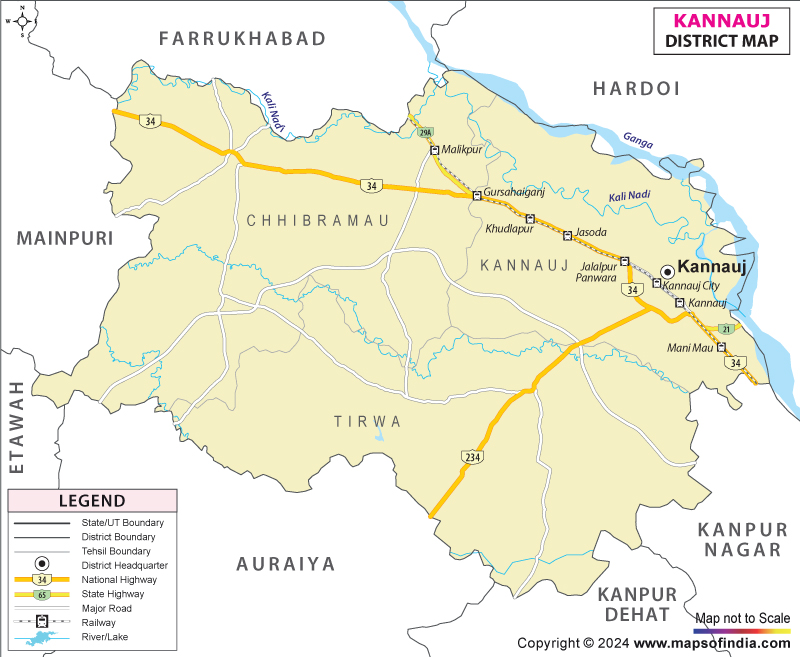
Kannauj’s geography is a picture of the rich and fertile lands in the centre of North India. The district is right in the Doab which is the term for the land between two large rivers. To the north and east the sacred Ganges River flows, also the Ramganga which borders it. This location which is very flat, makes the land ideal for farming.
In Kannauj we have what may be the most important element of the geography which is our alluvial soil that is very sandy and light. What the rivers do annually is bring in fresh minerals which in turn make the soil very soft and very good at holding water. What we have here is a very particular type of soil which is the secret to why we grow roses and other flowers so much better here than in other places.
Water is all over the district. As for the large rivers there are many small canals and ponds which keep the ground very moist. This network of water bodies reports to do well in the farmers’ effort to grow up to three different crops each year. Also we see that the underground water level is quite high which in turn keeps the trees green in the very hot summer.
In that area climate plays a large role in day to day living. In summer it gets very hot which actually is great for jasmine flowers which they put out their scent. With the Monsoon rains coming the district becomes a bright green setting. Winters here are cool and foggy which in turn gives the famous Damask roses perfect weather to bloom in the early morning.
Another pretty aspect of Kannauj’s geography is the Lakh Bahosi Bird Sanctuary. It is a large wetland which weaves between two large lakes. Due to the very flat terrain the lakes there function as huge basins which collect rain water. It is a very peaceful place at the interface of land and water which in turn is a great setting for thousands of wild birds.
The land here is a gift of the rivers. Flat plains, sandy soil, and an abundance of water make up what is perhaps the most productive region in Uttar Pradesh. From vast potato fields to sweet smelling rose gardens the area’s geography is a product of nature which designed it to be a garden of plenty. It is this natural beauty which has kept the city famous for thousands of years.
| Facts of Kannauj District | |
|---|---|
| State | Uttar Pradesh |
| District | Kannauj |
| District HQ | Kannauj |
| Population (2011) | 1656616 |
| Growth | 19.27% |
| Sex Ratio | 879 |
| Literacy | 72.7 |
| Area (km2) | 1993 app. |
| Density (/km2) | 792 |
| Tehsils | Chhibramau, Kannauj, Tirwa |
| Lok Sabha Constituencies | Kannauj |
| Assembly Constituencies | Chhibramau, Kannauj, Tirwa |
| Languages | Hindi, Urdu, Kanauji |
| Currency | Indian Rupee (INR) |
| Religion | Mostly Hinduism and Islam |
| Rivers | --- |
| Lat-Long | 27.052094,79.914157 |
| Travel Destinations | Lakh Bahosi Sanctuary, Government Archaeological Museum, Siddheswar Temple etc. |
| Government Colleges/Universities | Bau Singh Mahavidhyalya, Ch. Manesh Colege For Women Education, Ch. Mohar Singh Mahavidlay, Dr. Bhim Rao Ambedkar Ajkiya Medical Colege, Gautam Budh Balika Degre Colege, Gautam Budh Degre Colege, Govt. Degre Colege, V. .K. Degre Colege, Swami Girshanand Egre Colege, Sri Mukund Sanskrit Mahavidyaly, P. S.M. Degre Colege, Neharu Degre Colege etc. |
FAQs
Q1: Why is Kannauj known as the Perfume Capital of India?
Kannauj for a thousand years has been the home of natural perfumery which we know today as Attar. They use ancient distillation techniques which they have passed down through generations to draw out pure scents from flowers like roses and jasmine which they in turn export to countries all over the world.
Q2: What does "Mitti Attar" mean and what makes it so special?
Mitti Attar is a one of a kind perfume which is a product of Kannauj. We see the smell of rain on dry land in every bottle. Local artisans achieve this by the process of baking river clay which they then distill with sandalwood oil, a method which is unique to the area.
Q3: What is the "Deg-Bhapka" method?
This is what has been done for generations to make perfume which we use large copper pots called Degs and bamboo pipes. We steam the flowers in water and the fragrant steam is collected in a receiver which in turn preserves the fragrance free of any alcohol.
Q4: What is Kannauj’s primary product besides perfume?
Kannauj is a large producer of potatoes in India. In the area which is of soft sand near the Ganges river which is very good for farming the district puts out potatoes which go to markets all over the country.
Last Updated on : May 08, 2026
