




Introduction
Deoria is a beautiful district which is in the east of Uttar Pradesh, India. It borders with Bihar and is a part of the Gorakhpur division. Also known as the “Sugar Bowl” of the area which it is true in large part due to the many sugar mills which we still have there. It is a place which has rich soil, very friendly people and air that smells of fresh produce.
In the past our district took its name from a very special word, Deopuri which means the place where gods live. When you visit you will see that life here is very peaceful. People value their land, their families and their local gods. It is also a perfect example of a traditional Indian rural district which is slowly moving into the modern world.
History
The history of Deoria is a very long and ancient past which goes back to the beginning of Indian civilization. In the old religious books it is told that this area which we see today was once filled with dense holy forests which great sages called home and spent their days in prayer. It was a key area of the Kosala Kingdom which in history is known to us as the land which was home to the ancestors of Lord Rama. Because of this Deoria has had and continues to have a very strong spiritual tie to its earth.
In the times of the Buddha Deoria became a very large historical center stage as it was part of the Malla Republic which in turn was one of the sixteen great powers of India known as Mahajanapadas. Also in that time the cities of Kushinagar and Pava which are near to Deoria saw the end of Lord Buddha and Lord Mahavira’s lives. Thus the area becomes a very important spot for those who wish to trace the roots of Buddhism and Jainism.
As we move into the medieval period the land saw many different rulers which included the Gupta Kings and the local Rajas of the Majhauli Raj. The Majhauli dynasty is a very old royal family in the area which did great in preserving local traditions during the Delhi Sultans and Mughal rule. You can still see old ruins and small forts in the villages which tell us of those royal times.
During the British rule which was a very important phase in the history of Deoria the area was a part of Gorakhpur district for a very long time. But with very fast growth of the area which also saw the development of many sugar factories it became necessary to have a separate identity. On the 16th of March 1946 Deoria was finally made into a separate district. This move which gave the local people a separate entity also brought them better schools, roads and government offices.
In this land, people also are known for their bravery in the struggle for India’s freedom. In 1942 during the Quit India Movement villages in Deoria were abuzz with activity. Many local leaders and farmers rose up against the British police to demand “Purna Swaraj” or total independence. Also we have the story of the sacrifice at Dohari Ghat which is famous for the great courage put in by the people to protect their motherland.
After the 1940’s the district saw great growth in farming and industry. At one time we were called the Sugar Bowl which we earned by having the largest number of sugar mills in the state. Though today the world is changing the way we work, Deoria’s past is in the hard work of its farmers and the wisdom of our old saints. We have seen the rise of empires and the birth of great religions here.
Culture
The culture in Deoria is a blend of great faith which is very much a part of life, hard work which is the backbone of the community, and the sweet spirit which is typical of the Sugarcane belt. Here life is very much rooted in tradition which the people take great pride in. As this district is right at the border of Uttar Pradesh and Bihar the way of life has elements of both regions. What you will see is that people are very humble and they treat each guest as if they are family.
The city is named after “Deopuri” which means the home of gods. You see this in the many small temples which are under large Banyan trees in almost each village. These temples serve not only for prayer but are the primary forums where people come together to discuss daily issues and sort out village problems.
Festivals bring out the culture of Deoria in all its vibrancy and color at which time we also see the musical element. Chhath Puja is the largest of these events when from all over the district the masses come together at the riverside to worship the Sun. Also at this time the whole area is like one large family. As for other festivals such as Holi, Diwali and Janmashtami we see traditional dance and special local music.
Music plays a huge role in the soul of this place. In the harvest season you will hear out of the distance “Bhojpuri” folk songs. Also in the villages of Deoria there is a very special style of singing which is “Birha”. These songs tell of great warriors and the every day struggle of the common man.
The food in the area is basic but very healthy and we also see a lot of what is produced in the local farms. “Litti Chokha” we notice is the favorite dish which people like to eat near a fire pit in the winter. When Deoria was the former ‘Sugar Bowl’ of the country that is still true today, as we have many varieties of sweets made from fresh sugar cane juice. Also at family functions, weddings you will see lots of their choice of fresh yogurt and “Bati-Chokha”.
Traditional clothing is what the majority in the rural areas still choose. Men put on a white “kurta-pyjama” or “dhoti” and women wear colorful sarees in the local style. At the village fairs or “Melas” you see people in their finest traditional attires. These fairs are the best to see the culture of Deoria which includes hand made wooden toys and brass utensils sold at every turn.
In other words what we see here is a lifestyle that is very much in tune with nature. They put their language, their land, and their community first. As the rest of the world changes around them with new tech and large cities, the people of Deoria hold onto their old ways which they do with grace. It is a culture which also shows us how to find happiness in little things and how to respect all.
Language
In Deoria their language is what truly defines the character of the place. Although Hindi is what is used in the government and in schools, in the homes and on the streets it’s Bhojpuri which is the language of the heart. This dialect they put their own spin on which also has to do with the district’s location between Uttar Pradesh and Bihar.
Although Bhojpuri is the local language, what we see is that most people also speak very good standard Hindi. This helps the people of Deoria to integrate with the rest of India in terms of trade and education. In Deoria Sadar you will often hear a mix of both languages in the market which is very active with traders and farmers coming in to do business each day.
In recent times what we are seeing is the younger generation also going out to learn English in search of better job opportunities in metropolitans. But at the same time their love for their mother tongue is very strong. At weddings which see the singing of folk songs, and every other day when we meet over a cup of tea, our language in Deoria is what brings the community back to itself and us to each other.
Geography
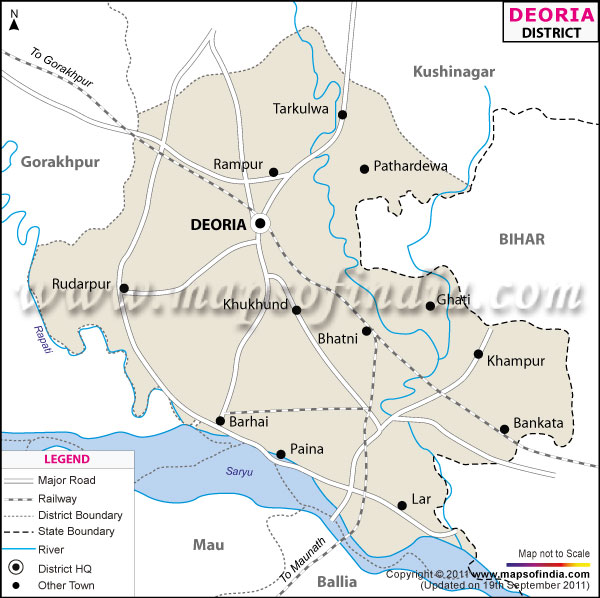
The geography of Deoria is so interesting, in this case that the land is for the most part flat and green. It also sits at the eastern edge of Uttar Pradesh by the Bihar border. That region is part of what is known as the “Sarayupar” plains which is to say that they sit beyond the sacred Sarayu River. Also due to the very flat terrain you can see for a few miles out over golden wheat fields and green sugarcane patches.
The district is home to many large and small rivers. The Great Ghaghara River which forms the south boundary of the district separates it from Mau and Ballia. That river is very large and powerful, also at the time of monsoons it brings in a great deal of water from the mountains.
Another key river is the Little Gandak which runs through the center of the district. These rivers are the cause of the very rich and “Alluvial” soil in Deoria. This type of soil is a natural gift for farmers as it does very well at retaining moisture. It is the best for growing sugarcane which is how Deoria earned its reputation as a sugar producing hub.
In summer it is very hot, during monsoon which falls in the months of July and August we get heavy rain which turns the whole district into a bright green paradise. The farmers look forward to these rains which in turn fill up local ponds and small lakes which are called “Jheels".
In winter the weather turns very cool. In the early morning you’ll see thick white fog which is great for the wheat’s growth in the fields. The air is very fresh and clean as there are no large mountains to break the wind. This open terrain gives Deoria a very large and peaceful feel which nature lovers will enjoy.
Although we do not have large forests here, the land is full of Mango and Mahua trees. These trees provide shade for village homes and delicious fruit in the summer. Also we have a high water table which allows people to easily access fresh water from the ground. This along with the flat terrain, abundant water and fertile soil which characterizes Deoria which in turn makes it one of the best farming regions in the state.
In other words, the land is a gift of the rivers. The geography of Deoria has played out over thousands of years which in turn has made the people expert farmers that very much know how to work with the seasons and the soil to feed their families.
| Facts of Deoria District | |
|---|---|
| State | Uttar Pradesh |
| District | Deoria |
| District HQ | Deoria |
| Population (2011) | 3100946 |
| Growth | 14.31% |
| Sex Ratio | 1017 |
| Literacy | 71.13 |
| Area (km2) | 2535 |
| Density (/km2) | 1220 |
| Tehsils | Barhaj, Bhatpar Rani, Deoria, Rudrapur, Salempur |
| Lok Sabha Constituencies | Deoria |
| Assembly Constituencies | Barhaj, Bhatpur Rani, Deoria, Pathardeva, Rampur Karkhana, Rudrapur, Salempur |
| Languages | Hindi, Deoria include Bhojpuri |
| Currency | Indian Rupee (INR) |
| Religion | Mostly Hinduism and Islam |
| Rivers | Ghaghara |
| Lat-Long | 26.428769,83.800564 |
| Travel Destinations | Ramlilala Maidan, Hanuman Mandir, Somnath Mandir, Deorahi Mandir, Dugdheswarnath Mandir, Dirgheswar Mandir, Parshuram Dham etc. |
| Government Colleges/Universities | S.S.Wilayt Husain Degree College, Baba Raaghav Das Pg College, Pg College (Aashram Barhaj Deoria), Sant Vinova Pg College, Mahila Post Graduate College, Mahara Agrasen College Of Commerce etc. |
FAQs
Q1: Why do they call Deoria the “Sugar Bowl” of Uttar Pradesh?
In the past, Deoria was a district which had a high concentration of sugar mills as compared to other districts. Fertile soil and an abundance of river water made it the best place for farmers to produce large quantities of sugarcane for the entire country.
Q2: What does the past tell us of the relationship between Deoria and Lord Buddha?
Deoria was part of the Malla Republic at the time of Lord Buddha’s death. What is present day Kushinagar which is a very famous Buddhist site was a part of Deoria district at that time which became a separate area in 1994.
Q3: What does Deoria have as its top local food?
Litti Chokha is the favorite dish which is of the recipe of roasted wheat balls filled with sattu and served with a side of mashed vegetables. Also as this is a sugarcane hub you will see that they serve many traditional sweets which are made from fresh jaggery.
Last Updated on : May 08, 2026
