






Introduction
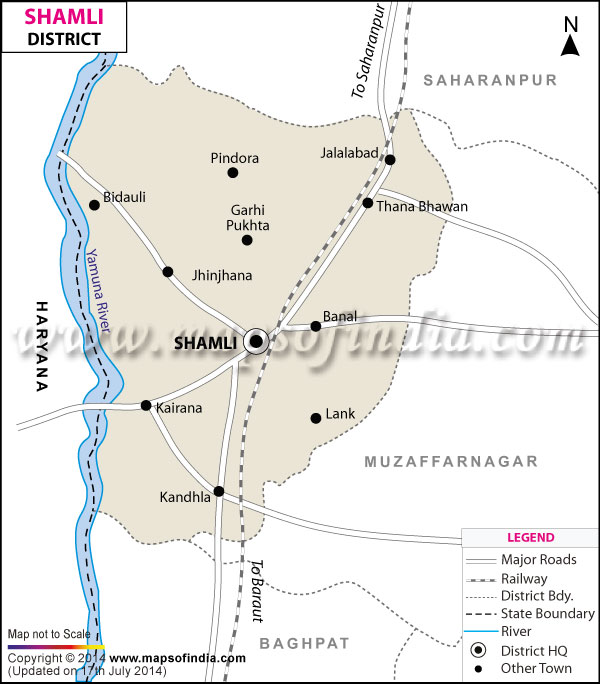
Shamli is a newly formed district and is part of western Uttar Pradesh. The district is also known as part of the “Sugarbowl of India”, as it has many functioning sugar and jaggery mills, which bolsters the economy of Shamli. Along with being a sugarcane producing district, Shamli district has become a trading and transportation center and is one of the sugar producing districts of India as it lies on the Delhi-Saharanpur highway and is adjacent to the state of Haryana. Shamli has a history as it was one of the districts to take part in the British India struggle, namely in the 1857 British era uprising.
Shamli has also written history in many folk stories and constructed stories. Presently, it has become an industrious district with many small scale industries. It has a culturally rich interior that has many traditions to bolster it such as folk music, cultural fairs, and also many rituals with the purpose of enriching the state. It has a lot of history and is an indicative district of the prosperity and depth of the ancient heritage of the region.
History
Shamli has a long history that has religious significance as it is believed that the district is part of the route of Lord Krishna in the Mahabharata from Hastinapur to Prayag and it also has devotional centers like Hanuman Dham that attract a lot of followers. The history of the region is long and interesting. The region was the Upper Doab in ancient times that was very fertile and had a lot of settlements. According to mythology, Lord Krishna crossed it and stopped to drink from a well that is still there.
This connection has relayed a sacred feel to the district, integrating it into the epic traditions of India. During the medieval age, the fertile lands of the region made it a prized possession with the Mughals incentivising farming and trading. The area was a critical contributor of the food supply to northern India and remained connected to growing civilisations. It experienced brutalities of the greatest magnitude during the Great Indian Revolt of 1857 where it was the centre of anti-British rule resistance and local leaders and farmers out of their own will, revolted.
The early 20th century witnessed the construction of Upper Doab Sugar Mill which was a pillar in the acquisition of the city as a sugar centre, and there was also the construction of a market centre. This centre connected the farmers of the surrounding area and the growing trade of agricultural produce to the wider market. It always remained in Muzaffarnagar district after India gained independence in 1947, and with time, built up.
The construction of roads and railways brought it closer to other trading centres of Delhi and Panipat. With the setting up of small scale industries and educational institutions, Shamli began to diversify its economy which had mainly been agrarian. The significance of its role as a trading hub started increasing. It started emerging as a politically important constituency in the Legislative Assembly of Uttar Pradesh, influencing the political equilibrium of the region.
The long pending demand of Shamli's district status was granted in 2011 when it was cut out of Muzaffarnagar and named Prabuddh Nagar and the renamed district did not sit well with the locals and, not long after, was renamed Shamli in 2012, Restoring its historical name and status.
Its involvement in the 1857 revolt and the subsequent decline of the region in importance, until the recognition as a district in 2011, shows the rise and decline of importance of the region. The district now symbolizes the agricultural success, industrial development, and diversity of the region, which, and the heritage of the region.
Culture
Rooted in agriculture and community interconnection, the culture exemplifies its rural beginning and agricultural success. The cycle of daily life is defined by the sugarcane fields and the seasonal festivals and sugarcane fields and the local markets. The culture and prided hospitality are reflective of the simple and genuine warmth and simplicity of the people. Holi, Diwali and Eid are equally celebrated. The people of Shamli integrate and include and enrich the culture with the festivities. Shamli folk songs, storytelling genres and local dialects further enrich the already deeply human and vivid culture.
People come together in strong rural societal bonds as a farming oriented local fair and market place creates its own social life separate from its economic one. Folk songs and dances and story-telling are all part of village gatherings during weddings and seasonal festivals. This community of the city has a living oral history that is shared for generations as a revered part of community identity.
Shamli's cultural characteristics are uniquely her own and influenced by factors that include language. Whilst Hindi is most common, the local dialects of West Uttar Pradesh front conversational layers of rich and earthy idioms. Equally strong, and reflecting the agricultural pull of the region, is the hospitality of the people.
When guests arrive, they are received cordially and an abundance of simple agricultural foods are served. From the land, sugarcane juice and freshly made jaggery, rustic breads, and sugar are everyday and enduring tastes.
While agriculture is the primary use of land, and is valued by the people, the area is witnessing the influence of modernity and the coalescing urban lifestyles that accrue from an expanding network of cities and roads.
With the outside world enticing youth, the resilient, rooted traditions of the older generation remain, and inspire a unique amalgam of the new and the old. Farming and communal celebration is the heart of Shamli, where the present and past co-exist and define true belonging.
Language
Shamli is a district with a rich cultural and social diversity, showcasing its diversity through its main dialects and languages; Khari Boli, Hindi, Punjabi, and Urdu. Though Hindi is dominant and official, Fauji Boli and Punjabi are communicational and celebratory aids. Most educational and governmental institutions are Hindi dominated. That said, the region has a Khari Boli influence.
It is a dialect of western UP that is direct and rich in idioms. It is seen to be earthy, and distinct, making it different from the standardized Hindi of urban areas. Urdu is another language that is esteemed, especially in the Muslim community as it is dominant in speech, literature, and poetry. It is present in the social events and religious activities and is even seen in the market as it is blended with Hindi and Urdu phrases.
Geography
Shamli is located in Ganga-Yamuna Doab of Western Uttar Pradesh. The alluvial soil in the district is rich. This makes it very productive and good for growing crops. The land is mostly flat and grows sugarcane, wheat, and mustard. Seasonal monsoons make possible the replenishment of groundwater and the Hindon river and many irrigation canals support the growth of crops. Being close to Delhi, Meerut and Panipat also connect Shamli to trade networks, however the district still remains very rural.
The terrain is mostly flat and is only gently undulating, supporting large expansive rural fields of agriculture that dominate the great rural landscape of the region. The presence of various water systems has a long history of promoting settlement, and the development of villages and towns. The typical plain climate of northern India is of simple structure: Hot summers are followed by a Monsoon season which recharges the fields and a Winter season which is cool, provides relief and completes the crop cycle.
The monsoons dictate the productivity of the farmers, who, along with the rest of the town, have an agrarian way of life. The seasonal rhythms it experiences create seasonal trade. Shamli has trade routes from the villages to the towns between the major trade hubs of Delhi, Meerut, and Panipat. Each of these trade centers has their own unique trade influences.
It has a typical north Indian climate. There is a hot summer, a monsoon season, and cool winters. During summers, dry heat can be extreme, and later in the season, the monsoon brings rain which is important for farming. Frosty and dry winters are pleasant. The seasonal changes here are in a close relation to farming activities. The climate patterns allow the crops to grow.
The rural character allows it to preserve an agrarian and seasonal trade dominated civilization, unlike more urbanized regions, as the vegetation, dominated by wheat, sugarcane, and mustard, with patches of mango groves, is heavily utilized by man. The wildlife is composed of the small and common vertebrates and invertebrates. The majority of the vertebrates are birds.
| Facts of Shamli District | |
|---|---|
| State | Uttar Pradesh |
| District | Shamli |
| Location | Western Uttar Pradesh |
| District HQ | Shamli |
| Population (2011) | 1578174 |
| Growth | * |
| Sex Ratio | * |
| Literacy | * |
| Area (km2) | * |
| Density (/km2) | * |
| Tehsils | Shamli, Kairana |
| Lok Sabha Constituencies | Kairana |
| Assembly Constituencies | Kairana, Shamli, Thana Bhawan |
| Languages | Hindi, Urdu |
| Rivers | --- |
| Lat-Long | 29.447969,77.310591 |
| Travel Destinations | Hanuman Tilla etc. |
| Government Colleges/Universities | Govt. Girls Polytechnic College, R. K. Post Graduate, Hindu Maha Vidhayalya etc. |
FAQs
Q1: What is the palace famous for?
It is famous for sugarcane farming. People do a lot of farming. The town has sugar mills. Farming is a part of the economy and daily life. It is mainly known for its sugarcane farming.
Q2: What languages are spoken here?
The main language spoken is Hindi. Many people also speak Urdu. The way people speak is like the way people speak in Uttar Pradesh. When people talk they use words that you hear in rural areas.
Q3: What is the climate like?
The weather here is very hot in the summer. It gets a lot of rain during the monsoon season. Winters are cool. Sometimes the summers are too warm. The winters can be foggy. This usually happens in December and January.
Q4: What is the main occupation of people here?
Agriculture is the major activity of the region. Sugarcane farming is the most dominant livelihood. It is supported by related industries like jaggery production.
Q5: What are the significant industries in Shamli?
Besides sugar production, Shamli contains small scale industries like jaggery manufacturing, textiles, and agro-based industries.
Last Updated on : July 13, 2026
