






Introduction
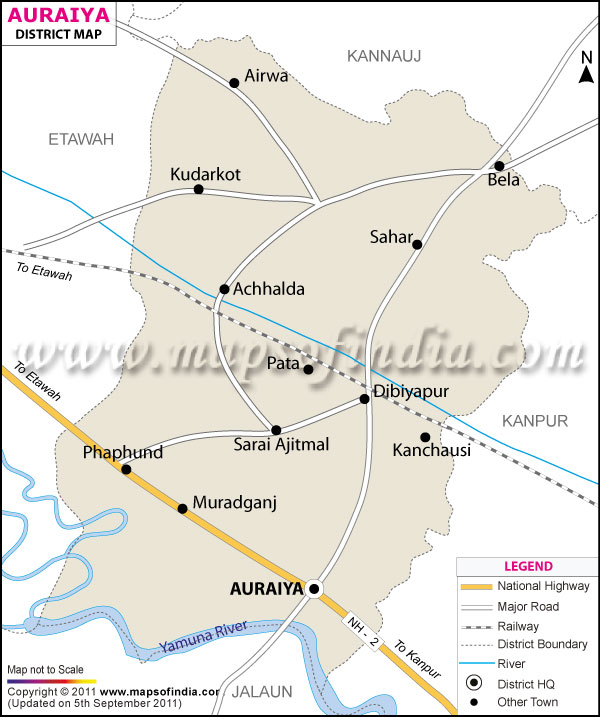
The Auraiya district map showcases that the district is situated in the middle section of Uttar Pradesh that is an Indian state and is geographically a part of Kanpur division. The administrative seat is in the town of Auraiya and it serves as the centre of administration, business and state apparatus. The area is an area of fertile plains in the north of India and it has a long history of supporting a major population that is mainly rural and that whose livelihoods are directly linked with agriculture. An excellent conception of the landscape of the region can be achieved using an Auraiya district map that shows the location of the district in the neighbouring districts including Etawah, Kanpur Dehat, Jalaun and Kannauj.
The location of the district in Uttar Pradesh is also convenient in terms of the major transport corridors in the state. The road networks allow residents to trade and travel to the major cities like Kanpur and Etawah via the road networks in the area. These links can be seen in the map of the aurasaiya district and how the district is incorporated into the overall regional transport system.
History
Historical Auraiya district is very much related to the general historical process of the central part of the Ganga-Yamuna region. This region belonged to a number of historical kingdoms which contributed to the northern India in ancient times. The Yamuna River has been habituated by the fertile grounded plains where early settlements, trade routes and agricultural communities have been developed which led to the long historical legacy of the region.
The political and cultural policy of the Mauryan Empire had an effect on the region during the Mauryan period in third century BCE. The rule of emperor Ashoka enhanced more integration of the north India as a unit of a central government. Even though the historic archaeological evidence in Auraiya is sparse, historic data on the form of an Auraiya district map can frequently recognize regions where ancient habitation and trade paths used to be found. The next several centuries were marked by the impact of the several dynasties such as Guptas and subsequent local authority. The Gupta period is generally taken as a period of cultural and economic flourishing in northern India and the land around currently known Auraiya was no exception to this greater historical view point.
In the medieval period, the region was placed under the rule of various rulers known as Rajput who ruled over the central part of the plains. Fortified towns and government centres were also formed in other regions of the region and this led to the expansion of the local communities. The Auraiya district map is commonly used by scholars of the regional history to determine the places related to the settlements of the medieval period and landholding.
As the Delhi Sultanate grew, and eventual the Mughal Empire grew to include more realms, the areas of the Auraiya and other realms eventually became incorporated within larger imperial administrative structures. There was a more systematic organisation of the agriculture and revenue collection system under the Mughals rule. Historians often use the Auraiya district map to indicate the position of historically existing villages which were historically revenue estates.
The political course in the eighteenth and nineteenth centuries was modified when the influence of the British East India Company slowly spread over the northern part of India. The area later acquired British colonial rule and the colonizers brought with them new structures of rule, land revenue policies and development of infrastructure like roads and railways. The general effect of the freedom movement in India was also felt in the district during the twentieth century. A vast number of the inhabitants were part of nationalist movements that sprung up to resist the leadership of the colonizer. Following the Indian independence in 1947, the region was incorporated into the state of Uttar Pradesh.
In the contemporary history of Auraiya district, the establishment of this region as an administrative entity in 1997 was a significant turn in the history of the area. Since then, the programmes of governance and development became more focused on the needs of the district. Auraiya district map is a significant resource of information to planners and historians interested in knowing how the district has changed its history since ancient times lines to a contemporary administrative district.
Culture
Auraiyan district has the culture, which reveals the traditions, social values of central plains of Uttar Pradesh. The agricultural activities of the district and the rural life form a part of the cultural identity of the district. Festivals, Fairs and the local traditions unite people and enhance the relationships between the families and villagers.
The religious festivals are more of a central part of the culture within the district. There are many Hindu festivals like Diwali, holi, navratri and dussehra and people are very much enthusiastic and follow the rituals. These events transform markets or the open spaces into very colourful places of celebration. Tourists traveling within the area often use an Auraiya district map of the area to identify where towns hold large festivals and fairs.
Local fairs are called melas and are held in various sections of the district at various times in the year. These occasions involve a mixture of religious activities, entertainment and commerce. Many of these gathering places can be understood by a detailed Auraiya district map. As for the villagers, they go in the market buying household items, farming gadgets and traditional arts besides appreciating cultural shows.
The songs that local singers perform talk about the life of the countryside, the transition of seasons and the social relations. Music and dancing which depict the cultural heritage of the region is mostly a feature of weddings and family ceremonies. The cultural nature of the district is also represented by traditional jobs. Pottery, small-scale handicrafts of weaving and handicrafts, are still in practice in some of the villages. These are Generation-old crafts that are significant as a local identity.
Language
Auraiyan district has a language which shares the same linguistic diversity to that of central Uttar Pradesh. The official language in the administration, education and medium of communication is Hindi. Real offices, schools and media houses address and record government documents in standard Hindi.
Kannauji is the other dialect that is widely spoken in the non-scholarly communication of local residents along with Hindi. Kannauji is a language which belongs to the Indo-Aryan family and has been closely related to Hindi language yet retained some peculiar vocabularies and pronunciation patterns. Kannauji is still the main local language in the daily communication of the villages and local markets of the Auraiya district. The linguistic environment thus comes together with formal use of Hindi and culture of the regional dialects. Schools promote Hindi as the educational language and Kannauji is still keeping the local traditions and oral history. Auraiya district map occasionally points out those townships where the schools and administrative centres encourage the standard use of Hindi.
The language also has a significance when it comes to the maintenance of the folk traditions and storytelling practices. The folk songs, proverbs and narratives pertaining to rural life are usually presented in Kannauji. These oral traditions have a role of transferring cultural information to young people in society by the older generation members. The aspects of urbanisation and media availability have progressively promoted the knowledge of young people about standard Hindi and even English. Nevertheless, Kannauji is deeply rooted in the social life of villages and is still used as an indicator of a local identity.
Geography
The district of Auraiya is located in the central plain of Uttar Pradesh and it belongs to the fertile Ganga-Yamuna Doab state. The land is very flat with a deposit of alluvial soils which are as a result of rivers depositing them over centuries, leading to a very fertile land. The economic activity and pattern of settlement in the district has been significantly influenced by the geographical location of the district. It occupies an area of about 2,016 square kilometres and is divided into a number of tehsils, development blocks and many villages. In the Auraiya district map, the administrative districts and the distribution of the settlements on the territory are clearly displayed.
The district has a good agricultural potential because of rivers and canals. The Yamuna River is located at the very southern part of the district and it affects the soil structure and water supply of regions, in general. To enable farmers to feed the nation, they depend on the canal irrigation as well as ground water resources. Agriculture controls the geographical and economical environment of the Auraiya district. The common crops include wheat, rice, mustard, pulses and potatoes. The irrigation networks and the agricultural areas that use these farming activities are commonplace in the Auraiya district map.
There is the typical climate of the northern plains of India in the district. Summers are normally hot and arid whereas winters are cool. The bulk of the rainfall that takes place here occurs during the monsoons and it is critical in maintaining agriculture and recreational ground water resources. The district has a farming nature as shown by the patterns of settlement. The rural villages, which are spread all over the plains, are inhabited by a big percentage of the population. Administrative and commercial centres like the town of Auraiya and Bidhuna are places where rural population is connected to markets, educational institutions and health facilities.
The transportation routes also determine the geographical organisation of the district. There exist major roads linking Auraiya to its surrounding cities such as Kanpur, Etawah and Jalaun. Such routes allow trade, travel and economic exchange of the district to other areas. In general, the landscape of the Auraiya district is typical of fertile plains of the northern part of India, where the agriculture, river basin and rural villages meet to form the landscape of both the nature and man.
| Facts of Auraiya District | |
|---|---|
| State | Uttar Pradesh |
| District | Auraiya |
| District HQ | Auraiya |
| Population (2011) | 1379545 |
| Growth | 16.91% |
| Sex Ratio | 864 |
| Literacy | 78.95 |
| Area (km2) | 2054 |
| Density (/km2) | 681 |
| Tehsils | Auraiya, Bidhuna |
| Lok Sabha Constituencies | Kannauj |
| Assembly Constituencies | Auraiya, Bidhuna, Dibiyapur |
| Languages | Hindi, English, Urdu, Kannauji |
| Religion | Predominantly Hinduism |
| Rivers | --- |
| Lat-Long | 26.470112,79.519876 |
| Travel Destinations | Devkali Temple, Badi Devi Temple, Guariya Temple etc. |
| Government Colleges/Universities | --- |
FAQs
Q1: What is the administrative headquarters of Auraiya district?
Auraiya town serves as the administrative headquarters of the district.
Q2: When was Auraiya district established?
Auraiya district was established as a separate district in 1997.
Q3: Which river influences the geography of Auraiya district?
The Yamuna River forms an important geographical feature along the district’s boundary.
Q4: What is the main occupation of people in Auraiya district?
Agriculture is the primary occupation of most residents in the district.
Last Updated on : May 08, 2026
