




Introduction
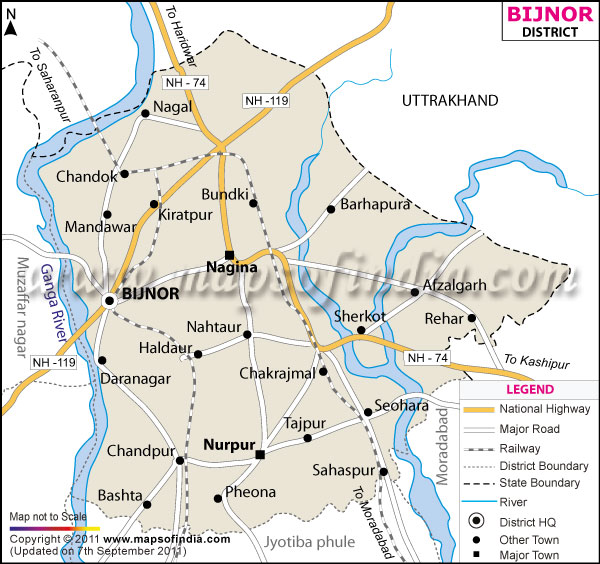
Bijnor is a historical city, which is at the north-western side of Uttar Pradesh on the foothills of Himalaya, clearly visible on the bijnor district map. Bijnor is located on the banks of the Ganga River, clearly visible on the bijnor district map, and it lies in the fertile part of the Upper Ganga-Yamuna Doab, clearly visible on the bijnor district map. The city boasts of a history that is associated with the ancient kingdoms, Mughal era and the Revolt of 1857. Bijnor mainly depends on the agricultural economy with its major dealings being sugarcane factoring, though small industries and trading are also common there. It has a fusion of Hindu and Muslim culture in terms of its celebrations and local culture.
History
The Bijnor history entails the ancient, medieval and colonial developments that influenced the western part of Uttar Pradesh. Located at the foothills of the Himalayas and alongside the rich plains of the Ganga, Bijnor is one of those places where people have been residing and political activities have been taking place. Other historians also identify the region with the early Indian literary references to the ancient kingdoms, and archaeological evidence indicates that the area had been inhabited continuously.
In the early medieval days, the control of Bijnor was taken by different Rajput clans, creating strongholds locally. As the Delhi Sultanate extended its territory in the 13th century, it slowly became part of the expanding Indo-Islamic political system. Bijnor was also included in the imperial administrative division, which established the control of Emperor Akbar, in the Mughal Empire especially during his reign in office. It is also blessed with fertile land, which earned it much agricultural income particularly the crops such as wheat, rice, and sugarcane.
Political unrest and changes in power were observed in Bijnor in the 18th century when Mughal power was getting weaker. The area came under the influence of Rohilla Afghan chiefs who were in control over most parts of Rohilkhand and its surroundings. The growth in strength of the British East India Company at length transformed the politics of the region.
Bijnor greatly contributed to the Revolt of 1857. It turned out to be one of the focal points of opposition to British domination in Uttar Pradesh west. The local leaders and zamindars were also involved in the rebellion and they were against colonial rule. The Bijnor rebellion was an example of dissatisfaction of the region with British policies, such as land revenue structures and administrative changes. But a few months of fighting later, the British troops retreated and re-established control with force.
Under colonial rule, Bijnor was a key district headquarters in the late 19th and early 20th century. The improved agricultural output and trade followed roads, canals and rail connections. The development of irrigation systems gave another impetus into sugarcane agricultural activities, becoming one of the main characteristics of the local economy.
Bijnor continued to develop as an administrative and agricultural centre after India became independent in 1947. The gradual urbanization was achieved through the involvement of modern educational institutions, small industries, and better connectivity.
Culture
Bijnor culture indicates a combination of historical tradition, religious practices and rural-urban influences elaborated over a period of time. Bijnor is located in western Uttar Pradesh between Ganga River and the foothills of Himalayas and has been shaped by early settlements, Mughal rule, Rohilla influence and changes imposed by colonialism in its cultural identity. The outcome is a multi-cultural society based on agriculture, religion, art and life in the community.
Bijnor is a place where religion is of primary importance to the cultural life of the residents. There are many temples, mosques and shrines that can be found within the city and its environs which have devotees year round. There is a celebration of festivals like Diwali, Holi, Navratri, Eid, Muharram among others which show communal harmony and common traditions. This is due to religious fairs and local gatherings which enhance social ties and the practice of age old practices that have been happening since generations.
Farming defines the everyday life and culture in Bijnor to a considerable degree. Being an area of sugarcane production, the rural traditions related to the cycles of production and harvesting, as well as the annual fairs, are currently valuable. The conventional clothing is typical of festivals and ceremonies and the wedding ceremonies are elaborate and have music and rituals performed with the involvement of the community. There is an emphasis by folk traditions and ritual activities to showcase the old traditions that continue to persist in the rural area as well as semi-urban areas.
Small-scale industries and craftsmanship is also a tradition of Bijnor. The district has its identity based on woodwork, local handloom products and artisans. The markets are dynamic areas where agricultural products, artisanal craft, and traditional products are traded and they represent the activity in the economy as well as the cultural interaction.
The food in Bijnor reflects the more general tastes of western Uttar Pradesh, as affected by agricultural production. Food will frequently consist of wheat based breads, rice, lentils, vegetables in the seasons and dairy products. Festive occasions involve sweets and food items cooked in common and reinforce kinship bonds, hospitality.
Language
The linguistic environment of Bijnor shows how it is situated in Western Uttar Pradesh and how it has been culturally interacted. The main language of Bijnor is Hindi which is the key language of administration, education and general communication. The widespread use of standard Hindi, the Devanagari script , has been an integral part of formal communications in the district, which is used in schools, government offices and media.
Coupled with the normal Hindi, vernacular languages are also a significant part of life. Khari Boli and other western speech forms with Khari Boli in the region influence the pronunciation, vocabulary and style of talking. These dialects are also used in rural places, where traditional expressions and idioms of an agrarian life and community relations have been maintained. The speech pattern has a tone that is most common within the Upper Doab area.
There is a large concentration of Urdu in Bijnor as well because it has deep roots in the Mughal era and the Islamic cultural influence. It is usually used in the religious institutions, in the literary meetings and in sections of the population which have close cultural links to Urdu. The availability of both Hindi and Urdu in the city helps to have a bilingual environment where a significant number of inhabitants feel free to learn and utilize aspects of both languages in their day to day speech.
The use of English as a secondary language is in the workplace, academics, and administration. It is widely school taught, applied in higher education and official publications. Informal communication often uses a combination of Hindi and English phrases especially in the younger generation particularly in cities.
Geography
The geography of Bijnor is an important factor to determine its economy, settlement patterns and the development of the region. Bijnor is a town in western Uttar Pradesh, clearly visible on the bijnor district map, and is situated along the Ganga river. The state of Uttarakhand borders the district to the north, clearly visible on the bijnor district map making it near the Himalayan foothills. Being a strategic site, Bijnor links the plains of the north of India to the hill regions.
The Ganga river flows along the western border of Bijnor, clearly visible on the bijnor district map making it one of the most important geographical elements. The river has been culturally significant but also, it provides sources of irrigation and production of agriculture. The river has a number of canals and irrigation systems; hence a constant water supply to the farming activities. The district is also irrigated by the Ramganga River that passes through the areas of the district, even more enriching the fertile landscape.
Bijnor is a part of the Indo-Gangetic Plain which is a deep alluvial soil, the deposit of which has been caused by rivers over centuries. This soil is very fertile and has large-scale farming. The area is also known especially in sugarcane cultivation, wheat, rice, and pulses. The land has a flat landscape, and thus farming and transportation are relatively feasible, promoting rural settlement and agrarian development.
Bijnor is a humid subtropical climate. It is hot and dry in the summers that span between April and June with temperatures that normally reach above 40°C. Monsoon season comes at the end of June and reaches late in the month of September due to moderate to heavy precipitation which replenishes ground water and aids the crops. Winters between November and February are cool and occasionally misty and drop to the single figures.
The vegetation within the district comprises agricultural and arable lands as well as patches of natural vegetation and areas that have been influenced by the adjacent forests of Uttarakhand. The close proximity to forest areas provides ecological diversity to the upper areas of the district.
| Facts of Bijnor District | |
|---|---|
| State | Uttar Pradesh |
| District | Bijnor |
| District HQ | Bijnor |
| Population | 115,381 |
| Growth | 17.60% |
| Sex Ratio | 917 |
| Elevation | 225 m |
| Literacy | 68.48 |
| Area (km2) | 4561 |
| Density (/km2) | 808 |
| Tehsils | Bijnor, Chandpur, Dhampur, Nagina, Najibabad |
| Lok Sabha Constituencies | Bijnor |
| Assembly Constituencies | Barhapur, Bijnor, Chandpur, Dhampur, Nagina, Najibabad, Nehtaur, Noorpur |
| Languages | Hindi, Urdu |
| Rivers | Ganga, Khoh, Ramganga |
| Lat-Long | 29.377388,78.375664 |
| Travel Destinations | Vidur Kuti, Kanva Ashram, Sita Mandir Math, Mandawar Ka Mahal, Najibudaulah�S Fort, Sena Ka Dawar, Sita�S Temple, Jahanabad etc. |
| Government Colleges/Universities | R. B. D. Girls Pg College, Krishna College, S.P. Degree College, R.S.M. Pg College, L.B.S.S.M.(P.G.) College, Dr. B.R. Ambedkar Engineering College Of Information Technology, Govt. Polytechnic College etc. |
FAQs
Q1: What is Bijnor famous for?
Bijnor is a home to large scale sugarcane cultivation, sugar mills and also has very fertile soil. Also it is known for its history and location by the Ganga River.
Q2: Where is Bijnor located?
Bijnor is in the western part of Uttar Pradesh which also is the base of the Himalaya’s. Also it sits by the Ganges River and borders Uttarakhand.
Q3: Why is Bijnor important for agriculture?
The district is a home to very rich alluvial soil and we also have a great irrigation network. We grow sugarcane, wheat, rice and pulses here.
Q4: Why is Bijnor important for trade?
Its location by Uttarakhand and on major highways has made Bijnore an important trading centre. We see here that it is a center which supplies agricultural products and local goods to the nearby markets.
Q5: Which tourist places are popular in Bijnor?
Popular sites include Vidur Kuti, Kanva Ashram, Sita Mandir, Najib-ud-Daulah’s Fort, Mandawar Ka Mahal, and Jahanabad.
Q6: Is Bijnor a great place for nature lovers?
Bijnor is a destination that presents river landscapes, nearby forest areas, and very peaceful countryside. Also it’s very close to the Himalayan foothills which is very attractive to nature lovers.
Last Updated on : July 23, 2026
