

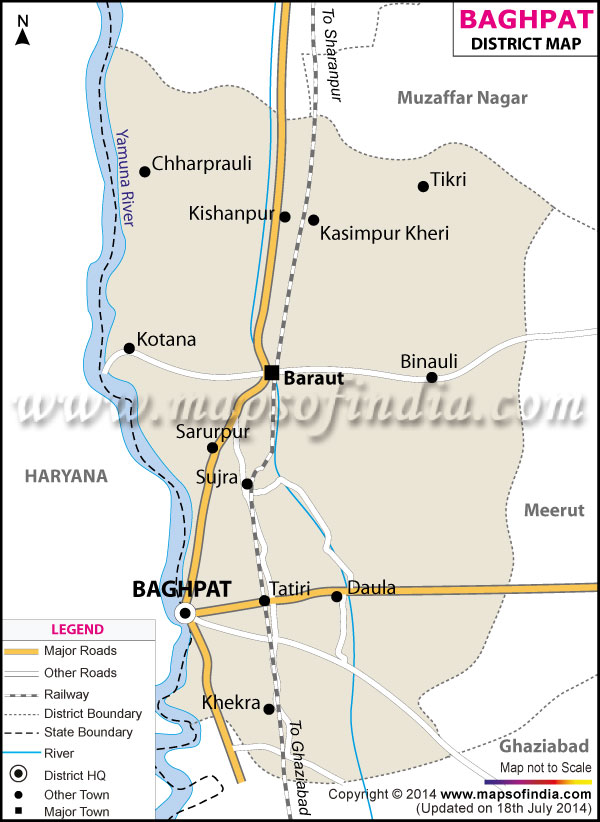



Introduction
Baghpat district was carved out of Meerut district on 17 September 1997. Situated westward in Uttar Pradesh, it belongs administratively to the Meerut division. The seat of governance bears the same name - Baghpat - a settlement tracing life along the Yamuna's edge. Because of placement inside the National Capital Region, quiet fields meet modern access without clash. Long before maps marked it new, this land answered to Vyaghraprastha: said to be the place of tigers. Epic tales from the Mahabharata brush against its soil, especially near Barnava, tied to fire and deception in ancient storylines. Shaped by shifting powers, notably during Mughal rule, speech softened the old name into what stands now.
Fertile fields dominate the landscape where sugarcane thrives; jaggery follows as another key harvest supporting local livelihoods. Though education reaches 72% of residents, customs remain deeply rooted amid gradual change. Close to Delhi yet distinct in identity, this part of western Uttar Pradesh holds heritage while adjusting to new rhythms.
History
Once called Vyaghraprastha, Baghpat lies in western Uttar Pradesh, holding traces from times long before recorded rule. Its presence lingers in ancient tales, tied loosely to the Mahabharata's vast narrative sweep. Over centuries, shifts came quietly - Mughal footprints, then colonial design reshaped its framework slowly. Now within the National Capital Region, it balances old rhythms alongside newer patterns of life. Tigers may have roamed once; today, memory does. Layers remain visible, not in grand displays but in quiet endurance across temples, fields, and village names.
Long before modern times, it took shape through legends tied to the Mahabharata's Pandava brothers. It is said Vyaghraprastha formed part of their peaceful demand - five villages meant to prevent bloodshed. Barnava is traditionally believed to be the site of Lakshagriha. Because of such tales, reverence settled into the soil here.
Over centuries, this land remained fixed in North India’s shared imagination - not just as geography but as inherited memory. Beginning in ancient times, the term evolved gradually from Vyaghraprastha toward Vakyaprastha - interpreted as a site linked to spoken words. Later, under imperial influence, it became known as Baghpat by the time of Mughal rule. During that phase, governance structures expanded here, aligning the area more closely with regional systems across northern territories.
Following colonial upheaval in 1857, it rose in stature upon becoming a tehsil seat. the town's market slowly grew into a trading node. Jaggery and sugar defined its commerce, still anchoring local economic life today. Along the Yamuna’s rich lowlands, farming found firm ground. Sugarcane cultivation shaped identity here, linking the area firmly to western Uttar Pradesh’s productive arc. It was finally established in 1997 as a separate administrative district.
Culture
Located beside the Yamuna River and near Delhi, Baghpat carries a culture built on farming customs, oral histories, and layered pasts. Despite gaining official district status in 1997, its identity draws from eras long before. Myth, Mughal rule, and British presence mingle here with village routines. Tradition persists, yet change moves quietly through daily practices. Time seems suspended - though clearly shifting. Its uniqueness lies not in isolation but in balance: old songs sung without nostalgia, rituals observed without display.
From fields come staples like wheat, along with milk and dark sugar, shaping daily meals that stay uncomplicated yet filling. When visitors arrive, they receive treats made of jaggery - small gestures carrying deep welcome.
The district's culture takes shape through village-based making of things by hand. In homes across hamlets, weaving unfolds alongside shaping clay and woodwork, knowledge moving quietly from one age to another. Not merely useful, these works carry a quiet beauty born of everyday imagination. Though near Delhi brings new habits into view, older ways remain active, adjusting without disappearing. Objects shaped by hand - meant for common tasks or ceremonial moments - hold firm what the region keeps alive within shifting times.
Within the district , social patterns form through ties of lineage and neighborhood. Decision processes often flow through panchayats, where consensus emerges slowly. Work across farmland brings people together, building quiet trust over time. Unity among groups holds steady because mutual duty is expected. Customs persist, even when outside forces press change. Belonging shows itself in small acts more than grand statements. Together, these threads resist erosion without seeking attention.
Baghpat's way of life takes shape through farming roots, local music, spiritual customs, because history lingers in daily routines. Sugarcane stretches across the land while voices rise in Khadiboli tunes during celebrations near rivers - each moment part of an ongoing story. Though close to Delhi brings new influences, village rhythms remain steady, untouched by haste. Change flows around it; still, old patterns hold firm here, forming a distinct presence within western Uttar Pradesh.
Language
In Baghpat, a region located in western Uttar Pradesh, multiple languages coexist in quiet layers. Government work, classroom instruction, and public documents rely heavily on standardized Hindi. Spoken here too is Urdu, acknowledged formally across the state, heard particularly within certain community gatherings. Though prevalent in institutions, textbook-style Hindi does not mirror how most people talk at home. Instead, daily life unfolds through Kauravi - a grounded way of speaking rooted in rural settings. This version of Western Hindi shapes casual exchanges more than any regulated form. Its presence grows stronger near market lanes, family courtyards, even farmland edges. What emerges is less about policy and more about habits inherited over time.
Rooted firmly within local culture, Kauravi shapes how people speak throughout western Uttar Pradesh. Extending beyond borders, it reaches into sections of Haryana and Delhi - serving as a linguistic thread through northern India’s flatlands. Though scholars note similarities with Haryanvi and Braj, subtle shifts in word choice and sound set it apart. Despite overlap, differences remain clear upon closer listening. Take common terms in Kauravi - they often shift a touch from mainstream Hindi, lending talk a grounded tone strangers pick up fast. Not merely how people exchange thoughts, this way of speaking acts like an imprint of origin; using it reveals a tie to the land of western Uttar Pradesh.
Not far from Delhi, Baghpat feels the reach of the capital. Just a short journey away, the region absorbs features of standard Hindi through daily exposure. With schooling and mass communication shaping speech patterns, younger speakers move easily between Kauravi and Hindi. Where lessons are taught or duties carried out, one finds Hindi in control. Yet when voices relax among family or neighbors, it is Kauravi that carries meaning most naturally. Moving across these forms shows how lives stretch toward new opportunities without leaving older ways behind.
Though not widely spoken in daily life, Urdu weaves quietly into the districts language landscape. Within cultural gatherings and spiritual settings, it finds steady footing - especially through poetic expression and faith-based dialogue. Communities rooted in its tradition help sustain its voice across generations. This subtle inclusion brings variation to local speech patterns.
Geography
Fertile land stretching beside the Yamuna defines much of Baghpat’s layout. Close to Delhi, yet seated inside the wider National Capital Region, its position holds quiet significance. Flat ground covers nearly all, allowing farming to thrive without obstacles. Alluvial deposits enrich the earth deeply, season after season. Water moves through canals that branch like threads across fields.
Along its west, the course of the Yamuna River outlines the district’s border, influencing both terrain and farming practices. Human habitation here dates back due to consistent access to water, enabling communities to grow near the shoreline.
Situated across three tehsils and six development blocks, it follows a structured administrative layout. While villages spread widely throughout the area, places such as Baghpat city function as centers for commerce and administration. Because it lies within the National Capital Region, growth patterns here are shaped by closeness to Delhi - only around 40 kilometers distant - and better roads. Urban influence arrives through connectivity; yet much of the land remains countryside at heart. Open farmland, irrigation channels, and older-style communities define what one sees when moving beyond town limits.
Fertile expanses mark the district , formed by the flow of the Yamuna and its network of canals. Rivers shape the land, while proximity to Delhi introduces quiet shifts within rural norms. This place rests between old patterns and new currents, held together by soil, water, time. Here, farming feeds communities - yet landscape does more than nourish bodies. It ties past rhythms to present changes without force or fanfare.
| Facts of Baghpat District | |
|---|---|
| State | Uttar Pradesh |
| District | Baghpat |
| Location | Western Uttar Pradesh |
| District HQ | Baghpat |
| Population (2011) | 1303048 |
| Growth | 11.95% |
| Sex Ratio | 861 |
| Literacy | 72.01 |
| Area (km2) | 1345 |
| Density (/km2) | 986 |
| Tehsils | Baghpat, Baraut, Khekada |
| Lok Sabha Constituencies | Baghpat |
| Assembly Constituencies | Baghpat, Baraut, Chhaprauli |
| Languages | Hindi, Urdu, Kauravi (Khadi Boli) |
| Rivers | Yamuna, Hindon |
| Lat-Long | 29.046566,77.337856 |
| Travel Destinations | Jain Mandir (Bada Gaon), Jain Temple Sisana (Jain Tirthankar), Yamuna Ghat, Gufa Wale Baba Ka Mandir, Pura Mahadev Mandir, Bhole Ki Jhaal, Barnawa Ka Sanskrit Gurukul, Barnawa Jain Mandir, Barnawa-Dera Sacha Sauda, Dhan Dhan Satguru Tera Hi Aasra, Nageshwar Baba Ka Mandir etc. |
| Major Educational Institutions | Shri Yamuna Inter College, Shri Nehru Inter College, Shilchand Inter College, Neta Ji Subhash Smark Inter College, Jat (Janta Inter) College, Samrat Prithviraj Degree College, Digambar Jain College, Jat (Janta Vedic) College, D.N. Inter College, Seith Tarif Singh Jain Degree College, M. G. M. Inter College, D.A.V. Inter College etc. |
FAQs
Q1: When was Baghpat district formed?
Baghpat district was created on 17 September 1997 after being carved out of Meerut district to improve administrative governance in western Uttar Pradesh.
Q2: Is Baghpat part of the National Capital Region (NCR)?
Yes, Baghpat is part of the National Capital Region (NCR), which has contributed to improved connectivity, infrastructure, and economic development.
Q3: Which districts border Baghpat?
Baghpat shares its borders with Meerut, Muzaffarnagar, Shamli, Ghaziabad, and Gautam Buddha Nagar districts of Uttar Pradesh, while the Yamuna River separates it from Sonipat district in Haryana.
Q4: What is the literacy rate of Baghpat district?
According to the 2011 Census, the literacy rate of Baghpat district is 72.01%, which is higher than the national average recorded in the same census.
Q5: Which is the nearest airport to Baghpat?
The nearest major airport to Baghpat is Indira Gandhi International Airport (IGI), New Delhi, located about 60–70 km away, depending on the destination within the district.
Q6: What is the main occupation of the people in Baghpat?
Agriculture is the primary occupation in Baghpat district. Many residents are engaged in farming, dairy production, jaggery manufacturing, and related agro-based businesses.
Q7: Which national highway passes through Baghpat district?
The Delhi–Saharanpur Highway (National Highway 709B) passes through Baghpat district, providing road connectivity to Delhi, Baraut, Shamli, and nearby regions.
Last Updated on : July 13, 2026
