






Introduction
Jaunpur is an old city with great significance. It is located in the state of Uttar Pradesh and lies along the banks of the Gomti River. It was founded in the 14th century and was ruled by the Sharqi dynasty. This dynasty ruled over the city and saw it become a place for all forms of artistic expression, learning and cultural practices. During this time, the dynasty built huge monumental buildings and multi-storey mosques along with big bridges, which are a reminder of the great past of the dynasty. One of those huge mosques is known as Atala Masid and it, along with the Shahi bridges are great examples of the Indo-Islamic ancient architecture.
Jaunpur is a city with a rich past, and along with that, it has a number of great schools as well as a number of vibrant local cultures and traditions. Owing to the great traditions of poetic expression, the city has been named the Shiraz of India, or the Shiraz-e-Hind. Jaunpur has great food, adding to the warm nature of the city. Modernisation has taken over the city, whilst the presence of old structures emphasises the royal heritage the city possesses.
History
The establishment of Jaunpur has come with numerous cultural changes and developments. The earliest history of the region is the landscape of the Ganga-Yamuna Doab. The existence of ancient settlements in the area has been hypothesized based on archaeological evidence and settlement traditions that have been observable for centuries. The area became a trade center and farming region. Small settlements developed in the area, and the river reinforced their trade activities.
The area experienced a major turning point in the medieval construction period of Jaunpur. It was established in the 14th Era of Mohammed Tughlaq of the Delhi Sultanate. Tughlaq named the city after his cousin and predecessor Jauna (Khan). The city of Jaunpur was establishing its primary military and administrative center under the Tughlaqs. The foundation of the city was developed with the construction of its first city walls, mosques and bridges.
Jaunpur's Sharqi dynasty rule in the 15th century had reached its peak prominence. After the Delhi Sultanate collapsed, the Sharqi leaders claimed responsibility and founded the Sharqi kingdom, making Jaunpur its capital city. It became a major city of learning, culture, and architecture in the empire. Jaunpur became known for the gathering of great scholars, poets, and religious thinkers. It was a major intellectual hub of North India. The Sharqi rulers had a unique style of architecture. The city also became famous for the construction of the magnificent Atala Masjid, which was finished in the early 15th century, and many other structures, such as the Jama Masjid and the Lal Darwaza Mosque, which also belong to the Sharqi period. These monuments have unique and superb degrees of architecture from Indian and Islamic culture, great doors, and rigid stone supports with a fully structured design.
With Mughal rule over the region during the 15th and 16th centuries, Jaunpur continued to be an important hub of trade and governance, and the Mughals were able to get the upkeep and restoration of much of the aging trade and academic infrastructure.
With the growing economy, the expansion of agriculture in the hinterlands of Jaunpur continued to grow. With the fall of the Mughal Empire in the 18th century came the establishment of the British East India Company, bringing the first of the colonial influences to the formerly Mughal Empire territories, an influence that still exists in Jaunpur today.
New governance structures were introduced in the 19th century, and with them came the construction of railroads and the establishment of modern schooling. All of these things provided the first real physical and economic contact of Jaunpur with the close urban centers of Varanasi and Allahabad. Jaunpur also contributed to the greater freedom struggle against British imperialism. As with many northern Indian towns, it experienced political mobilization and engagement in the quest for India’s independence.
The local leadership and the masses led the demonstrations and campaigns that resulted in India's independence in 1947. When the British left India, Jaunpur was made part of the state of Uttar Pradesh and rapidly evolved into an important district headquarters. The city has gradually modernized with the extension of contemporary education, road networks, and industries, but it also has a distinctive manifestation of the antiquity of its past. Its ancient structures, such as the old neighbourhoods, mosques, bridges e.t.c also continue to remind us of its medieval majesty.
Culture
Jaunpur's culture is a unique amalgamation of history, religion, and customs of daily life. Religion is a major influence on culture, and over the centuries, the city's culture has experienced the influence of many rulers and different communities on the Indian sub-continent. Because of the city's history, both the Hindu and Islamic practices are the basis of the region's food, festivals, architecture, way of life, and culture. The lifestyle of the area's populace incorporates festivals, both economically and socially.
Songs, along with the dholak and harmonium music, accompany, and are, prized, and cherished, and may be made loved and replaced, adopted, acted and transferred and reproduced and constructed and perpetuated and renewed and resaturated and preserved and restlessly through the ages.
The local culture is also expressed through food. The local food varieties have traces of the Awadhi cooking and the cooking of eastern Uttar Pradesh. During celebrations and festivals, sweets are preferred. The local markets are also rich in age-old prepared and preserved traditional sweets and snacks.
Language
The languages used in Jaunpur encompass the entire verbal culture of the eastern Uttar Pradesh region. Most of the district’s inhabitants speak Hindi, which, because of its status as the state’s official language, is used in all administrative, educational, and media-related functions. Hindi is clearly used in government and administrative offices, and in schools, it is the language of instruction. Therefore, the younger generations have very little challenge in the reading and writing of Hindi. However, most vernacular dialects of Hindi are used in casual, day-to-day parlance in the home, the village, and the marketplace.
The village dialects of Hindi, of which the most dominant is the Awadhi dialect, which, in its phonetic and tonal qualities, is very polite and highly developed and expressive. The dialect is most appreciated as it is the one used in family communication and communication with the neighbors. It is also the channel through which the folk tales, folk songs, and traditional idiomatic expressions are transmitted. The other language of significance in the district is Urdu, and because of the historical antecedence of the area with the Islamic culture and the medieval monarchs, the presence of Urdu was magnified. It is the most dominant language of the literature, poetry, and religious assemblies of the Muslim community.
A few of the elder community members possess the ability to read and write in Urdu, and some schools continue to teach it. In the rural parts of the district, the way of speaking is different and more versatile. A single speaker can mix Hindi and Awadhi in one speech. This way of speaking is distinctive and is a characteristic of the area. Although the specific words in the area may differ, almost everyone will understand the overall idea. The people of the district also use language to conserve and pass on their culture.
Geography
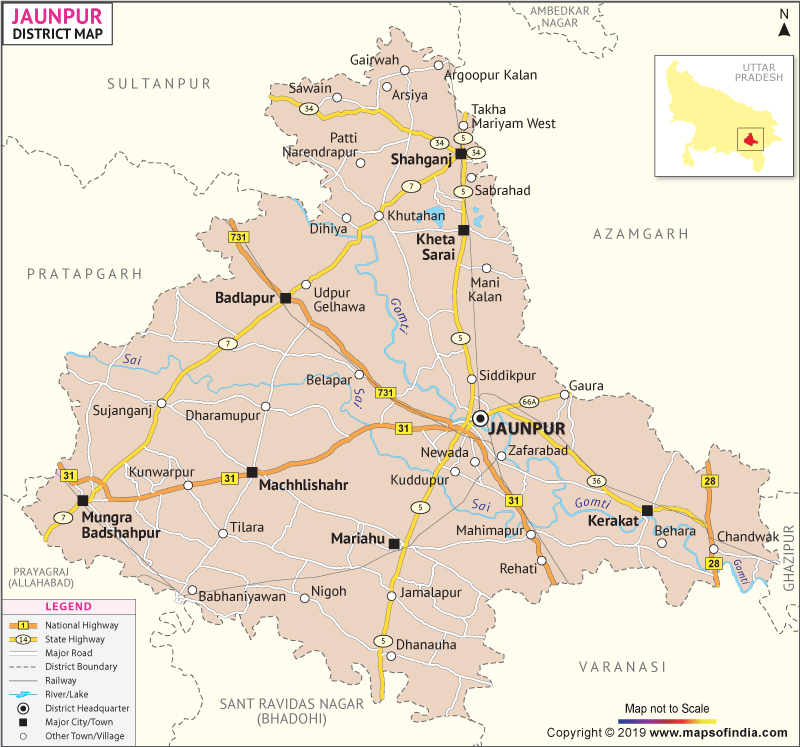
Jaunpur is located in the fertile plains of the Indo Gangetic plains in eastern Uttar Pradesh, where agriculture is the backbone of the economy. The Gomti River is the most prominent feature of the geography of Jaunpur. It has shaped the human settlement and the geography of the region. The river provided the essential resources for daily use and farming, which led to the emergence of settlements.
The river has also enhanced the aesthetic of the region and supported trade and commerce in the region. The entire region has a flat topography, including Jaunpur. The alluvial soil of the Indo Gangetic plains is very fertile and supports the cultivation of extensive wheat, rice, sugar cane and pulse farming. This explains that farming still principally employs many in the region. The climate is primarily classified as sub-tropical in the entire region.
During the summer season from June to September, the region gets the most rainfall. These months are part of the southwest monsoon season. Rainfall also helps recharge the water table which helps farming. The winter season is cool, allowing residents to comfortably travel and perform daily activities.
Most of the district’s vegetation is agricultural, with scattered trees and some natural vegetation. There are some mango and neem trees along the rural roads as well as the villages, and many home gardens are also part of the district’s greening efforts. The district is bordered by some regions of eastern Uttar Pradesh, with which it shares well-established roads and trade routes. These spatial relationships have ensured cultural and economic integration of the nearby regions.
| Facts of Jaunpur District | |
|---|---|
| State | Uttar Pradesh |
| District | Jaunpur |
| Location | South East Uttar Pradesh |
| District HQ | Jaunpur |
| Population (2011) | 4494204 |
| Growth | 14.89% |
| Sex Ratio | 1024 |
| Literacy | 71.55 |
| Area (km2) | 4038 |
| Density (/km2) | 1108 |
| Tehsils | Badlapur, Jaunpur, Kerakat, Machhlishahr, Mariahu, Shahganj |
| Lok Sabha Constituencies | Jaunpur, Machhlishahr |
| Assembly Constituencies | Badalpur, Jaunpur, Kerakat, Machhlishahr, Malhani, Mariyahu, Mungra Badshahpur, Shahganj, Zafrabad |
| Languages | Hindi, Awadhi |
| Rivers | Gomti, Sai |
| Lat-Long | 25.725684,82.687797 |
| Travel Destinations | Shahi Qila, Main Gate, Atala Mosque, Jhanjhari Mosque, Lal Darwaza Mosque, Jama Mosque, Shahi Pul, Kali Temple, Gasuri Shankar Temple, Hanuman Temple, Kabir Math, Gomteshwar Mahadev etc. |
| Government Colleges/Universities | Veer Bahadur Singh Purvanchal University, T D College etc. |
FAQs
Q1: Which river flows through Jaunpur?
The Gomti River flows through this district. It has been a river of great importance for agriculture, settlements, and trade for many years.
Q2: Which language is spoken in Jaunpur?
The Jaunpur district people are in great numbers in the profession and in educational work who speak Hindi. The daily conversation of the local people flows in Awadhi and even in Urdu for cultural reasons.
Q3: What is the main source of occupation for the people in Jaunpur?
The main occupation in the district is agriculture. Due to the rich, fertile alluvial soil and the climatic conditions, almost all the rural areas are a soup of productive agriculture, and the farmers here are involved in agriculture, where they cultivate wheat, rice and pulses.
Last Updated on : May 08, 2026
