




Introduction
Sambhal is a very special destination in the state of Uttar Pradesh, India. It is a district that has it all in terms of history and religious importance due to it’s great depth of heritage. Also known for old world traditions which are very much alive and for home to some of the most unique handicrafts in the world. It is located at a distance of 160 km from Delhi which also plays a key role in the area’s identity.
In ancient texts you will find reference to the town of Sambhal. It is more than what present day district it is a place which is said to have existed for thousands of years. Presently it is a trade center which also does a great deal in mentha oil and fine horn craft. The district became an official entity in 2011 and since then it has been growth which they have managed to do while preserving its past.
History
The history of Sambhal is a very old story in India. It is told that this town has seen every age as depicted in ancient books. In very old times it was a place which kings and saints would visit. Also many religious texts report that Sambhal was a holy site for thousands of years which pre dates modern cities.
During the medieval times King Prithviraj Chauhan ruled here. He considered Sambhal very important in his kingdom which was the route to large cities. To this day we hear many a valiant story of his battles related by the elders in the village. After him the town became a key prize for the Delhi Sultans who sought to control the north.
The Mughal era saw Sambhal in great glory. When Emperor Babur came to India, he had the Shahi Jama Masjid built in 1528. This grand mosque which is still a present day structure was also among the very first Mughal buildings in the country. At one point Sambhal was so important that it served as a capital for the new empire for a few years.
As time passed other great rulers like Humayun and Akbar also graced this place with their presence. They built strong walls which in turn made the town a hub for trade and learning. Sambhal’s history is also unique in that it is tied to what is to come. Many think it to be the spot where the last incarnation of Lord Vishnu which is known as Lord Kalki will appear.
In the 1800s the people of Sambhal played large role in India’s freedom struggle. They joined the resistance against the British with great bravery. Post independence the town was a part of the Moradabad area for many years. Only in 2011 did the government make it a separate district to pay tribute to its past which is very rich.
Today as you traverse the narrow streets of the old city you feel the past in the weathered stone walls. It is a place which tells the tales of ancient gods, brave Rajput kings, and Mughal emperors which play out all at once. That deep history is what made the people of Sambhal very proud of their home and their local customs.
Culture
The culture in Sambhal is a blend of the past and present which also includes great handiwork. What we see is that for a very long time people of different religions have lived here together. This shared history has made the town very peaceful and welcoming. You can see this peace during Diwali and Eid which we all celebrate together, we share sweets and joy with our neighbors.
In the domain of local culture what is very much a part of it is the horn and bone craft. In Sarai Tarain which is the area they have for generations hundreds of years been into this art form which has seen thousands of families involved. They use basic tools for very fine carving which produces beautiful spoons, jewelry boxes and home decor. These skills are handed down father to son which makes the craft a living element of their family history.
Religion is very much at the core of what the people do every day. In India many Hindus think that Sambhal is a holy land which is the predicted birth place of Lord Kalki. Because of that the town has report of many old temples which see great activity in the morning and evening as the bells are rung. The people live out very much by these ancient stories which they respect greatly and they live their lives filled with faith and duty.
In Sambhal also we have very special music and poetry. As it was once a Mughal center, the town has a great love for Urdu poetry which they call “mushairas”. In the evenings people come together to hear poets which recite beautiful verses on love and life. This love for words shows that the culture of Sambhal is not just of hard work but also of art and deep thought.
Food is a way that people put forward their culture. in Sambhal they are known for their mughlai food which includes the spicy biryani and soft kebabs which you can get in the old market. Also the farmers bring in fresh milk and sugarcane from the fields to make local sweets.
In short what we see in Sambhal is a culture of hard work and also great respect for tradition. People are very into what they do but at the same time they preserve their heritage. You will see a craftsman at work on a bone inlay while at the same time playing in to an old religious song. That mix of the past and present which you see in the everyday life there is what really sets the tone in Sambhal.
Language
In Sambhal district of Uttar Pradesh one sees the simple and warm nature of its people through the language they use. Mostly what you hear from the people of Sambhal is Hindi which is the everyday language. In schools, offices and local government the use of Hindi is pre dominant. People of Sambhal use very simple and clear language in their conversations.
In Sambhal district Urdu also has its own importance. In many homes of Sambhal people use Urdu. One can see Urdu in poems, at religious functions, in local writing. In some parts of Sambhal people speak both Hindi and Urdu fluently.
In the villages of Sambhal district people speak a variety of what is essentially a local form of Hindi. This local speech has a milder tone and in some ways is very different from standard Hindi. The accent in Sambhal is that of Western Uttar Pradesh. May the words change a little which is fine but the meaning comes across clearly.
In the present which more children are attending modern schools, English is also emerging as the third language. Many youth are using English to run export businesses of horn crafts and mentha oil. This mix of Hindi, Urdu and English we see as a proof that Sambhal is a place which holds onto its past while also embracing the modern world.
Geography
In terms of geography Sambhal is mostly characterized by flat and fertile plains which are a part of the large North Indian basin. As the land is so level it is ideal for farming which is what you see when you travel through nothing but green fields. The district which sits at a height of 190 to 200 meters above sea level has a very open and stable landscape.
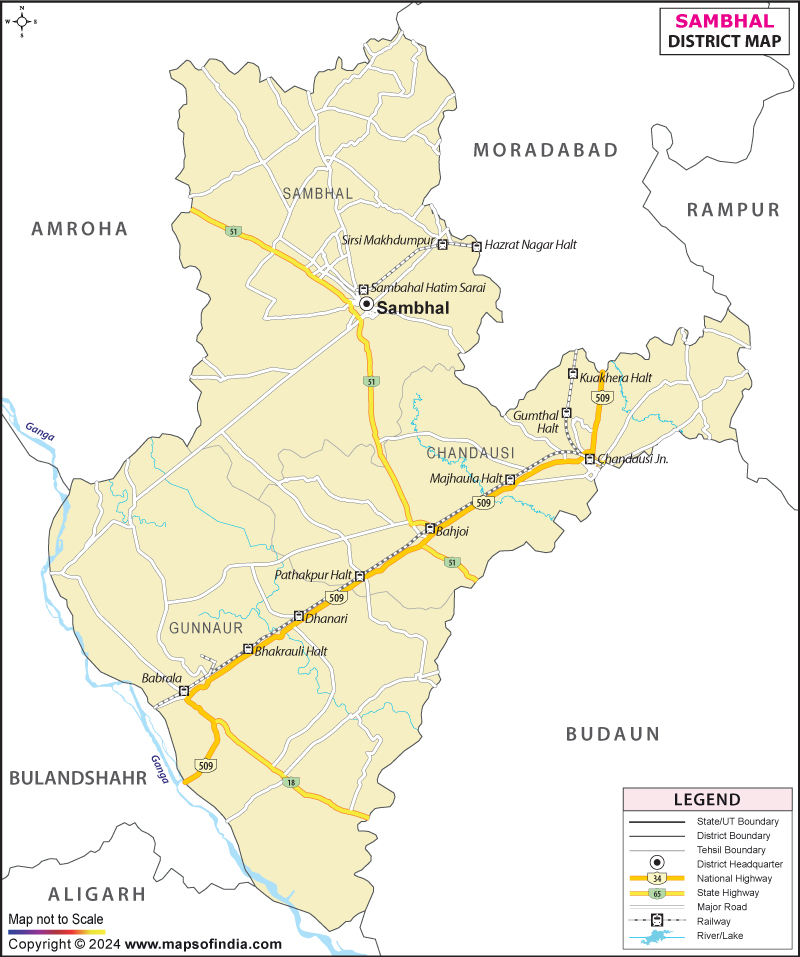
The Ganges River is a primary natural element which forms the boundary to our district. Also we see many a small stream and canal which cross through the land which in turn gives us ample water for our crops. Also the soil in this area is very rich and sandy which in fact makes Sambhal a best in India for growing Mentha and sugarcane.
In this area weather is very variable by season. We see very hot and dry summers, then from July to September the monsoon rains transform the whole landscape into a rich and green environment. Also in the winter the air turns cool and in the morning we see thick fog which covers the fields.
Sambhal borders with noted districts like Moradabad and Amroha. It’s a central point in the plain area which in turn is a key pass for trade between the mountains and large cities. Also the simple flat terrain has seen the development of a complex road network which in turn connects the remote villages to the main trade centers.
| Facts of Sambhal (Bheem Nagar) District | |
|---|---|
| State | Uttar Pradesh |
| District | Sambhal (Bheem Nagar) |
| District HQ | Sambhal |
| Population (2011) | * |
| Growth | * |
| Sex Ratio | * |
| Literacy | * |
| Area (km2) | 2453 |
| Density (/km2) | * |
| Tehsils | Sambhal, Chandausi, Gunnaur |
| Lok Sabha Constituencies | Sambhal |
| Assembly Constituencies | Asmoli, Bilari, Chandausi, Gunnaur, Sambhal |
| Languages | Hindi, Urdu |
| Currency | Indian Rupee (INR) |
| Religion | Mostly Islam and Hinduism |
| Rivers | --- |
| Lat-Long | 28.591154,78.572745 |
| Travel Destinations | Kalki Mandir, Suraj Kund Mandir, Manokamna Mandir, Gauri Shaya Mandir, Chemnath Teerth, Singhpur Teerth etc. |
| Government Colleges/Universities | Rajkiye Degree College, M. G. M. Degree College, Govt. Mahavidiyalaya etc. |
FAQs
Q1: Why has Sambhal become a global name?
Sambhal is known for it’s unique Horn and Bone crafts which are carved by artisans of beautiful items out of buffalo horns. Also they are the largest producers of mentha oil (peppermint) in Asia which is exported to many countries.
Q2: Is there a spiritual mystery related to Sambhal?
Yes, it is true that many think the tenth avatar of Lord Vishnu which is to appear as Lord Kalki will be born in Sambhal. This ancient prediction which has come down through time makes the district a very important site for the spiritual and historical seekers.
Q3: What do I find at the local markets?
You should check out the handmade jewelry, buttons, combs, and home decor made from horn and bone in Sarai Tarin. What you will find there is very unique and also you’ll get great value when you buy them from the local craftsmen.
Q4: Which crops do farmers grow in Sambhal?
Here the farmers are experts in growing Mentha (mint), wheat, rice and sugarcane. In this area which is very fertile Sambhal has become a primary center for the production of peppermint oil used in medicines and perfumes.
Q5: What do I have to try from the traditional cuisine of Sambhal?
You should go for the local Mughlai Biryani and Kebabs which we have very authentically and spiced up. Also for sweet stuff the local shops have what is made from fresh milk and jaggery out of the nearby village farms.
Last Updated on : July 27, 2026
