




Introduction
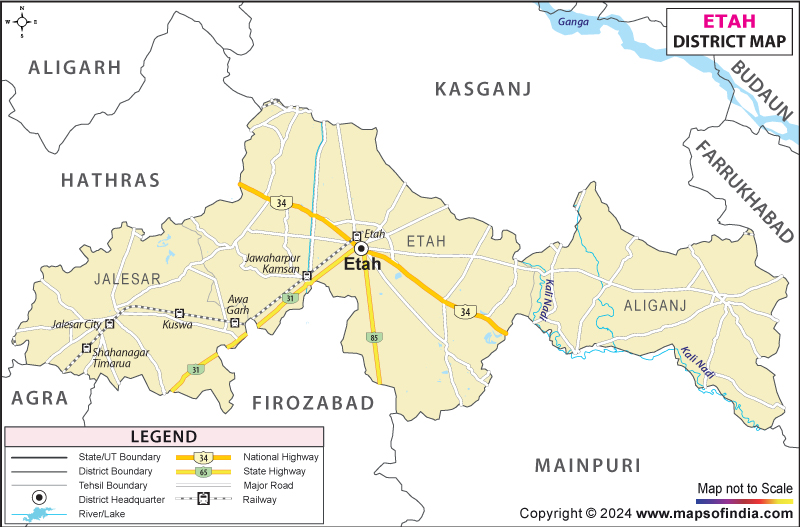
Etah is a district in the western part of Uttar Pradesh. The district is a part of the Gangetic plains, which has traditionally been a fertile area, as well as a region populated by many centuries of agriculture, trade and settlement. It is positioned close to several key districts which includes Aligarh, Mainpuri, and Kasganj creating a road and market network amongst towns and rural settlements.
The administrative and business center of the region is the city of Etah and the headquarters of the district. Throughout the time, the region has grown with some rural customs and urbanization. Agriculture has remained a significant part of the local economy and small industries, trade, and services also determine the livelihoods of people.
Besides its agribusiness foundation, the district has since built through time its educational infrastructure, transportation service systems as well as administration. The area is linked to other cities through roads, and people can now easily travel to other cities to engage in trade, education, and work. The district is mostly rural in nature but it is developing further preserving its historical and cultural background.
History
The narrative of the Etah district in its formation reflects the general trends of the political and cultural transformation that has been experienced in the north of India over the past centuries. The archaeological evidence and ancient traditions indicate that people had been living in the area since ancient times because of fertility of the Gangetic plain and water availability.
Villages and small towns were enabled by the ancient trade routes and agricultural lands. These colonies were the basis of the immediate society and economy, through which communities were able to farm and trade with their neighbors. With time, the area was integrated into other broad political entities, which ruled the north of India.
The Gangetic plains were under the influence of different regional kingdoms that ruled the region during the early medieval period. This and other agricultural regions were a source of economic support to these kingdoms. Due to this, land revenue and agriculture was one of the key elements in the government of the region.
The region then was included into the larger imperial administrative systems later in the period of the growth of the Delhi Sultanate and the Mughal Empire. During the reign of Mughal emperors, the agricultural activities were systematized in terms of taxation to villages and landlords in the form of revenue. These regimes assisted in the upholding of political regimes in addition to making the economy of the empire successful.
The era of British colonial rule was one of the major historical events that influenced the area of the district. Since the decline of the Mughal Empire, the British slowly came to control major parts of northern India. The district was included into the British Indian administration system and new systems of governance and land income and development were introduced.
The nineteenth century was a period of considerable transformation with the colonial powers enacting administrative changes and opening transport systems. Access to neighboring areas became easier through roads and railways allowing trade and goods to move easily. Meanwhile, the social and economic development of the local communities was altered with the introduction of new policies that impacted agriculture and land ownership.
The area was also directly affected by what occurred with the Indian Rebellion of 1857 that spread to most of the areas in north India. Despite the various degrees to which the rebellion was fought in the various districts, this was a significant turning point in the history of colonial rule and its interactions with the people in the region.
Subsequently, when India became an independent state in 1947 the district joined the state of Uttar Pradesh of the newly established Republic of India. The region was slowly changing through administrative developments, development programs and expansion of learning institutions. Economic growth and social welfare were promoted through rural development projects and agricultural development and infrastructure projects.
Culture
Religious festivals constitute a significant aspect of culture in the land. Local communities strive to celebrate such occasions as Diwali, Holi, Eid, and Navratri. These festivals are characterized by the decoration of homes and open areas, where people sit down and eat together as well as perform rituals. Such events reinforce the social ties and promote cultural traditions dating back to generations.
Cultural life is also significant because of village fairs and local markets. Such events are accompanied by music, native foods, and handcrafts, bringing a very vibrant atmosphere by uniting people representing various villages. Fairs are often linked with something religious, or even seasonal, and they serve a commercial purpose, as well as a social one.
The dressing in the district is reminiscent of the dresses that are prevalent in northern India. Kurtas-pajama or dhoti are very common among men whereas sarees or salwar-kamiz are common among women. These clothes are in different colours and designs according to the local practice and what one likes. Festivals and weddings require people to wear more complex clothes with embroideries or ornaments.
Narratives and music are also the cultural heritage of the district. Singing of folk songs is done at a wedding, in a feast or communal event. Such songs are usually about love, agriculture, family life and devotion. Local history and cultural values are maintained through oral traditions, stories and songs.
The traditions of food in the district are highly related with the production of food. Daily meals are made of wheat, rice, lentils and vegetables. The popular food consists of roti, dal, sabzi, and rice. There is also a wide consumption of dairy products like milk, curd and ghee. Local sweets that are cooked on festivals and special occasions also contribute to the food variety of the land.
The district cultural practices are dynamic as individuals get exposed to larger social and economic forces. Learning, media and migration have opened new ideologies and ways of life but the traditional culture is still a significant aspect of community identity.
Language
Using language in the Etah district, one can see the diversity in language of the northern parts of India. Hindi is the official and primary language of administration and education and most common parts of everyday communication. The majority of inhabitants speak in Hindi and it commonly links various residents in the district.
In addition to common Hindi, there are a number of regional dialects, which are spoken in the rural areas. Braj Bhasa is one of the most well known dialects and historically speaking, the language has a background to its origin in the western Uttar Pradesh and the surrounding areas. Braj bhasa has a unique pronunciation and words and has been historically used in devotional poetry and literature.
The Urdu language is also represented within the district especially in the cultural and literary aspects. Urdu is well known in the context of poetry, literature and even in arts. Even though it is used in daily activity by various communities differently, the language is a significant element of the language heritage of the region.
English is also being used in learning institutions and administration. Educational institutions such as schools and colleges usually incorporate English in their courses, enabling the students to be exposed to a wider academic world as well as career. This has resulted in the younger generations now being more comfortable with the use of English in formal places.
High levels of presence in different languages and dialects give rise to a dynamic linguistic environment in the district. Individuals also interchange languages, based on the situation, either in educational institutions, in shopping centers, or in family discussions. Such character in various languages is indicative of the cultural variation and the history of contact that has given rise to the region with time.
Geography
The physical landscape of the Etah district is typical of the fertile plains so valued in the northern parts of India. The district is located on the huge Gangetic plain which is a result of the silt deposit coming from the Himalayas. These deposits have formed alluvial soil which is agriculturally fertile and supports the rural settlement.
The district terrain is usually flat and it is good for farming and transportation. Fields cover expansive regions of the rural land, and farmers grow wheat, rice, sugarcane, and pulses. The seasonal changes in temperature and rainfall affect the activities of agriculture in a year.
The district climate is subtropical. It is normally hot and dry during summers which sometimes reach over 40°C. The rainy season that takes place in between June and September is what is known as the monsoon season that helps in boosting the supply of water and also helps in the growth of crops. Winters are rather mild and offer good conditions to some agriculture activities.
The vegetation in the district is mainly grasses, shrubs and sporadic trees which are characteristic of the plains. Several parts of natural vegetation cover rural areas though, due to the agricultural growth, much of the land has been turned into an agricultural space.
The transportation systems in the district are significant because they link the district to the nearby areas. The local towns and villages are connected with local cities like Agra and Aligarh by means of roads. These interconnections promote trade, travel and communication. The other transport system that provides a significant connection between the area and the bigger urban centres is the railway system.
Its fertile soil, available terrain and transport networks have been supporting human settlement in the area for several centuries. Geography still determines the economy of the district, the patterns of settlement and agricultural tradition.
| Facts of Etah District | |
|---|---|
| State | Uttar Pradesh |
| District | Etah |
| District HQ | Etah |
| Population (2011) | 1774480 |
| Growth | 13.62% |
| Sex Ratio | 873 |
| Literacy | 70.81 |
| Area (km2) | 2456 |
| Density (/km2) | 717 |
| Tehsils | Aliganj, Etah, Jalesar |
| Lok Sabha Constituencies | Etah |
| Assembly Constituencies | Aliganj, Etah, Jalesar, Marhara |
| Languages | Hindi, Urdu |
| Rivers | --- |
| Lat-Long | 27.5375,78.793144 |
| Travel Destinations | Sufi Sant Hazrat Abdul Gafoor Shah'S Dargaah, Bada Jain Mandir, Kailash Mandir, Kaali Mandir, Janta Durga Mandir, Pathwari Mandir etc. |
| Government Colleges/Universities | Scs Inter College, S.B.S Inter Colleage, Dr. Ram Kumar Gayatri Devi P.G. Collage, Sbs Degree College, Chet Ram Singh Inter Collge , Scs Inter College, Girls Govenment Inter College, Dr. Ramsingh And Rajbeti Inter College etc. |
FAQs
Q1: When will be the most appropriate time to visit the district?
The season is best visited during October and March when the weather is not warm and the weather is cool and comfortable to travel. Summers are extremely hot, whereas the monsoon season is associated with moderate precipitation.
Q2: Does the district have potential for rural tourism?
Yes, the area has a chance to be visited by tourists with an interest in countryside landscapes and farm economy. The tourists may observe farmlands, village communities and traditional markets that depict the normal way of life in the area.
Last Updated on: May 08, 2026
