




Introduction
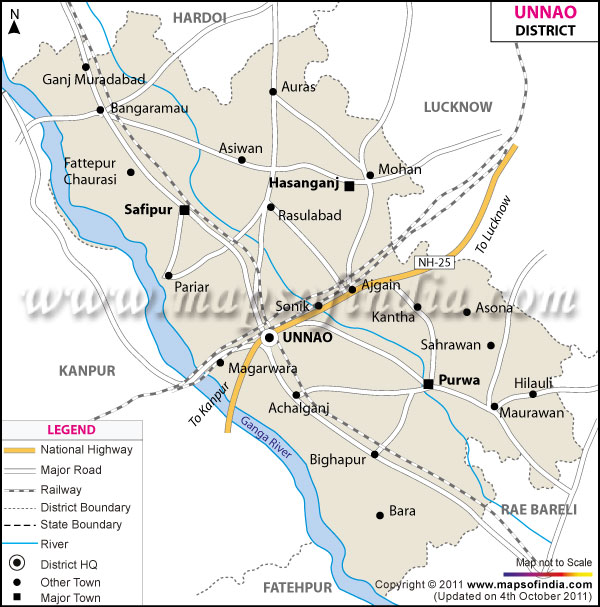
Unnao District is one of central districts of the northern area of the Indian state of Uttar Pradesh, clearly visible on the unnao district map, which is placed between two of the most important historically significant cities of the state, Lucknow and Kanpur. The location of its location along both major road and rail sections has given it the character of a region that inhabits rural nature with a growing urban presence. The district has its headquarters in the town of Unnao that serves as the administrative and commercial centre of the district. Unnao has over the years developed to encompass an agriculture based terrain, but one which has integrated agriculture, small scale industry and service sectors.
The fact that Unnao is between Lucknow, the state capital, and Kanpur, a major industrial city has seen to it that Unnao has been linked to the larger economic networks, all clearly visible on the unnao district map. This has brought about industrialization coupled along the highways corridors particularly those connecting Lucknow and Kanpur. Meanwhile, much of the district still has its rural beat, in the form of traditional markets, weekly bazaars and local community life based on agriculture and local institutions. Essentially Unnao is a transitional district, in which the legacy of the Gangetic plains has been subjected to the forces and challenges of contemporary development.
History
The history of the Unnao District is closely connected with the history of the bigger one of the history of the Awadh region. During ancient times, the land was a part of the cultural and political history of Kosala and was since then conquered by different dynasties ruling in the northern part of India. Pieces of archeological evidence in the area indicate the possible primitive patterns of settlement on the fertile plains along the Ganga, where the people had relied on agriculture and riverine resources.
At the medieval period, the area was linked to the kingdom of Awadh which came out as a great centre of culture and administration. Awadh became a wealthy province during the Mughal Empire, and the present-day Unnao state became part of the administrative division of Awadh. Agrarian revenue collection, village administration, and landholding patterns were developed to a great extent, influencing the rural society permanently.
During the eighteenth century when Mughal power was deteriorating, the Nawabs of Awadh had considerable autonomy. Awadh had a cultural impact on the whole of the region through the influence of nurtured manners, poetry and architecture. Though Unnao was not a significant centre of courtly life, it was still a component of the social-political structure of Awadh that shaped as a result of its institutions and customs.
The nineteenth century saw the administrative reorganisation with the start of the British rule. After the annexation of Awadh by the British East India Company in 1856 and the happenings of the uprising that occurred in 1857, a lot changed in the area. Similar to other Awadh districts, Unnao experienced unrests in the uprising with local leaders and peasants fighting against the colonial rule. Once the rebellion was crushed, the British centralised their rule and restructured the borders of districts and administration regimes.
Unnao was built in the context of the British colonial rule in the late nineteenth and early twentieth century. The infrastructure like roads and railway lines was developed which connected the district with Lucknow and Kanpur more closely. The agricultural production was still at the center and the land revenue policies still influenced the rural life. During the decades preceding the Indian independence, the nationalist thought extended with the countryside, and the population of the district took part in the general freedom movement.
The city of Unnao joined the Republic of India state of Uttar Pradesh after gaining independence in the year 1947. Rural structures were slowly changed by post-independence reforms which included land redistribution policies and the growth of local governance institutions. Green revolution in the second half of the twentieth century increased agricultural productivity in sections of the district and industrialization in the neighboring Kanpur and Lucknow, clearly visible on the unnao district map helped shape the economic trends. The history of Unnao, today, portrays the stratification of the ancient settlement, the culture of Awadh, reorganization during the colonial period and the change during the period after independence.
Culture
Unnao District culture is based on the culture of the Awadh region, which is known by having hospitality, respecting the elders, and high sense of community. The traditions of the countryside are still lively, and festivals, fairs and religious practices constitute a significant segment of the social life. Including Diwali, Holi, and Eid among other local celebrations are celebrated enthusiastically uniting all members of other communities.
The cultural expression in the district is still influenced by folk traditions. Oral histories and common values are maintained by local songs, especially songs that are sung at weddings and during harvest seasons. The simplicity of agrarian life is usually echoed in the traditional clothing worn in rural regions, even as the urban touch is becoming more apparent in towns. Small scale weaving and handicrafts, which are craft traditions, have traditionally played a role in the local livelihoods, but many have adjusted to new economic conditions.
Food in Unnao reflects the overall Awadhi food. Although the rich cuisine related to the courtly kitchens of Lucknow might not be as leading in the daily life of the villages, one can trace the influence of the Awadh flavours in the usage of spices, slow cooking and feast dishes made during the special occasions. Breads made of wheat and rice are some of the staple foods along with lentils, vegetables, and seasonal foods.
The district is covered with religious sites and local shrines which became the centres of worship and socialisation. These areas are usually the ones on which the annual fairs are held and they include people in neighbouring locations. The observation of the Hindu religion and Muslim population coexisting has made these groups have a shared cultural ethos due to their mutual contribution in each other festivals and local cultures.
The cultural life in the district has also been reflected in education and literature. Unnao is near big education hubs like Lucknow and Kanpur; this has made the dissemination of schools and colleges beneficent in Unnao. The region has been affected by the literary traditions on Hindi and Urdu which portray the composite culture of Awadh. On the whole, the Unnao culture is the continuation with the local culture as well as the gradual adjustment to the modernity.
Language
The main language in Unnao District is the Hindi language that is the medium of administration and education. Nowadays, in the colloquial language of numerous of the inhabitants there are dialects more or less of the Awadh linguistic tradition, owing to the location of the district in the cultural area of Awadh. There is also understanding and speaking of Urdu between groups within the populace especially in the city and semi-urban areas. The official and educational language is English particularly in higher institutions and government offices. The fact that these languages co-exist depicts the stratified linguistic identity of the region where the formal language and the informal language spoken in villages and local markets may differ greatly.
Besides regular communication language also indicates migration, education and media trends in Unnao. Formal education and digital communication have reinforced the position of the standard Hindi and exposure to television, cinema and the Internet has added some elements of the modern vocabulary into the local speech. The younger generation tends to rapidly alternate between Awadhi at home and standard Hindi in professional places of work, which is a vivid example of dynamic language space under the influence of the tradition and modernity.
Geography
Unnao is geographically located at the central region of Uttar Pradesh, clearly visible on the unnao district map, and is part of a vast Indo-Gangetic plain. The land is mainly in the form of plain lands with fertile alluvial soils which have been deposited over centuries by the Ganga and its tributaries. The River Ganga provides a natural border to a portion of the district, clearly visible on the unnao district map, and serves as a source of agricultural productivity as well as being a source of cultural importance. The landscape is crossed with smaller rivers and seasonal streams which promote irrigation and local ecosystems.
The weather of this district is that of northern India, hot in summer, but the bulk of the yearly precipitation falls during the monsoon, and the winter is cool. The farming seasons are very much related to these seasonal changes. The topography is also flat which makes it easy to practice farming, and irrigation systems are supplementing the rain in most places. Although the district is generally fertile, other challenges like periodic flooding along the riverbanks and strains of population growth on the land resources are other issues confronting the district.
Unnao soil is mainly alluvial in nature and the soils are formed by centuries of rivers that deposited their soils over the land and are very favorable to planting of cereals, oil seeds and pulses. The difference in the soil texture in the district determines the pattern of cropping, with some parts being more favourable to wheat and others to paddy during the monsoon season. The productivity of agricultural activities is directly related to irrigation systems that comprise of canals, tube wells and natural water sources.
The issue of environment has slowly followed the trend of development, especially where industries and major highways are situated. The development of the industry against the maintenance of fertile farmlands and water in the district is one of the key issues that sustainable planning should put into consideration. Meanwhile, the physical characteristics of Unnao are still largely dominated by rural sceneries, vegetation beside the roads and rivers and agricultural lands.
| Facts of Unnao District | |
|---|---|
| State | Uttar Pradesh |
| District | Unnao |
| District HQ | Unnao |
| Population (2011) | 3108367 |
| Growth | 15.11% |
| Sex Ratio | 907 |
| Literacy | 66.37 |
| Area (km2) | 4045.2 |
| Density (/km2) | 682 |
| Tehsils | Bighapur, Hasanganj, Purwa, Safipur, Unnao |
| Lok Sabha Constituencies | Unnao |
| Assembly Constituencies | Bangermau, Bhagwantnagar, Mohan, Purwa, Safipur, Unnao |
| Languages | Hindi including Awadhi, Urdu |
| Religion | Predominantly Hinduism |
| Rivers | --- |
| Lat-Long | 26.539394,80.488536 |
| Travel Destinations | Nawabganj Bird Santuary, Lingeshwar Mahadeo Temple, Tomb Of Muhabbat Shah, Balkaneshwar Nath Mahadeo Temple etc. |
| Government Colleges/Universities | St. Jude'S College, Ben-Hur Inter College, Sir Syed Inter College, J.N. Shah Memorial College, Government Inter College For Boys (Gic), Government Girls Inter College etc. |
FAQs
Q1: What is the administrative headquarters of Unnao District?
The administrative headquarters of Unnao District is the town of Unnao.
Q2: Which major rivers influence the geography of Unnao District?
The River Ganga is the principal river influencing the district’s geography, clearly visible on the unnao district map.
Q3: What is the primary occupation in Unnao District?
Agriculture remains the primary occupation for a large portion of the population.
Q4: Which cultural region does Unnao historically belong to?
Unnao historically belongs to the Awadh region of northern India.
Last Updated on : May 08, 2026
