

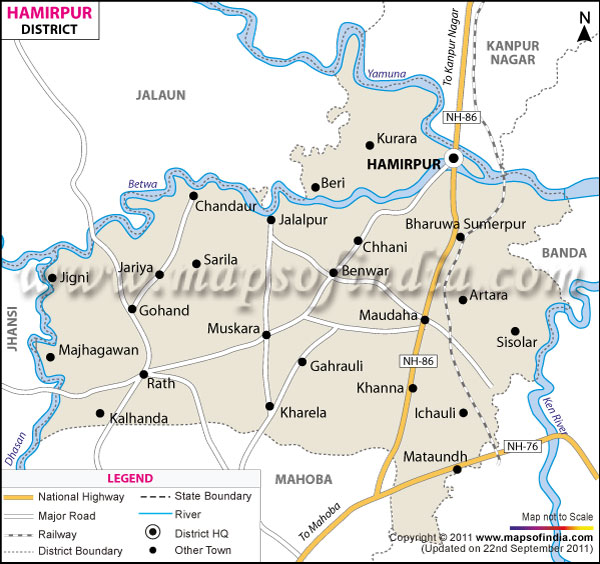



Introduction
Hamirpur district is a blend of beautiful natural settings and historical sites which make up its character in southern Uttar Pradesh, India. It is located in the center of Bundelkhand which is known for its brave warriors and rich past. It is also known for its distinct geographic features that sit between the main rivers Yamuna and Betwa. There is a mix of history and local villages each with their own past in this area.
History
The past of Hamirpur is a great story of ancient kingdoms and brave warriors. In the dawn of the Stone Age early man lived along the banks of the Yamuna and Betwa rivers. Archeologists have reported that we have old stone tools in this area which is proof that people have lived in this land for thousands of years. That long timeline is an element in the story of this district which also makes it one of the oldest populated areas in the Bundelkhand region.
In the olden days of Mahabharata the history of Hamirpur was a part of the Chedi Kingdom. That was a great power which saw to it that its kings were known for their strength and justice. The district was on key trade routes which connected the north plains to the central hills of India. Because of this many travelers and soldiers passed through these lands which in turn left behind pieces of their culture and stories.
The medieval time saw the rule of the Chandela kings which are known for the beautiful temples at Khajuraho. At that time Hamirpur was a key defense point. Local legends tell that the town was founded in the 11th century by Rajput ruler Hamir Deo. He built a strong fort to protect his people and the district which we see today took its name from him in honor of his bravery.
Later we see the growth of the Bundela Rajputs in the history of Hamirpur. The preeminent leader was Maharaja Chhatrasal who forged valiantly at keeping the peace in the land which he defended from foreign invaders. He was a great hero that brought together the people of Bundelkhand. Even as the Mughals and Marathas pressed into the area the spirit of independence lived on in the local villagers and their leaders.
In 1857 which was a turning point for the district. When the call for freedom reached Hamirpur the local people and soldiers joined the revolt against the British with great energy. We saw many a battle on the dusty plains and at the river crossings. Though in the end the British retook control, the sacrifice of the local freedom fighters became a part of the very pride of Hamirpur’s history.
After independence in 1947 which came with the birth of a new India our district stepped onto a growth path of its own. We separated from other admin areas to become what we are today which is a home for farming and local development. Today as we see modern bridges built over the Betwa River we also think of the great ancient kings and brave rebels that played a part in shaping this land. We have a history which is a story of courage, of rivers and very deep rooted traditions.
Culture
In Hamirpur we see a great blend of simple day to day life and large scale celebrations. Here people are very bold, honest and helpful. As it is a part of Bundelkhand the local culture is a blend of folk songs and dances which speak of bravery and nature. Life here is based around the seasons and each harvest is celebrated as if it’s a grand festival.
In Hamirpur religion plays a huge role in day to day life which in turn forms the base of the culture. The district has many beautiful temples which include the Chaura Devi Temple and the Maheshwari Mata Temple. These temples serve not only for worship but are also social spaces where people come together to share news and support each other. During festival times these temples are decorated with bright lights and flowers which brings together the community in a spirit of peace.
In the villages you can often hear the “Alha” being performed. It is a special kind of folk music that talks of two valiant brothers who fought over their land. These songs are filled with energy and do a great job at keeping our past alive. At weddings the “Diwari” dance which includes jumping and using sticks is very much in practice and is also very exciting to watch.
In Hamirpur which has what we call Melas the village fairs you get to experience the whole culture at once. At these fairs you see local artisans selling off their hand made wooden toys, clay pots, and brass work. Also you have the traditional wrestling events called Dangals which is a display of young men’s strength. The fairs are a riot of laughter, the smell of fried Jalebis, and the sound of children playing on wood swings.
We see that in Hamirpur life is about holding onto the past. People there value their land, their animals, and their age old songs more than anything else. What we have also is present day change but at the same time the village feel of old warm village life is very much present. That balance which they have achieved between the past and present is what makes the identity of Hamirpur so unique and appealing.
Language
In Hamirpur language is a beautiful aspect of the local culture that ties present day population with that which was valiant in past. While Hindi is the official language which is used in schools and at the office, what truly is of the people is Bundeli. This regional dialect is known across Central India for it bold and rhythmic quality that also is true to the spirit of the Bundelkhand area.
As you walk the streets of the local markets you will see that which is characteristic of the Hamirpur tongue in every conversation. It is a very direct and at the same time an expressive language that uses a great deal of local proverbs. These short sayings which give out about farming or everyday life, have been passed down from grandparent to child over the course of hundreds of years.
In the local speech there is a unique feature which is its use in folk music. The famous "Alha" which tell of great warriors are always performed in that traditional dialect. To hear these songs is to see the importance of the language of Hamirpur in preserving local history which it does very well.
In today’s time it is seen that many youth study up to get jobs in metropolitan cities but at the same time they do not leave their native language. At home with family they speak a mix of Hindi and Bundeli. This language mix is an indication that although Hamirpur is progressing, its people are very much attached to their cultural past.
Geography
Hamirpur’s geography is a result of the role that water plays in shaping it. In a very unique setting the district is positioned at the confluence of two of India’s most renowned rivers, the Yamuna and the Betwa. This location which is a narrow strip of green is surrounded by flowing blue water. Also because of these rivers the area has been a key for people to settle and grow food.
In the district mostly what you see is flat terrain which is great for large scale farming. We have a special type of soil which is what the local farmers call “Kabar” or “Mar”. This soil is like a natural sponge that which holds in a lot of water. This makes the geography of Hamirpur very rich for growing crops like wheat, mustard and gram which do not require too much extra water.
As in the south of the district you will see the change in the landscape. Flat fields here are few and far between what you will find are small rock covered hills and uneven land. This part in the geology which we see is that of the old Bundelkhand plateau. In this area you will find large rocks and dry shrubs instead of what once were green fields. It is a tough but beautiful area, that displays a more feral side of nature.
In terms of climate which greatly changes the look of the land throughout the year. In summertime the sun is very strong and we see temperature rise to very high levels. Rivers at times become narrow and the land appears dry and golden. But with the arrival of monsoons which we see in Hamirpur the geography of the area transforms. The rivers swell up and the whole district turns into a bright, lush green paradise.
Rivers in Hamirpur do more than just supply water they also are a source of sand. That which comes from the river beds of the district is known far and wide in North India for use in home construction. This natural resource is a key element of the local economy. From the large river valleys to the rock filled southern hills which we see in this area, the geography of Hamirpur is a treasure chest of what the people require to live, build, and grow their community.
In other words the land here is a gift of the Yamuna and the Betwa. We have flat plains which give way to rocky edges, in which the soil is deep and the water is never far away. This unique mix of features has made Hamirpur a home which has been stable for many generations of farmers and warriors.
| Facts of Hamirpur District | |
|---|---|
| State | Uttar Pradesh |
| District | Hamirpur |
| District HQ | Hamirpur |
| Population (2011) | 1104285 |
| Growth | 5.80% |
| Sex Ratio | 861 |
| Literacy | 68.77 |
| Area (km2) | 4118 |
| Density (/km2) | 268 |
| Tehsils | Hamirpur, Maudaha, Rath, Sarila |
| Lok Sabha Constituencies | Hamirpur |
| Assembly Constituencies | Hamirpur, Rath |
| Languages | Hindi including Bundeli |
| Currency | Indian Rupee (INR) |
| Religion | Mostly Hinduism |
| Rivers | Betwa, Yamuna, Virma, Dhasan |
| Lat-Long | 25.799891,80.007534 |
| Travel Destinations | Gram Khandey Temple, Singh Maheshweri Temple, Chaura Devi Temple, Meher Temple, City Forest, Gayatri Tapubhumi, Bake Bihari Temple, Brahamanand Dham, Kalpa Vraksh etc. |
| Government Colleges/Universities | Abhinav Pragya Mahavidyalaya, Government Post Graduate College, Government Girls Post Graduate College, Manjul Mishra College Of Science And Art, Shri Ramkrishan Mahavidhyalaya Etc. |
FAQs
Q1: Is there a well known temple to visit in Hamirpur?
Yes, Chaura Devi Temple is a very popular place which stands by the banks of the Yamuna River. It is a large scale spiritual centre which sees great attendance of local people who come to pray and celebrate festivals like Navratri.
Q2: What was the role of Hamirpur in the freedom struggle?
In the 1857 struggle for independence Hamirpur was right at the front. We see local freedom fighters and village men putting up a brave stand against the British rule which is also today remembered in many folk songs.
Q3: Which local food is popular here?
Litti Chokha is the top choice of food which is very much a part of the culture in this region. Also very popular are the sweet treats like Jalebi which we have here made with local jaggery or sugar from the nearby mills.
Last Updated on : May 08, 2026
