




Introduction
Pilibhit is a very peaceful and remote district in the north of Uttar Pradesh, India. It is at the foot of the Himalayan hills which puts it in a unique position in the state to have large dense forests and also wild life. Pilibhit also known for its green fields, rivers and forests. In terms of wildlife and farming in Uttar Pradesh you often hear of Pilibhit.
Pilibhit has a large number of small towns and also many villages. In Pilibhit most families base their income on farming. The district has also become a point of interest due to the famous Pilibhit Tiger Reserve. This has made Pilibhit a very important place for nature and wildlife lovers.
History
The history of Pilibhit is a very old and fascinating account which goes back to ancient times. It is told that at the time of Mahabharata a king by the name of Mayurdhwaj ruled here. He was very much associated with Lord Krishna and Arjun and also many outlying ruins in the area bear his name. For long this place was mainly an extensive wild forest in which the tribal people lived in peace with nature.
In the 1700s the history of Pilibhit saw a turning point when the Rohilla leaders rose to power. Notable among them was Hafiz Rahmat Khan who fell in for this place and made it his home. He built many grand structures which included the famous Jama Masjid in 1780 that which is a miniature of the one in Delhi. Also during his rule the town became a busy center for trade and learning in Northern India.
When the British arrived in India they had great interest in the geography of Pilibhit which they did because of the dense forests there. They required the strong wood from the Sal and Teak trees to construct railway tracks and ships. In 1879 the British made Pilibhit a separate district to better manage the forest resources. Before this the area was just a part of the nearby Bareilly region.
In the struggle for Indian freedom Pilibhit’s people also played a brave role. In 1857 we see many a local hero that took up arms against the British to protect what was theirs and their forests. There is a noted site at Khakra Chouki which is the grave of many freedom fighters who gave their lives for the country. Also in 1929 Mahatma Gandhi visited the town to put out the call to the local people to join the movement.
After 1947 when India won independence Pilibhit went through a great change in its history. Many families which had left for Punjab during the partition came back here for the very reason that the land was so fertile for farming. That is the reason you see today’s strong Punjabi influence. From an ancient kingdom to a home of tigers and flutes the history of Pilibhit is a tale of bravery and natural beauty.
In recent past a great step for Pilibhit was the creation of Pilibhit Tiger Reserve. The forest land which was given that special protection to save the tigers and other wildlife. That step put Pilibhit on the national map.
Culture
Pilibhit’s culture is a blend of forest life, music, and very deep faith. Over hundreds of years diverse groups of people have come together to form this very peaceable community. As the district is right at the foot of the mountains and in the midst of dense jungles which are almost a part of life there, people here have a very close affinity for trees and animals. You will see that the locals are very reserved but at the same time they are ever so welcoming to guests with a big smile.
In the local culture a very popular element is the Handmade Flute which has earned the city the name of “Basuri Nagari”. In Pilibhit for many generations families have been transforming simple bamboo sticks into musical instruments. It is amazing to see what they do with their hands to carve out perfect holes and produce sweet sounds. These flutes go out to musicians all over the world which in turn makes this craft a point of great pride for the city.
We also see grand temples like the Gauri Shankar Mandir and beautiful mosques like the Jama Masjid which stand as symbols of the past. Also since many from Punjab came here post 1947 the Sikh culture has also become very strong. In the district the Gurudwaras are known for their Langar which is a free delicious meal served in a spirit of brotherhood.
The Pilibhit Tiger Reserve plays a large role in what people think and do. We hear many a time from local stories which speak of the tigers and leopards that call the nearby forests home. This has brought about a culture of respect for the forest laws and a peaceable coexistence with nature. Each year at local fairs you may hear folk songs which sing of the beauty of the rivers and the wildlife in the Terai region.
Food plays a huge role in Pilibhit’s culture. As the land is very rich in fertility people are into fresh produce of vegetables, rice, and what they make out of sugar cane. From the Punjabi culture which has had a large influence, great parathas and lassi are a large part of the food scene. Also in the old town you will find classic Mughlai dishes. And during festivals like Diwali, Eid, and Gurpurab all come together to celebrate which is the true form of what is known as Ganga-Jamuni Tehzeeb which is shared culture.
In short what we see in Pilibhit is a culture which is very much in touch with the earth. From the music of the flute to the conservation of the forest, here people are very much into their traditions. What makes this district special is this mix of nature and human skill.
Language
In Pilibhit Hindi is the main language. People use it in their day to day lives, in schools and at the office. In the villages of Pilibhit there is a local dialect of Hindi which is very soft and friendly. Pilibhit’s accent also puts out the flavor of the Rohilkhand region.
Urdu also is a widely used language in Pilibhit. In homes here many speak it as well as they do at the times of religious ceremonies. In urban centers of Pilibhit, people are fluent in both Hindi and Urdu, this which in turn makes for easy interaction in Pilibhit.
English is in the school curriculum in Pilibhit. We see young students enrolling in it for better education and job prospects. At the same time in Pilibhit’s day to day life Hindi is the main language. Pilibhit’s language is the tie that binds people to their heritage and traditions.
In Pilibhit old sayings and proverbs still are used in every day speech. The elders use these sayings to pass down advice and wisdom. This style which they use in conversation in Pilibhit is very warm. In Pilibhit language plays a very large role in the daily lives of the people.
Geography
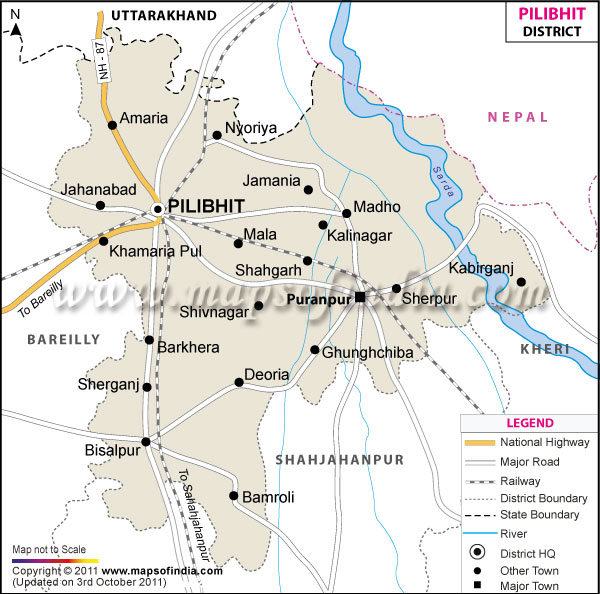
Pilibhit’s geography is in fact very distinct from the rest of Uttar Pradesh. It is at the foot of the Himalayas in a region which is the Terai. Also what you see there is a mix of large forest tracts, tall marsh grass, and an extensive network of small rivers instead of just flat farm lands. The area which the district covers is a narrow strip of land which also includes a section of the border with Nepal.
A great extent of Pilibhit’s geography is covered by the Pilibhit Tiger Reserve. This forest is a unique place which reports home to tigers, leopards and bears in the wild. What you will find here are mostly Sal and Teak trees which do not loose their leaves for the most part of the year. Also because of the heavy tree cover the air in this district has a much cooler, fresher feel as opposed to the large dusty cities.
Rivers play a large role in the look and function of this terrain. The Sharda is the largest river which runs along the east side and which also provides water for animal and agricultural use. Also we have many a smaller rivers like the Gomti which in fact springs out of a lake in this district. These rivers have formed a landscape which is full of small lakes and very marshy which in turn is a great environment for bird life.
Pilibhit’s geography is a gift from nature. It is a home to where mountain water meets plain rich soil. With its deep forests, flowing rivers, and large green fields it is one of the most natural and beautiful in Northern India. It is a place which truly channels the power and peace of the earth.
| Facts of Pilibhit District | |
|---|---|
| State | Uttar Pradesh |
| District | Pilibhit |
| District HQ | Pilibhit |
| Population (2011) | 2031007 |
| Growth | 23.45% |
| Sex Ratio | 895 |
| Literacy | 61.47 |
| Area (km2) | 3686 app. |
| Density (/km2) | 567 |
| Tehsils | Bisalpur, Pilibhit, Puranpur |
| Lok Sabha Constituencies | Pilibhit |
| Assembly Constituencies | Barkhera, Bisalpur, Pilibhit, Puranpur |
| Languages | Hindi, Urdu, English, Punjabi |
| Currency | Indian Rupee (INR) |
| Religion | Mostly Hinduism and Islam |
| Rivers | --- |
| Lat-Long | 28.574874,80.01812 |
| Travel Destinations | Gauri Shankar Temple, Jama Masjid, Dargah Hazrat Shah Md. Sher Mian Ki, Chhathavi Padshahi Gurudwara, Raja Venu Ka Tila, Methodist Church, Raja Ji Temple, Ardhanarishwer Temple, Jaisantri Devi Temple, Gomat Taal, Devha-Ghaghra Sangum, Chuka Beach etc. |
| Government Colleges/Universities | Ramlubhai Sahani Govt. Girls Degree College, Govt. Degree College, Upadhi Mahavidhyalaya, Springdale College, L.H. Ayurvedic Medical College etc. |
FAQs
Q1: What makes Pilibhit the "Basuri Nagari"?
Pilibhit which is known for its large scale production of high quality bamboo flutes. For generations skilled local artisans have been carving out these musical instruments which they in turn are exporting to musicians all over the world.
Q2: What does one go to see at Pilibhit Tiger Reserve?
The reserve is a great forest which has over 65 tigers, leopers and rare swamp deer. It is a beautiful part of the Terai region which also provides access to jungle safari to see wild animals in their natural habitat.
Q3: Is there a river which originates in Pilibhit?
Yes at the source of Holy Gomti River is a lake which we know as Fulhar Jheel (also named Paugoti Phulhar) in this district. Thus Pilibhit becomes a very important from a geographical and a spiritual point of view in Uttar Pradesh.
Last Updated on : May 08, 2026
