






Introduction
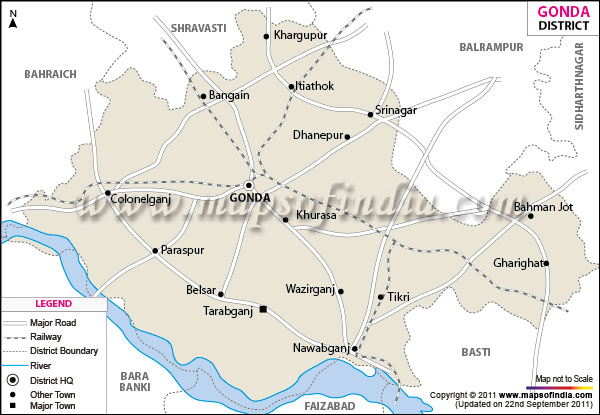
Gonda is a district located in eastern Uttar Pradesh and is an example of one of the most fertile regions of the Gangetic plains. The landscape consists mainly of flat terrain that has been deposited with alluvium over the centuries. The productivity of the soil is highly optimum. Life in this district is primarily agrarian, with an economy consisting of wheat, paddy, sugarcane, and pulses. The most important river is the Ghaghara river, which forms the eastern boundary of the district; other small rivers and seasonal streams criss-cross the district in a manner such that they support the irrigation of crops and sustenance of the people. The monsoon and winter periods of the plains cover the agricultural and routine activities of the people.
History
Gonda has been referenced since the days of the epics, such as the Mahabharata, as a land traversed by the Pandavas during their exile. While it does not receive a lot of mentions, and isn’t a place where battles were fought, its location by the Ghaghra river and its fertile plains made it a choice area for people to settle. The area is also believed to be settled well before the name was assigned by the British, as the word Gonard is associated with the area.
Up until the Medieval period, it was a little more than a cluster of settlements. It wasn't until 1620 CE that the city we see today started to take form, with Raja Maan Singh of the Mughal Empire noted for the establishment of the town. The period also saw the rise of local rulers and landlords who were a large part of the social and architectural development of the time.
The area's fertility helped agriculture become the dominant industry, while the area’s temples and shrines show the community’s spiritual depth. It may have not been an imperial capital, but it has been a valued place for flourishing local traditions, and for a jurisdictional ruler merging loyalty to an empire and concern for the subjects. The colonial period began a new chapter in Gonda’s history. The city became a district in 1856, just a year before the 1857 Revolt, which was the first large-scale uprising against the British Empire in India. Like numerous other districts in Uttar Pradesh, it embraced resistance and nationalist activities.
Settlement of the district marked the start of the colonial administration and accompanying agrarian economy system defiance. Identification of the city with the colonial oppression and the loss of large numbers of its residents in the struggle against colonial rule gave it a new and unique identity marked by defiance and sacrifice. It was among the regions which first realized the change which accompanied independence.
According to the 2011 census, the population of Gonda was 3.4 million. Such a high population led to lot governance and population control challenges for the district. The census data also highlighted the dire need for educational reforms in the district and it also showed the district's low literacy rate in comparison to the rest of the country. The District's economy was primarily agrarian with sugarcane, paddy and wheat as the main crops and also Mankapur had sugar mills which meant the district was not completely agrarian.
Gonda district, still with its long spiritual and cultural heritage also provided a home to its own community fairs, temples, festivals and traditions. This also provided a home to a community system and to cultural practices that were changing in the rest of the nation. It was not a mainstream center of tourism but the rest of the nation provided a calming tourism center with the ancient history associated with the Mahabharata, and also the history associated with the Mahabharata Freedom Struggle.
The district identity of the city was that of a merger of history and progress with the blend of heritage of the challenges of the agrarian economy, the history to be surpassed by the agrarian economy focused on modernity. The social services that had most demand were left to the state to reshape the identity as a district with the improved health care and also the modern aspirations with the improved ancient heritage.
It is not characterized by great battles and great empires but by great perseverance and great tradition. Its story is as old as that of the Mahabharata and includes colonial rule and the developing challenges that come with it. The history shows us that, without great notoriety, places exist that hold the stories that form the core of the nation. It is the district that has survived, changed and hoped, representing the silent strength of the heart of the nation.
Culture
The culture of the region is diverse. Identifying the Gonda culture fundamentally is the agrarian culture. The farming cycle of sowing, harvesting, and celebrating the fruits of labor, influences the festivals, songs, and rituals of the people.
The festivals embrace the communal feeling of the village, and celebrate the life of the economically agrarian society. Going beyond the cultivation, the religious practices integrate the culture of the district. Temples and churches are focal points of worship and separate from the centers of social life. The religious festivals of Holi, Diwali, and Navratri are a devotion and a communal relationship celebration. Rural fairs are organized near the temples and offer trade, relaxation, and culture to the different communities, alongside folklore and crafts.
The Mahabharata fosters mythical connections for the cultural imagination of the city ; Mahabharata’s connections remind the people of the epics. The district’s cultural expression includes folk music and dance. The elders tell the stories of the epics and the folklore to the younger people. The rapid modernization of the world has not diminished the collection of stories that the elders tell their children. This tells us that there is an established oral tradition that it has to stand the test of time.
Language
In the Gonda district of the Indian state Uttar Pradesh, the use of the Hindi language is a means of both social communication and identity formation. Native Hindi speakers use Hindi in schools, government offices, and in the community. As such, Hindi is a language of unification. In fact, Hindi is the first language of the majority of residents of the district. Although, it is important to understand that the Hindi language has a large number of other languages and dialects in the Indian Nation (for example, Urdu, Sanskrit, Punjabi, and so forth), that serve as regional linguistic communicative vernaculars. Hindi is the communication of government offices, of schools, of community activities (formal and informal) and of all social services, regardless of the regional communicative vernaculars.
As such, it is the most dominant language of the district. In fact, many outsiders (non-residents) use and interact with the Hindi language. Awadhi, the main dialect of Hindi, is the language of the day-to-day activities of the community. Perhaps, the most important functions of this vernacular language, is in the areas of music (particularly folk music), literature (particularly the prose of short fictional stories), performative activities, informal and social interactive activities of entertainment (for example, stand-up comedy, humorous entertainment rituals, etc.)
In fact, it is this dialect that government officials, school teachers, and social service workers use in all of their community informal and social welfare functions. It is truly a warm language, in that it has the flexibility (adaptability) to perform many community functions. In addition, this dialect has a great number of vernacular dialects (for example, Urdu) that also serve great community functions. It is a language of great versatility and a form of communicative expression that is used for the recitation and performance of great religious and community functions.
Geography
Gonda district lies in eastern Uttar Pradesh. It is also a part of the Gangetic plains. The district is covered with alluvial soil which is great for agriculture and supports the growth of wheat, rice, sugarcane, and pulses. A number of them assist with the growth of the mentioned crops and provide water all year round, and in every part of the district, assist with the fertile soil to grow crops. The most dominant is the Ghaghara river in the eastern part. Numerous smaller seasonal rivers and streams are present in the district's water rich area, and during the monsoon season, they provide water to grow crops but also provide ample floods.
These can still be seen near river banks, where the natural vegetation still exists and is a source of biodiversity. Throughout history, the geography of this area has influenced it being a central area for trade and the merging of different cultures. The first settlers were attracted by the fertile agricultural land and the rivers that provided easy routes for people to move. It has a history of settlement that is closely linked to fertile agricultural lands, rivers and their positions strategically located in the center of Eastern UP.
There is also strong connectivity to and from the neighboring districts. The agricultural rich plains provide a life and resource that is not expensive. The same simple life has been available to people living in the area for many centuries. The district has simple plains that have integrated fertile soil, lifegiving rivers and with the position of the district. Over many centuries the districts' life has been tied closely to the Practical, integrated landscape.
| Facts of Gonda District | |
|---|---|
| State | Uttar Pradesh |
| District | Gonda |
| Location | Eastern Uttar Pradesh |
| District HQ | Gonda |
| Population | 168000 |
| Growth | 24.17% |
| Sex Ratio | 921 |
| Literacy | 58.71 |
| Area (km2) | 4003 |
| Density (/km2) | 857 |
| Tehsils | Colonelganj, Gonda, Mankapur, Tarabganj |
| Lok Sabha Constituencies | Gonda, Kaiser ganj(partial) |
| Assembly Constituencies | Colonelganj, Gaura, Gonda, Katra Bazar, Mankapur, Mehnaun, Tarabganj |
| Languages | Hindi, Urdu, Awadhi |
| Rivers | Ghaghara |
| Lat-Long | 27.039557,81.951714 |
| Travel Destinations | Swami Narain Temple, Varahi Dev, Prash, Tirrey Manorama, Prithvi Nathan Mahadeo, Jhali Dham, Parvati Mahadeo etc. |
| Government Colleges/Universities | Meena Shah Degree College, Baba Gayadeen Vaidya Babu Ram Mahavidyalaya, Kisan Degree College, Bhagirathi Singh Memorial Mahavidyalaya, Chandra Shekhar Shyamraji Mahavidyalaya, Dashrath Singh Memorial Mahavidyalay, Dr. Bheem Rao Ambedkar Mahavidyalaya, Hakikullah Chaudhary Mahavidyalaya, Kamta Prasad Mathura Prasad Janta Mahavidyalaya etc. |
FAQs
Q1: What contributes to the fertility of Gonda's soil?
The district is located in the Gangetic alluvial belt where deposits from rivers over the course of centuries provide soil that is rich in nutrients and great for farming.
Q2: What river is the geography particularly reliant on?
The Ghaghara River is the lifeblood of the district; it sustains farming and settlements, but also floods in the rainy season.
Q3: What is the importance of Gonda's location?
Being in the center of eastern Uttar Pradesh, Gonda connects to multiple districts and regions, serving as a transit point between Awadh and the Terai, with significant cultural and commercial interactions.
Last Updated on : May 08, 2026
