






Introduction
The district of Lalitpur lies in the most southern region of the state of Uttar Pradesh, and is a part and parcel of the ancient Bundelkhand region of northern India. The town of Lalitpur serves as the administrative centre, the centre of government, trade and education of the larger region. The strategic and cultural importance of the region is based on the way the region is placed on the border with Madhya Pradesh; on three sides, the neighbouring state engulfs the region.
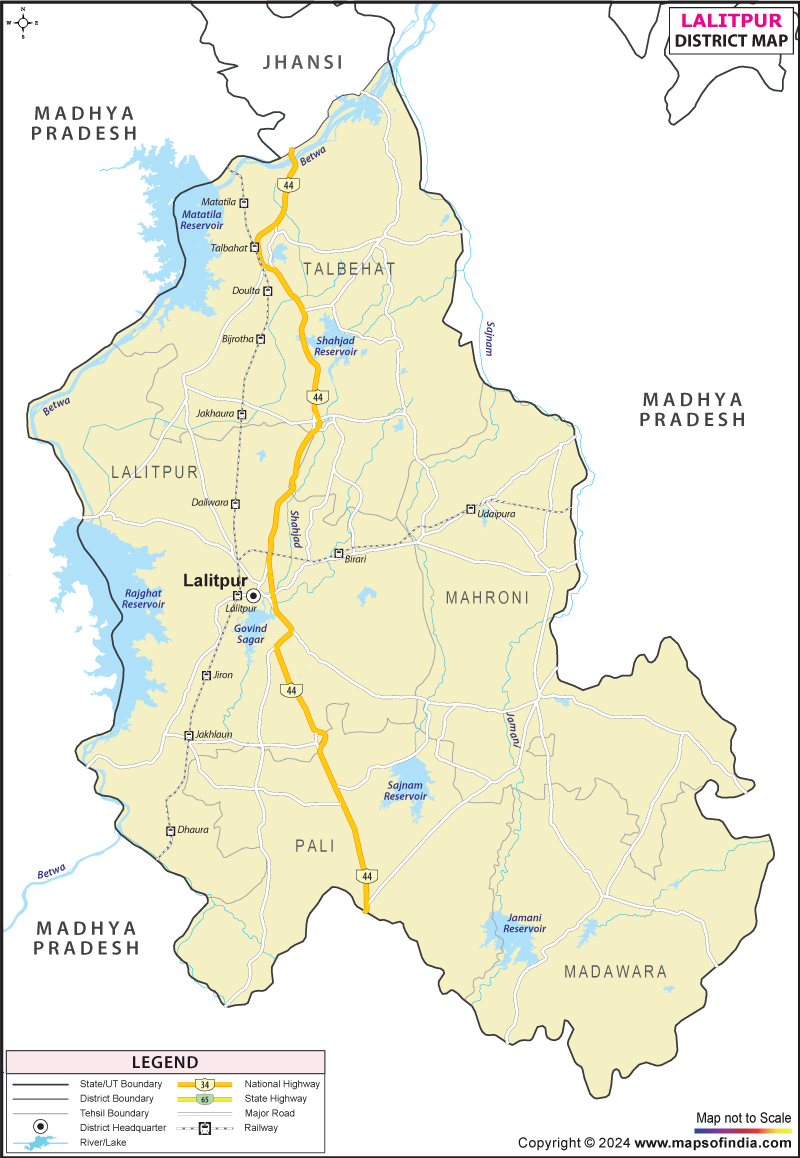
The geographical picture is easily explainable through a Lalitpur district map that reveals the long shape on which it is formed but extends southwards into central India. The Lalitpur district map indicates that the district is connected with Jhansi in the North and few Madhya Pradesh districts in the east, west and south. The administrative part is a part of Jhansi Division of Uttar Pradesh and is further subdivided into tehsils and development blocks to govern it on the local level. From a close study of the Lalitpur district map it could be observed how transport routes connect the rural settlements with headquarters town. The physical environment of the area in the Bundelkhand plateau also provides the area with a unique topography compared to that in the alluvial plains of the north of Uttar Pradesh.
It is mostly an agrarian economy with the major cultivations including wheat, pulses, oilseeds and coarse grains. Local markets and service activities as well as small-scale industries add to the rural incomes. The Lalitpur district map can be used in development planning to locate the sources of irrigation and road networks. The plateau topography and seasonal rivers and woodlands cover up the area of the district which occupies a significant ecological niche in the state.
History
The history of the Lalitpur district cannot be separated with the general history of Bundelkhand. With the help of ancient traditions, the region is said to be referred to in ancient Hindu religious texts such as Vishnu Puran and Varah Puran hence illustrating that the area was actually occupied in the early days. In local folklore the town of Lalitpur was founded by a ruler known as Sumer Singh who named the town after his wife Lalita hence the present name of the district.
In the medieval times the region was included in the realms of Bundela Rajputs especially of the state of Chanderi. The Bundelas had a significant influence on the cultural and political life in Bundelkhand. Strongholds, temples and governmental hubs grew in their favour. The Lalitpur district map of the area of then would have been a mixture of feudal lordships and estates under the local chieftains who paid homage to Bundela masters.
The eighteenth century in the region witnessed the expansion of the Maratha influence in central India. The power to control had been transferred to the Bundela rulers and the Maratha rulers, especially the Sindhia rulers of the Gwalior. The administrative boundaries changed due to political realignments in the time and this can be traced by historical versions of the Lalitpur district map which are available in the colonial archives.
As the powers of Britain grew stronger in India in the early nineteenth century, the region later became part of the British rule by signing treaties and annexing the region. It was constituted into a district under the greater system of administration of the North-Western Provinces. During part of the late nineteenth century, Lalitpur was combined with Jhansi District but it was reinstated as a separate district in 1974 following post-Independence reorganisation of the district in Uttar Pradesh. This re-established identity is reflected in the modern forms of governance as seen on the current Lalitpur district map.
The district also experienced involvement into broader trends of the freedom movement of India since the Bundelkhand was not the country that was not bothered by resistance and reformist efforts. The Bundela, Maratha and British influence added to each other over time and determined the administrative and cultural borders of the present day.
Culture
Lalitpur district has culture life that is associated with Bundelkhand culture, which is characterized by close community alliance, agrarian culture and rich religious practices. Holies, Diwali, Navratri and Dussehra are few festivals that are celebrated with zeal in both the towns and other villages. The temples hold religious fairs where people of adjoining districts, as well as those of Madhya Pradesh, attend. The sites are usually indicated on the Lalitpur district map.
The element of folk music and dance is a significant part of local identity. Oral histories and social values are kept by Bundeli folk songs that are sung at harvest times and during marriage ceremonies. These performances are supported with the help of traditional instruments and the communal connection. Lalitpur district map can be employed in tourism advertising usually points to key cultural hubs where fairs and annual conferences either occur.
Albeit on a small scale, craft traditions are a part of the cultural economy. Handloom weaving, pottery and metal crafts is still practiced to some extent in isolated villages, maintaining hereditary skills. The weekly markets provide the space of exchange of goods and socialization. Life in the countryside is still closely related to the annual agricultural rhythms, and this pattern determines the food trends, clothing and social practices.
There is a religious diversity, although most of the people are Hindu, there are Muslim minorities and small groups of other religions. There are mosques and temples in settlements which portray a common place and a historical tendency of coexistence. Social cohesion within communities is enhanced further by cultural programmes that are held by educational institutions.
Language
The major language of administration, education, and day to day communication in the Lalitpur district is Hindi. It is applicable in government offices, schools, courts and the media. The Bundeli dialect is a very common language in semi-formal contexts along with the normal Hindi. Bundeli possesses unique phonetic and lexical characteristics that distinguish it to the standard Hindi and still are mutually intelligible with it. Expressions of folk songs, proverbs and storytelling are commonly in Bundeli keeping a local flavor.
A smaller portion of the population speaks Urdu, and that is across the communities of the Muslims. It is manifested in religious education and cultural meetings. The multilingualism is widespread, and the residents can be operating in both dialect and standard variants depending on the situation. Schools are encouraging the use of Hindi as the language of instruction, but English is also a second language since it is taught according to the state curriculum standards.
The patterns of settlement and migration in the district are also reflected in language. Through observation of place names inscribed on Lalitpur district map, it is possible to observe linguistic influences, which give a clue to past settlement and social transformation.
Geography
The Lalitpur district is geographically situated in the Bundelkhand plateau with some undulating topography, rocky outcrops and forest cover. Tributaries of the river and the Betwa River affect the drainage patterns and form water resources to be used in irrigation activities. The monsoon months see the flow of seasonal streams which replenish tanks and reservoirs which are required in agriculture. These river systems and watershed areas are well seen on Lalitpur district map.
It has a subtropical climate, that is, hot summers, monsoon season (June-September), and cold winters. Agriculture is very sensitive to the variable climatic conditions because the south-west monsoon heavily relies on rainfall. The soils include black cotton soil in some of the tracts, red and mixed soils in the plateau areas. These soil zones are indicated in the Lalitpur district map that has been used by agricultural planners in order to plan crops.
Forests are broken with agricultural fields, which sustain biodiversity that is characteristic of central Indian ecosystems. These tracts have wildlife species that are adapted to dry deciduous forests. The District headquarters is connected to the rail and road network that links Jhansi and the cities of Madhya Pradesh further consolidating the purpose of transit. The Lalitpur district map indicates the presence of national and state roads which ameliorate the transport of goods and people.
Topographically, the district is at elevation level as compared to Gangetic plains in the north. The height has an impact on the change in temperature and the distribution of rain. The map of the Lalitpur district shows that the water conservation projects, reservoirs and minor irrigation schemes are planned in such a way that sustainable development planning is put into consideration. This plateau land and valley river topography provide the area with a diverse physical landscape in Uttar Pradesh.
The land use and rural settlement patterns within the plateau landscape have also been a result of the mineral composition of the plateau landscape. The hard rock formations of granite are exposed in various sections of the rural areas which determine construction activities as well as curtailing agricultural activities. The agricultural tracts or reliable sources of water are usually close to the villages, which is clear when a map of a Lalitpur district is compared with topographical information. A distribution of tanks, check dams and small reservoirs indicates the continuous attempts to control the water shortage in a semi-arid climate where rainfall may not be continual.
Trade and movement, the transport corridors consist of major road and rail lines, connect agricultural producers with the rest of the world. These connections are well depicted in map of a Lalitpur district that depicts highways, railway lines and administrative boundaries that separately constitute the spatial character of the district.
| Facts of Lalitpur District | |
|---|---|
| State | Uttar Pradesh |
| District | Lalitpur |
| District HQ | Lalitpur |
| Population (2011) | 1221592 |
| Growth | 24.94% |
| Sex Ratio | 906 |
| Literacy | 63.52 |
| Area (km) | 5039 |
| Density (/km) | 242 |
| Tehsils | Lalitpur, Mahroni, Talbehat |
| Lok Sabha Constituencies | Jhansi |
| Assembly Constituencies | 2-Lalitpur, Mehroni |
| Languages | Hindi, Urdu |
| Religion | Predominantly Hinduism |
| Rivers | Jamani, Sajnam |
| Lat-Long | 24.65201,78.469448 |
| Travel Destinations | Deogarh, Neelkantheshwar Trimurti (Pali), Ranchourji, Pavagiri, Devmata, Machkud Ki Gufa, Tuvan Mandir, Ata Mandir, Kshetrapalji Temple etc. |
| Government Colleges/Universities | Sudarshan Degree College, Pahalvan Gurudeen Mahila Mahavidyalya, Nehru Maha Vidyalaya, Government Degree College, Pandit Deendayal Upadhaya Government College, Nagar Palika Girls College etc. |
FAQs
Q1: What is the administrative headquarters of Lalitpur district?
The administrative headquarters is the town of Lalitpur.
Q2: Which region does Lalitpur district belong to?
It forms part of the historic Bundelkhand region.
Q3: What is the primary occupation in Lalitpur district?
Agriculture is the principal occupation of the population.
Q4: Which river is significant in the district’s geography?
The Betwa River is one of the important rivers flowing through the district.
Last Updated on : May 08, 2026
