




Introduction
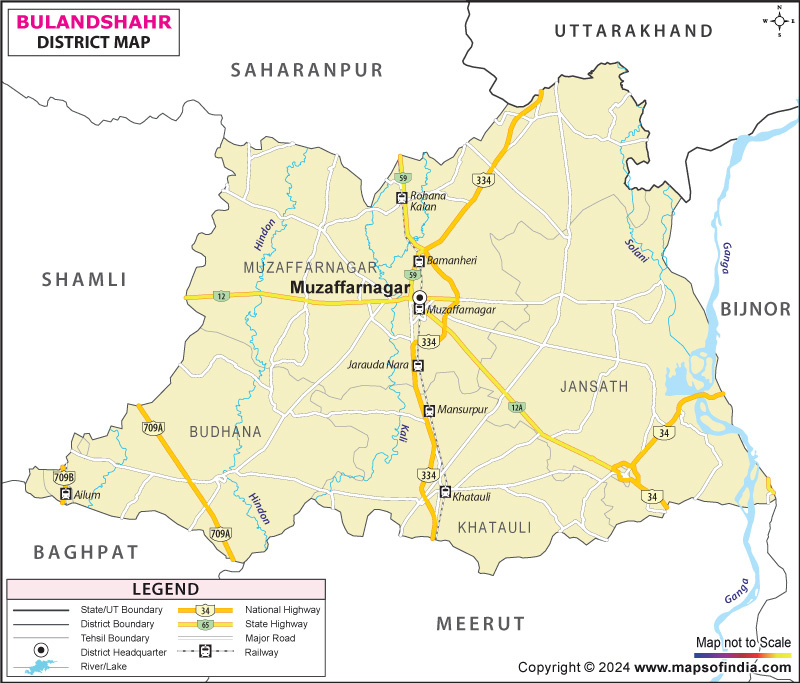
Muzaffarnagar is a major city and district in the northern Indian state of Uttar Pradesh, clearly visible on the muzaffarnagar district map which is one of the major focal points to agrarian and industrial activity in the upper Ganga-Yamuna Doab region. The city is commonly referred to as the Sugar Bowl of India as it has had long historical connection with the sugarcane farming and that they also have a rich web of sugar and jaggery production units that sell in the markets around North India. People who live and visit Muzaffarnagar call it a prosperous center balancing between the traditional agrarian existence and the challenges and prospects of modernization.
History
The history behind the Muzaffarnagar is profound and very complex as it dates back several hundred years to the medieval and early modern India. The first mention of the ancient occupation of the region refers to Sarwat, which is a name that existed before the foundation of the city in the early 17 th century. Sheikh Sayyad Muzaffar Ali Khan, the descendant of one of the Mughal commanders in the days of Emperor Shah Jahan, was the founder of the modern town, which he named after himself in 1633. This saw the start of documented urban history of Muzaffarnagar, which later on became a major political and economic hub in the area.
Prior to this establishment, the region which is now the Muzaffarnagar district was a part of a wider region that had been shaped by the previous rulers and empires. Later, during the late medieval times, the region was caught up in the Timurid invasions of Timur (Tamerlane) during the late 14 th century when his troops moved across the north of India and redefined the geography of its politics. Afterwards, under the Mughal Emperor Akbar, most of the district had become part of the Saharanpur sarkar, and administrative records of that time show the development of thriving agricultural and rural communities in the plains.
The Sarwat and the towns nearby began to experience an ever-increasing influence of the Indo-Islamic culture, forms and modes of architecture, and revenue collection systems that brought the local farming to the wider imperial networks. The period was significant in terms of cultural and socio-economic construction that would be maintained in subsequent times. Muzaffarnagar was incorporated into the Meerut Division of the United Provinces of Agra and Oudh in the British colonial period, and, additionally, into the colonial administrative systems. British rulers stressed on the farming potential of the region, especially of the cash crops such as sugarcane, which would later dominate in the economic life of the region.
Muzaffarnagar had been expanded beyond agriculture after India obtained independence in 1947. The developments in infrastructure, the growing industrial activity, the development of educational facilities and transportation connections were all sources of the modernisation of the district. As rural industries grew, as well as urban industries, over time, Muzaffarnagar was further integrated into the economic space of Uttar Pradesh, clearly visible on the muzaffarnagar district map. Its being part of industrial belts like the Delhi-Mumbai Industrial Corridor also reflects the fact that the region is still being developed as a whole within the economic development policy of India.
Culture
The Muzaffarnagar culture is enshrined in the tradition and social life of Western Uttar Pradesh, clearly visible on the muzaffarnagar district map centuries of social interaction, creative expression, and the community life in the heart of the Indo-Gangetic plains. Agricultural background shapes and underlines the cultural identity of the district and its rural-agency lifestyle, agricultural seasons cycle, and harmonious coexistence of various communities which create a unique social fabric.
Older quarters and the rural towns of Muzaffarnagar have preserved their historic features to a large extent. The impact of the Mughal epoch can be traced in the architecture and at the same time the space planning of these regions where fortification, old havelis (mansions) and other buildings related to the Sayyid family testify to the majesty of the past. About 22 kilometres south of the district headquarters, which is known as the tehsil of Jansath, one can find many havelis with complicated designs and expansive compounds that give us a glimpse of how the nobility and other elite families of the area lived in the past centuries.
The Muzaffarnagar cultural expression revolves around religious and spiritual life. The various population of the district follows a variety of faith practices, the two most popular religions in the district are Hinduism and Islam, and the other minor religions include Jains, Sikhs and Christians. Diwali, Holi, Eid, and Muharram are also celebrated with a lot of passion, which unite families and communities in the spirit of faith, togetherness in food, music, and dance. Cultural events usually involve folk shows and devotional singing and traditional narrations which are part of the living heritage of the region.
The existence of such places, such as Vahelna (approximately four kilometres, old city) where inter-religious coexistence is observed and demonstrated is another characteristic specific to the cultural landscapes of Muzaffarnagar. It is also important to note that, a mosque, a Hindu temple, and a Jain temple are placed close to each other which represents an ancient culture of coexistence and sharing of respect among religious groups.
In 1959 a Government Educational Museum was opened in Muzaffarnagar to hold the local art, history and material culture. In its collections, it has terracotta artefacts, ancient coins, stone sculptures, traditional paintings and dolls dressed in local clothes to shed light on the rich artistic traditions, which have been thriving in the district throughout centuries.
The cultural aspect of life in Muzaffarnagar is also furthered to the daily social life of the people of the village like weddings, fairs, village festivals, seasonal gatherings, where music, poetry and dance have a significant role to play. As folk songs are transmitted across the generations, the stories tend to be love tales, tales of labour and local pride which connect people and glorify the countryside.
Language
The district language is the Hindi language, and it is commonly used in governmental communication, education, media, and in day to day transactions. Also, in addition to Hindi, Urdu is also an official and a cultural language.
The most spoken dialect in the rural hinterlands and the smaller towns of Muzaffarnagar is the Khari Boli, a form of the Western Hindi sharing language affinities with other local dialects like Kauravi and Haryanvi because of the close proximity of the region to the state of Haryana and the National Capital Region. Khari Boli has a high status in the dialectology of the north of India, which is the foundation of the modern standard Hindi and mediator of the urban and rural dialects of speech.
Hindi, Urdu and local dialects play off each other to create an exceptional linguistic environment where everyday language, folk songs, oral poetry and humour thrive. The language Urdu is also present in Muzaffarnagar especially within poetry, Urdu prose and religious expression, which helps to foster a cultural environment in which multilingualism exchange is not only natural but also glorified.
English is another language in the linguistic depiction of the district, particularly in the formal education, businesses, administration and digital media, yet less widely used in the real-life communication than Hindi and Urdu. Coexistence of the two languages creates a rich communicative atmosphere where the language is not just used as a means of communication but represents a means of cultural transmission and social interactions.
Geography
Muzaffarnagar has an average elevation of about 272 metres above the sea level, which is at the very low range in the bigger Gangetic floodplain. It is bordered by other districts, with Saharanpur to the north, Bijnor and Meerut to the east and south respectively, and having a geographical neighbour to the north-west, the adjacent state of Uttarakhand, clearly visible on the muzaffarnagar district map. The city is also the administrative centre and linked to other big urban centres via a system of highways and rail networks and has the historic Delhi-Haridwar/Dehradun line passing through its centre.
The weather of Muzaffarnagar can be discussed as a humid subtropical region with differences in seasons. The period of summers, lasting between April and June, is usually hot and humid reaching temperatures up to 40 deg C and the monsoon season between end of June and September is the season that supplies most of the rainfall in the district, replenishing soil moisture and supporting agricultural processes. Winters are very cool and dry and at times the temperatures drop to almost freezing level providing comfortable weather that winter crops such as wheat and mustard grow well in.
The water systems of the district include rivers, canals and ground water sources which facilitate the irrigation system and the agrarian economy. Although natural biodiversity has changed with the increasing human settlement and agricultural activities, isolated wetlands, small tributaries and irrigation canals are a source to fish, birds and aquatic life and are an important ecological interface to the agrarian environment. The other geographic strength is connectivity whereby Muzaffarnagar, which borders on Delhi, Saharanpur and other cities in the north of India, clearly visible on the muzaffarnagar district map has been a transit hub in terms of business and travel.
| Facts of Muzaffarnagar District | |
|---|---|
| State | Uttar Pradesh |
| District | Muzaffarnagar |
| District HQ | Muzaffarnagar |
| Population (2011) | 2869934 |
| Growth | 16.94% |
| Sex Ratio | 889 |
| Literacy | 69.12 |
| Area (km2) | 2991 |
| Density (/km2) | 1033 |
| Tehsils | Budhana, Jansath, Khatauli, Muzaffarnagar |
| Lok Sabha Constituencies | Muzaffar Nagar, Bijnor (partial) |
| Assembly Constituencies | Budhana, Charthawal, Khatauli, Meerapur, Muzaffar Nagar, Purqazi, Shamli |
| Languages | Hindi, Urdu |
| Religion | Predominantly Hinduism |
| Rivers | Ganga |
| Lat-Long | 29.487425,77.820854 |
| Travel Destinations | Maa Sheetla Devi Temple, Maa Shakumbhari Devi Temple, Shiv Statue, Boharon Ka Mandir, Ganeshdham, Akshya Wat & 72 Ft Heigh Statue Of Hanuman Ji, Kamla Nehru Vatika, Bahu Ki Mazar, Brahma Ji Temple, Kali-Nadi Devi Mandir, Dallu Devta, Shri Shri Golokdham, Balaji Dham etc. |
| Government Colleges/Universities | S. D. Degree College, D.A.V. (PG) College etc. |
FAQs
Q1: What is Muzaffarnagar most famous for?
Muzaffarnagar is most famous for its extensive sugarcane cultivation and jaggery production, earning it the nickname “Sugar Bowl of India”.
Q2: Why is Muzaffarnagar referred to as part of the Upper Ganga–Yamuna Doab?
It is situated in the fertile tract of land between the Ganga and Yamuna rivers, clearly visible on the muzaffarnagar district map, which is traditionally known as the Upper Doab region of northern India.
Q3: What role does agriculture play in Muzaffarnagar’s economy?
Agriculture forms the backbone of the district’s economy, with sugarcane being the dominant crop alongside wheat and other seasonal produce.
Q4: When was Muzaffarnagar officially established as a town?
Muzaffarnagar was established in 1633 during the Mughal period by Sayyid Muzaffar Khan.
Last Updated on : July 13, 2026
